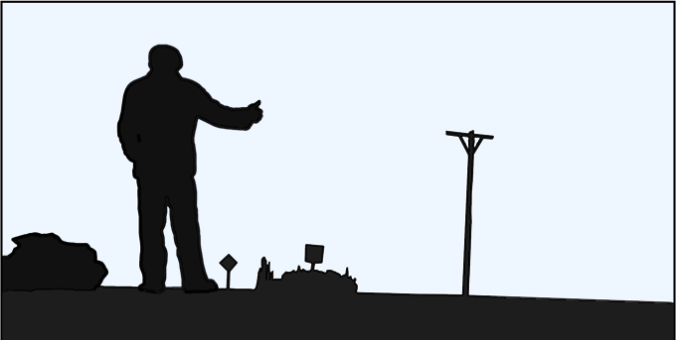
It’s time to retire

Hello all HitchTheWorld readers.

First of all I’d like to thank all of you for reading and your years of support in my time writing here on this website. It was a wonderful way to tell my story to the world. The travels, as always, continue — but sadly, it is time to retire HitchTheWorld. It no longer gives me the satisfaction that it once did.

Still, fear not — you can still read about my adventures –  even better, you can physically participate in them!

Visit The Drifter Letters:

drifterletters.wordpress.com

I’ll be awaiting your addresses.

Cherrio

Patrick

The trials and triumphs of the Amazon River – Óbidos to Jurutí

When I left Óbidos it was with a fresh face (figuratively – beard is now on second week) and a happy east tail wind to blow me across the narrows of the Amazon River in front of the city. Locally, the area is known as a garaganta da Amazonas  – or “the throat of the Amazon” since it is the mighty river’s narrowest point – with just over a kilometer of width during the dry season. The wind kept up until I had just about made it to the other side, and then slacked off and left me floating backwards with the current towards Santarém. Obviously this meant it was time to take the sail down and load the canoe for paddling – that of course meaning putting all my stuff in the back of the canoe so that when I sit in the front to paddle, waves do not sink me. Just as I was about to do so the wind changed once again, this time coming from the southeast, albeit rather weakly  – but good enough, and so I skimmed along the south bank of the Amazon River for a few hours at perhaps two knots.

Fishing

Around 1600 the wind weakened to a point where, despite the fact that I was travelling at perhaps five metres per second with the wind, I was actually stopped completely, since five metres per second happened to be roughly the speed of the current at the time. And so I docked on a protruding stick and decided to try and catch some fish for dinner. As I was preparing my gill net a local appeared out of nowhere and made a short interrogation, which ended with him giving me a watermelon and wishing me luck. I cut a chunk out and munched on farinha as I waited for my net to fill with fish. The local’s dog was overtly friendly and loved to swim, and was met with harsh words from his owner when he leapt joyfully into the river and got tangled up in my net.  If nothing else, at least I would have a dogfish.

Upon bringing my net in, I discovered that I had caught three aracú, a pacú, and two small yellow-bellied piranhas. I promptly cleaned the fish, salted them, and put them away. The wind had picked up once more, and so I sailed for about fifteen more minutes before it died again. Rather than loading the boat for paddling and continuing on, I decided to call it a day make camp for the evening, as it was half past five and I did have some pasta to cook. I was still on the watermelon benefactor’s land, and since he was out fishing in his canoe, too, I asked him if it was all right if I made camp in the nearby jungle. He assured me that it was no problem.

After removing my gear and pushing the canoe up onto the half sand, half mud beach, I brought my things into the jungle (about 30 metres from the river’s edge) in four trips, not including a trip to fill my big pot with river water. The pasta cooked quickly as did the fish, and I had an early night and went to bed around 2000. I must note that my decision to buy a litre of gasoline in Óbidos turned out to be an excellent one, as fires in the jungle were now accomplished in a matter of seconds, as opposed to the up-to-an-hour that the infuriating search for dry tinder in tropical rainforest would oftentimes take.

Overnight stealth camper in my canoe, along with millions of mosquito larvae

The next morning dawned calm and absolutely windless, and so I loaded the boat for paddling and set off upriver in a good mood, after my morning coffee and more watermelon – the latter which I ate until almost bursting, since I feared it would soon spoil in the heat.

After paddling for about an hour I came to one of the many riverside fishing communities in the area. As I was paddling by, a medium-sized boat and it’s occupants, whom were repairing what seemed to be miles of gill netting by hand, signaled for me to come over. I did so and proceeded to enjoy a few hours of chatting and a lovely lunch and half-hour nap in the shade.

Lunch benefactors mending their nets

The wind, it seemed, was playing games with me that day – for while I was on the boat eating it blew merrily from the east and everybody commented profusely on how excellent this was for me. However, as soon as I weighted the canoe for sailing, rigged the sail, and attempted to head upriver, it promptly died – not even having the decency to ruffle my sail. And so, with the whole world watching me and probably thinking something like that guy’ll never make it to Manaus, I paddled back to shore, emptied the water out of my boat (I have a small but persistent leak on the port side of my bow almost on the waterline that only really leaks when she is poorly weighted for paddling), weighted for paddling, and paddled off, chattering jovially with my boat friends as I passed about the uselessness wind in general.

Before I left, the net menders warned me of what they called praia grande – or “big beach” – and that as soon as I arrived to it that it was important that I passed on the outside and not the inside. I assured them that I would do so, and spent the next three or so hours trying the figure out what the bloody hell that meant. As evening came I passed an abandoned cement house along the side of the river that had two massive male iguanas guarding its doors and enormous baoba trees growing around it. I thought about camping here but decided that it would be better to try and make a few more miles before night set in. I stopped around six in a different fishing community and decided to camp for the night in the nearby jungle. As I was preparing my gill net for dinnertime, a local smelling strongly of cachaça came up and informed me that it was, ahem, proibido to fish here. I took a quick look around me at the at least four (that I could see) gill nets within my line of sight and asked why that was. He told me it was because I was desconhecido – a stranger, and basically that they didn’t take kindly to strangers in those parts. And so I explained what I was up to and showed him my passport – and at last he reluctantly agreed that I should be able to stay the night in the area, and that he supposed that it would be okay if I fished a little bit. I thanked Sr. Suspicious and set out my gill net and left it as I carried my gear to the jungle, set up camp, and gathered firewood.

When I went to retrieve it at just before sundown I found I had quite a lot of work ahead of me – for in the roughly 45 minutes my net had sat in the river it had snagged no less than eighteen red-bellied piranhas, four pacú, three aracú, a yellow-bellied piranha, and a catfish as long as my forearm.  Due to the sheer quantity of fish I had before me I threw everything that I could remove from the net without mortally wounding back into the river. However, I still ended up with quite a bit more than I could eat: eight red-bellied piranhas, three aracú, and the catfish. Also, I still had a salted yellow-bellied piranha and a pacú leftover from the previous day’s fishing. I sat on the beach cleaning fish well into darkness, and suffered the evening onslaught of mosquitoes with grudging acceptance.

That evening I made rice and fried up the catfish, one of the aracú, the previous day’s yellow-bellied piranha and pacú, and one of the red bellys. The rest I salted and put away, thinking that at least I would not have to stop early for fishing for the next two days or so.

Typical morning campsite, with coffee on the fire

The next morning I made coffee with chocolate and chatted with a friendly aged local who came up to my campsite and talked dryly of river life and his nearby cattle ranch. I asked him about the praia grande and what that meant, the business about passing on the outside. He told me yes, don’t pass on the inside, it’s too shallow.

“Even for a canoe?” I said, unbelieving.

“Hm, maybe a canoe can pass, but I know it’s very dry this time of year…”

After squinting at my blurry printed Google Map for a little while I figured out that the praia grande was in fact a large island in the Amazon River perhaps twenty kilometres before the city of Jurutí. There were two ways around this island: the south side (or “inside”) and the north side (“outside”). The southern route was massively shorter and not exposed to the openness of the main Amazon River, and seemed the obvious choice. Perhaps boats couldn’t pass this time of year, but on my map it seemed plenty big enough for a small canoe like mine.

Now that I had solved the mystery of the big beach, I set off paddling (windless yet again) upriver towards this so-called praia grande. After about an hour the wind decided to make a favourable appearance and I happily weighted my boat for sailing and enjoyed several hours of very decent sail time with an almost direct tailwind.

After perhaps an hour of I noticed what seemed to be the island emerging out of the distance to my right. It did not, however, look like any kind of beach I’d ever seen. In fact, it looked more like a large marsh. Regardless of its appearance, I would not have to look at it for long, since I would be taking the shortcut and passing on the inside. Several passing fishermen on motorized canoes warned me to not pass on the inside, but I resolved to attempt doing just that and ignored their warnings, thinking there must be some way to get my tiny canoe through there; I mean it looked wide on the map.

I sailed with an ever-stronger tailwind into the shortcut, ignoring the warnings of passing locals of aquí não vara, here you can’t pass – surely there was a way. After another hour or so of very fast sailing (maybe five knots) I promptly wished I had heeded the warnings of – well, of everybody.

No, not even my canoe was going to make it through there. There was a good five kilometres of dry land to pass before I could see on the horizon – just barely – the continuing portion of the river that went towards Jurutí. Thanks to my hard headedness, I had just lost about half a day, easily. Perhaps an entire day. As penance I was forced to paddle for three and a half hours into the wind with no current to help me (closed off, remember) back to the east point of the praia grande. That’s what I get for not listening!

“I didn’t listen!!”

Anyone know what kind they are?

I had seen, so far, very little beach on this island. What I saw instead was lots of marshy grass and what seemed to be an orgy of birds, whom were not at all amused with my arrival and squaked indignantly and dive bombed me for a good hour until I was too far away for them to bother with anymore.  Upon arrival to the point I decided it was a good time for a lunch break and decided to eat some dried, powdered fish mixed with farinha that I had brought with me from Óbidos. However, as it turned out, the point of the island was not the best place to stop for lunch – this due to the fact that the mud was actually quick mud and I sank up to my waist in it as soon as I got out of the canoe. Undeterred and hungry, I resolved to lunch there anyways – I had already stopped and was already out of the boat – and was forced to crawl on three’s (the fourth hand carried my lunch and water) like a crocodile through the mud for a good fifteen metres until the ground solidified somewhat. There I sat, covered in black, stinking mud under a blazing afternoon sun and ate dry powered fish washed down with muddy river water. And the birds came back to dive bomb me some more.

Late afternoon sailing

Upon rounding the point I found that at least the wind was now once again in my favour; I weighted for sailing (more troublesome than usual – anything is more complicated when you have to do it while waist-deep in mud) and enjoyed a much-needed two hours of pleasant sailing until nearly sundown, where I docked on the large beach that had finally decided to show itself.

The downsides of camping on beaches, for me, are the fact that there is nowhere to hang my hammock. Since I do not have a tent this means I must pass the night with basically no protection from the bugs. Bugs, on the beach? Oh yes. Worse than in the jungle, in fact – due largely to the fact that all around that beach is marsh with stopped, stagnant water – the perfect breeding ground for the little bastards.

Fortunately I located an old dead tree nearby, no doubt washed here during the flood season, which at least provided me with firewood with which to prepare dinner. I intended on frying some of the leftover piranhas and aracú – but it seemed that I would learn a lesson in fish preservation with the lives of these fish, all of which were quite spoiled and stinking. I figure I should have not left them all in the same bag together – and perhaps went a little too easy on the salt.

Fortunately I had a can of sardines for occasions such as this one, as well as leftover rice from the day before, which I heated and ate in the darkness while crouching in that area where the mosquitos don’t come due to the campfire smoke.  After that it was time for bed; my beach bed is constructed as follows: raincoat, hammock, me, and on top of everything, my mosquito netting, used as sort of a blanket. This, however, is not so efficient when it comes to keeping the bugs off you, since in every place the netting rests upon your skin the bugs have no trouble at all biting through it. Still, it was better than nothing.

As it turned out I would not have to worry too much about bugs that evening, since a nice nighttime breeze blew from the northeast for a good hour, keeping the insects hunkering down in the stinking marsh where they belonged. But every yin has a yang, and with that breeze came rain. I myself stayed dry, since I layed my sail out on top of my bed, but some of my other things got a bit wet and I had to shovel quite a bit of water out of my canoe the next morning.

It was as I was doing this that I discovered that my boat had suffered an invasion during the night; in the roughly ten hours that she lay pushed up on the beach near some reeds, my canoe was taken over by hordes of little yellow ants, whom had somehow managed to construct Ant Tokyo overnight in between the struts of my canoe. I tried to wash them out but it seemed the ants were determined to stay; I would need to get some ant poison somewhere pretty soon, or they would probably eat all the sealant out of my canoe and render her extremely leaky.

The tailwind from the day before continued into the morning, and I sailed around the rest of the island and made it back to the south bank before 1100, enjoying the company of a pod of river dolphins whom had been following me since my previous day’s failed shortcut attempt. I could tell that it was the same dolphins because there were several distinct charactars whom I consistantly recognized; these dolphins I gave names and talked to whenever I ran out of songs I knew the words to.

There was one dolphin who had a large chunk missing from his fin – probably from a propeller – whom I called Chunky. Another made a loud whistling shound every time he came up for air – Whistles. Scar was covered in scars and liked to surface very close to the boat; The Two Jacks were small, completely grey, and would surface very quickly, always in unison, before diving back down; Wheezy Fart made a strange, loud, wheezing fart-like sound every time he came up for air; King Louis and Queen Ana were a large pair, one solid grey and one solid pink, whom usually stayed at least thirty yards from the boat, surfacing slowly and regally before sliding smoothly back down without hardly even making a splash; Psyco-Groupie-Cocaine-Crazy had a habit of leaping entirely out of the water and making huge splashes, sometimes not even taking a breath because I think he was just doing it because he was full of energy, not because he actually wanted to breathe. So as you can see, while I was alone in my boat – I never travelled in solitude.

Wheezy-Fart

With each point of land on the horizon I expected to see Jurutí on the other side – and yet, the city refused to appear. I navigated through several channels which I feared would be dry like my last “shortcut” – but happily they were still passable. It was in one of these channels late that afternoon where I met three guys from….Texas. In kayaks. They had come from Peru and were on an expedition to paddle the Amazon from source to sea. West, who seemed to be the leader of the group, looked kind of like Allen Grant from Jurassic Park and paddled a single seat kayak which had obviously been shipped from the U.S.; the other two were in a tandum kayak and paddled with expensive-looking carbon fibre racing canoe paddles. I would later learn that they are professional canoe racers, and West is also a professional kayaker of some sort, who has been interviewed for Canoe and Kayak magazine several times.

The Texans. West is the guy on the far left.

I gave the group a “river report” – that’s what they called it – and they were happy to hear of the strong currents I had been fighting since leaving Óbidos. Ah, the subtle differences between “up” and “down…” West asked me what kind of navagation equipment I used and I showed him my Google Map. He asked me what kind of SAT phone I used and I showed him my VIVO chip $10 dollar local cell phone – which had three bars, by the way. West and his group were much better equipped than I, it seemed, and he informed me that he called home every night by SAT phone- I shuddered to think of the bill such a habit must run up. I believe he even blogs by SAT phone! I didn’t even know you could do that. He also had  GPS mounted right on his kayak, a SPOT, a Go-Cam – with which he filmed me and my boat for awhile – and probably many other cool gadgets hidden away inside the kayak that I did not see. Also, he had a lot of instant coffee – instant coffee sponsered him, apparently. Interestingly enough he would be writing something for National Geographic – so for you subscribers back home, keep an eye out for an article written by West Hanson, long distance kayaker and general badass.

When I asked the group how far it was to Jurutí, they asked me “What’s a Jurutí?” Apparently the GPS did not display that information. While I was very pleased to meet the kayakers and respected them a ton for the trip they were taking, I was a little suprised about how little they knew about the areas they were travelling through – outside of the details about the river itself, of course, about which they knew basically everything there was to know. But local cities and towns were just another stop for them – sometimes not even a stop, just something to pass – while for me they were sometimes whole chapters of my life. I understood, of course – they had a schedule and a budget to keep to, I’m sure – but I wondered if they knew what they were missing out on.

Anyways, I explained to them that Jurutí was the next town up ahead; they informed me that it was “just around the corner.” Great! I bid farewell to the expeditioneers and they faded off downriver as I docked quickly and weighted for paddling since the wind had died. Again.

I resolved to make it to Jurutí that day, even if it meant paddling into the night – but it seemed that “just around the corner” for a streamlined racing kayak heading downriver is quite a ways for a 500 lb wooden fishing canoe fighting the current; after an hour of paddling I still did not see the lights of the city and so decided that it would be better to stop and call it a night and make it to the city the following day, when it was light outside and much easier to make new friends.

As it was dark out (around 2000) I decided to stop in a community lighted by the sound of a rumbling gas generator. After tying up my canoe to the small dock I hiked up the steep riverbank to scope out the area. I walked up to a nearby house and asked about camping spots in the area, but the owner shined his flashlight directly into my face and told me to go away as he shooed his family into the house. Feeling rather mistreated, I returned to my canoe and paddled about 200 yards further downriver, pushed my canoe up onto a small mud bank and decided to put my hammock up between two trees up above on the high bank. I had just finished doing so when I saw the lights of three flashlights heading my way, coming from the village. As they approached, a voice shouted out “O qué tá fazendo ai??”what are you doing there? – and not in a friendly way.

“I’m going to sleep.”

The group closed in on me and I saw that one had a shotgun pointed at me. Here we go. What followed was a rant from the locals that I was a stranger, and I could be a robber or a murderer and, blah blah blah paranoia, think of the children. I sighed and tried explaining to them about my adventure, but they didn’t want to hear it, and informed me that I wasn’t going anywhere until they had the police come over to, quote, “check me out.”

“Whatever. Call them, see if I care,” I said, more than a little annoyed at all the suspicion that had been directed towards me lately. “I’ll wait.” And I did, sitting down at the base of a tree, and even getting a start on my dinner (dried fish powder), just to show them how much I didn’t care that the police were coming.

The man with the shotgun tried to get ahold of the police.

“Hello? Hello? Jesus?” he said, after four or five phone calls trying to get ahold of the man. “Man, I’ve been trying to call you, there’s a strange person who’s showed up here in the community. Yeah. Yeah. I don’t know, he says he’s in a canoe. He wants to go to Manaus. No, he doesn’t even have a motor, he’s just paddling I think.” He fingered the barrel of his shotgun as Jesus the Cop gave what sounded like a chuckle from the other end of the line. “Yeah. I don’t know, somewhere really far. Anyways, can you come over here and check him out? We’ve got him over here under the mango tree. Yeah, cause you know, the children, man. Okay. We’ll wait for you.” He hung up. “The cops are coming for you, stranger.”

“The anticipation’s killing me,” I said, crunching loudly a particularly large granule of farinha.

And so we waited. And waited. And waited. After nearly an hour Officer Jesus was still absent from the scene – no doubt busy preaching to the wise men in the temple – and the group was getting impatient. Sr. Shotgun tried several more times to get ahold of Jesus by phone but was getting no answer – apparently heaven has zero bars. I suggested he try praying – but he didn’t get the joke.

Eventually, the men decided to just send me away, and so I loaded my things back into my canoe and set off paddling towards Jurutí.  Again.

“Make sure you go far away,” said Sr. Shotgun. “Or we’ll call the police again.”

“Right, because that worked so well last time,” I muttered to myself as the lights of their flashlights dissapered around a bend. I ended up stopping about two clicks further down and sleeping in the jungle like usual; I didn’t even know why I bothered trying the communities at night. So much suspicion; I didn’t get it.

The next morning I arrived to Jurutí around 1000 – by paddle, since the wind was just teasing me with little gusts followed by large gaps of stillness. I had conqured another section of the Amazon River, and it was time for a well-deserved break. I docked my canoe under a big cement pier and went off looking for something to eat that wasn’t fish.

Mmmmmm….not fish……

-MN

1. Lunch with the net-menders
2. “I didn’t listen!”
3. “Praia Grande”
4. Where I met the Texans

Total Distance: 118 km (73.3 mi) 4.5 days.

Reporters in the Amazon don’t have a lot to report…

…so they report on me. Here is another interview taped last week (15NOV2012) in Óbidos, Pará

Translation:

O americano do Texas Patrick Falterman estive viajando pelo Amazônia em uma canoa desde o início do ano. O aventureiro já passou por várias cidades no oeste do Pará, e ontem ancoro aqui, no município do Óbidos. Veja a reportagem com participação da TV Eldorado na Itaituba e a comprobação da TV Sentinela. 

 The American from Texas Patrick Falterman hás been travelling around the Amazon in a canoe since the beginning of the year. The adventurer has already passed various cities in Western Pará, and anchored yesterday here in Óbidos county. Watch our segment, with participation from TV Eldorado in Itaituba and editing from TV Sentinela.

De Houston, no Texas, para Amazônia. Patrick e um americano de uma cidade conhecido nos filmes de ficção científica por ser o local onde ficam comandados foguetes enviados a o espaço. Mais o sonho do Patrick nunca foi pisar na lua; desde criança, sempre teve vontade de conhecer a terra – e de uma maneira meio estranho, mais tão corajosa quando a dos astronautas.

 From Houston, in Texas, to the Amazon. Patrick is an American from a city known from science fiction films for being the command center for rockets sent to space. But Patrick’s dream was never to set foot on the moon. Since childhood, he has always wanted to travel the Earth – and in a rather strange way, though just as brave as the astronauts sent into space. 

 “Eu sempre teve o vontade de estar aqui, desde criança, né? Amazônia sempre esteve, na minha cabeça, um lugar mágico, dos sonhos, né? Onde o velho espírito da aventura nunca morreu, né? Agora que aqui um ano…pois estava certo, né? Aqui já tem aventura, já fez muitas aventuras muitas massas.”

“I’ve always wanted to be here, ever since I was a kid, you know? The Amazon was always, in my head, a magic place, like a place out of a dream, you know? Somewhere where the old spirit of adventure never died. And now that I’ve been here a year…well, I was right, huh? Here there’s definitely adventure, I’ve already had some awesome ones.”

O americano vai viajando em uma canoa propulsionado só por uma pequena vela – e muitas vezes, apenas por remo. Para conhecer a região, início sua viajem pelo Rio Tapajós em uma pequena jangada com menos de quatro metros quadrados, onde viajo de São Luís do Tapajós, um paraíso natural no município da Itaituba, até Averio, onde compro a pequena canoa.

 The American travels in a canoe driven only by a small sail – and on many occasions, only a paddle. To get started, he started his trip on the Tapajós River in a small raft with less than four square metres, where he travelled from São Luís do Tapajós, a natural paradise in Itaituba county, as far as Averio, where he bought the small canoe.

 “Eu saí do meu Estado, do Texas, e foi pegando carona para Califórnia, para Arizona – o oeste do meu país, e daí, eu foi pro México – só pra ver como que era – e aí… pois ainda não volte. E de Belém pegue também muitas caronas pelo Trans-Amazônica. Chegue até Rurópolis, e daí pegue a Cuiabá-Santarém e foi pro garimpo. Fique lá num lugar que se chama Jardim do Ouro. Lá tente de fazer uma jangada pra baixar  para Itaituba, Santarém…mais não deu certo por causa das cachoeiras que se tem lá no garimpo, e então não deu para viajar de jangada. Obviamente.  Então eu foi para Itaituba, para São Luís do Tapajós, onde acabam os cachoeiras do Rio Tapajós, e lá e onde eu fez a jangada, com ajuda dos ribeirinhos lá. E aí viaje nela por umas 180 kilometros, de São Luís do Tapajós, Itaituba, Barreiras, Fordlândia, Brasília Legal e Averio. Em Averio tenha que deixar a jangada por causa do vento. Ela estava puxando a jangada muito e não deu pra baixar mais. E Então, fique em Averio umas dois mesas, curtindo a cidade, fazendo amizades, e compre a canoa que eu tenho agora. No finalzinho do Abril deste ano eu baixe de remo de Aveiro pra Santarém.”

“I left my State, Texas, and went hitchhiking to California, to Arizona – the West. And from there I went to Mexico, just to see how it was…and, well I haven’t really been back yet. And from Belém I also hitchhiked a lot along the Trans-Amazonian highway. I got as far as Rurópolis, where I took the Cuiabá-Santarém highway to the gold mines in the southwest. I stayed in a place calle Gold Garden, where I tried to build a raft to float to Itaituba, Santarém…but it didn’t work out. There in the mines the rivers have a lot of rapids, so travelling by raft was impossible. Obviously. SO then I went to Itaituba, to São Luís do Tapajós, where the rapids along the Tapajós river run out, and built my raft there with lots of help from locals. From there I travelled about 180 kilometers, from São Luís, to Itaituba, Barreras, Fordlândia, Brasília Legal, and Averio. In Aveiro I had to abandon the raft because of the wind. It was blowing strongly against me, and was impossible to keep going in that way. So, I stayed in Averio about two months, enjoying the city, making friends, and I bought the canoe that I have now. At the end of April of this year I paddled down the Tapajós River from Aveiro to Santarém.”

A intenção inicial era viajar a Macapá – mais como a vida de uma viajante solitária sempre é imprevisível, resolveu mudar de áreas e subi o Rio Amazonas depois de vários dias na cidade do Santarém. Agora, o próximo objetivo e ancorar em Manaus – claro, depois de conhecer todas as cidades ao longo do maior rio do mundo.    

The initial goal was to arrive to Macapá – but since a solitary traveler is always changing plans, he decided to change his destination and headed up the Amazon River avter some time in the city of Santarém. Now, his next goal is the anchor in Manaus – after, of course, he visits all of the cities along the largest river in the world.

 “Eu não tenho tecnologia nenhuma. Sei que e o rio maior, mais bravo do mundo, e é por isso que a viagem, né? O Amazonas e o rio maior do mundo, e o rio mais poderoso… o que tem a mais força que se tem neste mundo. E é por isso que a aventura e ainda mais massa. Pra navegar eu tem um mapa que imprimi da internet, do Google Mapas, né? E tem minha cabeça, né?

“I don’t have any technology at all. I know it’s the largest, most turbulent river in the world, and that’s why I’m doing the trip, you know? The Amazon is the largest river in the world, the most powerful…that which has the most force out of any other in the world. And that’s why the adventure is even more awesome. To guide me I have a map I printed off Google Maps…and I’ve got my head, right?”

Patrick tem blog onde posto historia e fotos das belezas naturais que conheceu. Apesar de que antes de conhecer a região, como a maioria dos estrangeiros, achava que a Amazônia era simplesmente natureza, com poucos moradores.

Patrick has a blog where he posts stories and photos of the beautiful natural wonders he has seen. Though before arriving to the Amazon, like most foreigners, he thought that the Amazon was simply wilderness, with few inhabitants.     

“E claro que a Amazônia tem todos os bichos que os americanos acham que tem, e claro que Amazônia e quente, tem muitos rios – e o mato mesmo, né? Mais também é diferente porque lá nos Estados Unidos ás pessoas acham que a Amazônia quase não tem pessoas. Um parte da Amazônia que eu não ouvi falar eram os brasileiros do Pará, do Amazonas, que realmente me trataram muito muito bem, e na verdade, sem a ajuda deles muitos dessas aventuras que eu fez não seriam possíveis.”

“Of course, the Amazon has all of the animals that Americans and other foreigners think it has, and of course, it’s hot, it has lots of rivers – it’s the real jungle, right? But also it’s different than I imagined, since in the USA, most people think that the Amazon has basically no people. A part of the Amazon that I never heard about was the Brazilians who live in Pará, in Amazonas, who really treated me spectacularly – and to be honest, many of the adventures I’ve had so far would have been impossible without their help.”

Boa viagem Patrick, que Deus e Nossa Senhora Santana abençoe o seu caminho, e que você levou ao mundo a boa receptividade Amazônico!

Have a good trip, Patrick, God and the Virgin Mary bless your path! May you take our Amazonian hospitality with you around the world!

Also, here is a list of news blogs and websites whom have done stories on me since the beginning of the year. Some of the comments are funny, mentioning something about how I must have murdered a lot of people in the USA before my escape to Brazil. Actually, I just owe JP Morgan $1,000. Haha.

Raft (March 2012)


http://garimpandonoticias.blogspot.com/2012/03/americano-quer-chegar-macapa-em-um.html


http://www.pepitanegocios.com.br/matriz/diversas/365-americano-quer-ir-de-itaituba-a-macapa-utilizando-uma-jangada


http://blogdojuniorribeiro.blogspot.com/2012/03/o-americano-patrick-falterman-de-21.html


http://blogdoestado.blogspot.com/2012/03/jovem-norte-americano-cruza-rios-da.html


http://portaltrairense.blogspot.com/2012/03/americano-cruza-rios-da-amazonia-em.html


http://blogdoeliasjr.blogspot.com/2012/03/americano-cruza-rios-da-amazonia-em.html


http://marlicarmenescritora.blogspot.com/2012/03/americano-cruza-rios-da-amazonia-em.html


http://amazoniaacontece.blogspot.com/2012/03/turismo-americano-cruza-rios-da.html


http://betoparanatinga.blogspot.com/2012/03/americano-aventureiro-pelos-rios-da.html

Canoe (November 2012)


http://www.obidense.com.br/NC_Americano_Canoa.html

No I am not dead and no I haven’t run home to Mommy and Daddy so stop asking

The tropical sun has chapped my lips once again, and my hands are covered with dry, peeling calluses and cuts in various stages of healing from the pressure and friction of the sail line in my hand and the rough wood of my paddle, which I use to force my boat to slide sideways through a crosswind or keep her sailing straight with an overenthusiastic tailwind on the holy Amazon River of Brazil. The river dolphins take a special interest in my craft, for some reason; nearly every time I round a point or make a decently long crossing to or from some island or another a pod of the strange, pinkish creatures is never far away, the sound of the air shooting from their blowholes ringing out loudly and suddenly, sometimes causing me to jump a little in surprise – but never fear, for the river dolphin is docile and navigates superbly through the dark, murky waters of the Amazon by sonar and thus the probability of an accidental ramming and consequential overturning of my boat by dolphin is extremely low, unlikely, even impossible.
The days the wind favors me I spend sitting in the back of my canoe, both hands on the paddle, steering, and with the guiding rope of the sail wrapped around the handle and a few of my fingers. There I sit for hours, watching boats pass me by – boats of all sizes and shapes. Canoes, like mine, paddled or powered by small motors that look like weed eaters with propellers instead of string on the ends (known locally as rabetas), by fishermen tending to their drifting gill nets; old, weathered faces, aged well before their time by hard lives and the sun. The wrinkles are like canyons that start in foreheads and the corners of eyes and continue snaking down naked, leathery backs like a map of the river itself, until they disappear under pairs of old canvas cargos or barely recognizable Nike basketball shorts, all bleached almost white by years of sun and rough hand washing with bar soap. The wrinkled faces give me long, non-comprehending stares as I sail quietly by and squint at the big fish in the bottoms of their boats; some wave, some grin to show a few haggard teeth, but most just stare and stare and stare until I’m too far away to see their stares anymore but I can still feel them. I wonder about their lives and their years on the riverside, the fish they’ve caught, the ones that got away. I wonder about the loneliness they must feel, their families, loved ones, here and gone. I wonder who has wronged these men, taken advantage, stolen, broken trust. I wonder what makes those faces smile, I mean really smile, and I wonder about happiness in general, theirs and mine.
Medium sized boats five to ten metres long are called bajadas and they are powered by a motor that sits in the bottom of the back of the boat and makes a distinct pop-pop-pop-popping sound that you hear long before you actually see the boat. Usually there is a family, or a group, inside. The women lounge and knit in hammocks tied to the supports of the short roof that covers the majority of the craft while the men mend nets and hunch over masses of tangled line that seem impossible to undo, working steadily and without pause, and the piles of smooth, coiled line grow inexplicably. The same wrinkled faces stare back at me, the fishermen of the Amazon River whose dark brown eyes seem as cloudy and mysterious as the waters of the river herself.
Speedboats, or voeaderas carry people from the cities by at high speeds, sometimes business travelers, sometimes families of city people from Santarém, and sometimes drunk groups of loud young men who blast tecno-breggae music with the bass turned up too much and leave a meter –high boat wake and empty beer cans behind them. They are too busy having fun to notice me, creeping along near the bank and counting birds. I am also too busy to notice them, with the massive waves they’ve sent barreling towards me.
Medium-sized passenger boats (barcos da linha) pass at regular intervals, usually loaded well over the legal number of passengers permitted by the Brazilian Navy. Hammocks are hung in every available space and angle, and everybody on board looks like they’d rather just arrive where they were going and get off the damn boat already. The large passenger ships, or naveos, travel for days at a time, from distant cities like Belém to other distant cities like Manaus. They have many floors and are made of metal. The top floor always seems to host a bar and dance floor and lights. These passengers seem less miserable than the others on the smaller barcos da linha.
Then, always in the distance, massive ocean freighters from foreign lands around the world trudge up and down the mighty Amazon as if she were nothing more than another sea current, humming deeply and sinisterly like UFO’s, and about as incongruous. They push up a wall of water off their sterns that is harmless while away from shore but once collides with the riverbanks regularly sinks poorly docked canoes and even bajadas. I can never see faces aboard; I wonder if they see me, and if they stare, too. Or perhaps, as I sometimes suspect, they are merely controlled by soulless robots as bleak and efficient as the ships they pilot.
Whenever the wind does not favor me I am forced to paddle, sticking as close to the shore as possible and maneuvering my vessel through the maze of waves and countercurrents the river throws at me. This at times is so tedious, draining, and above all slow that it is actually both easier and faster for me to leave the canoe and wade through the shallows while pulling my canoe bodily along behind me. This, however, is a risky business due to the large number of fresh water stingrays the Amazon River is home to, and the fact that the shallows are favorite hangouts for young, fresh-barbed specimens.
I had fever for four days, poorly-timed strep throat is all, and the only solution that existed in these waters was to simply tough it out. It really wore on me sometimes, though; in the evenings I sometimes hadn’t even the energy to cast my net I paid R$60 for in Santarém, and if I somehow found strength for that, build a fire to cook the fish – more heat. I existed for three days on just farinha de mandioca (crushed-up dried yucca root) and lukewarm river water. I remember lying in a huddled mass of malaise under my sail on the sandbar of some lonely island one night as an uncommon dry season storm howled away over me long into the wee hours of the morning; I tossed and turned and shivered through feverish dreams, frightening and confusing, and woke up the next morning tangled up in my sail and a sandy old sheet, wondering frantically if I was still sane as I crunched the hard, flavorless granules of farinha and sucked down rainwater from puddles that had formed on the sandbar during the night.
But like all things the fever ran out, and I was back on my feet and healthy enough to accept the offers of beers from impressed locals in the city of Óbidos, many whom had seen my during the days I spent sailing from Santarém and couldn’t believe I had come all that way, though I told them it was only 118 kilometers. But sailing up the Amazon River in a canoe – that’s not something everybody does.
Many of you are probably wondering where all this is coming from – what about the raft, what about Macapá, and all that stuff I was up to the last time I wrote here? Well, I built the raft, yes. It took three tries but I finally built a solid, pretty raft in the city of São Luís do Tapajós that supported my weight and that of my things and was slightly maneuverable. Granted, locals helped me with the heavy lifting, since each one of the six massive samaoma trees I cut down with my tiny hatchet weighed a good 500 lbs. But I finished her, and just after celebrating Carneval I floated alone down the Tapajós River as the majority of the population of the riverside community stood on the riverbank and watched me go, sending me off with solemn waves in the early morning mist.

My raft. For photos of the inside go to this reporter’s blog who interviewed me in Itaituba: http://blogdojuniorribeiro.blogspot.com.br/2012/03/o-americano-patrick-falterman-de-21.html

I floated to Itaituba in two days, stayed there for a week, tried to leave again but found that the raft was sinking due to it ramming the dock too much when boat wake hit it, so I lashed a mess of boyant fat old banana trees under her which seemed to do the trick. And so I continued to float downriver, weathering many angry, enormous March rainy season storms and fearing for my life more than a few times when the roiling waters of the Tapajós seemed an inevitable and very permanent part of my immediate future.

What’d I tell you? Massive attention.

I attracted massive attention, due to the strange appearance of my craft, and I believe more photos were taken of her by cell phones than were taken of me my entire life. I spent many long afternoons lounging on my paddle deck, smoking my pipe or stash of pot, grinning and tickled pink that this was actually working out all right.
At night I tied up the raft to some tree or another, tied my black plastic doors shut, and passed out on the old damp foam mattress a caring soul had given me in São Luís, (from which I got the name, The Wet Mattress) which I had spread out on the inside of the little house. The next morning I’d be back on the river, early as can be. Sometimes I stopped in small communities, where I was treated well and enjoyed unlimited food and positive attention for my brave endeavor and interesting transportation.
After awhile on the river – probably about two weeks – I arrived to Averio, which would end up being the final resting place for my raft. It wasn’t my fault, or anyone’s, really – the river simply wouldn’t allow for more raft travel after Averio, due to the fact that the Tapajós River goes from 1-2 kilometers wide to 15-20 kilometers wide. The current almost stops, or I think just flows very deep – and if there’s no current, the raft doesn’t go. Add this to a prevailing headwind and you’ve got impossible conditions for the raft I had built. So I scrapped her.
Undeterred, I spent a good two months in Aveiro, devising a way to get a canoe. In the end I traded my small laptop for one – something I thought was a pretty good trade at the time, but looking back on it now I see that I could have probably gotten enough money for that laptop to buy four canoes, if I would have just known better. Live and learn.

Before remodeling

After remodeling

Drinking too much in Aveiro

I celebrated my 22nd birthday in Averio, made friends, got drunk a little too often, and left the city with a similar ceremonial departure as São Luís do Tapajós, with at least 200 people lined up on the bank to see me off on my paddling journey to Santarém in my newly painted and remodeled boat, which I had dubbed C/R Muiraquitã – after a traditional Indian frog amulet of the same name.

Happy paddler on the Tapajós

The canoe proved much more maneuverable and enjoyable to pilot than the raft – though the Wet Mattress was indisputably more comfortable, even if the mattress was a little damp – and I had a lovely time following the Tapajós National Forest for 160 km to Santarém. I stopped in a total of 7 different fishing communities along the way and learned how to roast giant river turtles and how to break their shells to get at the best meat, and where to leave gill nets during the rainy season. Total time to Santarém was about fifteen days, including the three days I spent in the then-flooded beach town of Alter-do-Chão, which was seasonally beachless.

It’s worth noting that all the paddling I did from Alter-do-Chão to Santarém I was forced to do at night, since the turn east forced a mighty strong headwind upon me that was impossible to paddle into. After a few close calls involving boats almost destroying me in the darkness, I arrived to Santarém exhausted to the extreme but also extremely pleased with myself. This was sometime in mid-May.

Chilling on the beach in Alter-do Chão

After the problems the wind had given me between Alter-do-Chão and Santarém I was about ready to forget the idea of heading to Macapá – downriver but right smack into a powerful prevailing headwind that had been kicking my ass for three days. And that would go on for another 1.500 kilometers. And so a slight change in plans was made: now I would be going up the Amazon River – and I’d be sailing, so that wind would be helping me instead of hurting me. The plan was to stay in Santarém for a few weeks, get some money together to buy more gear and build a sail and then head up river with the whole dry season ahead of me.

Here’s a typical memory I have of a night in Santarém.

What actually happened was I stayed in Santarém for about five months in total, most of that time which I spent mingling with all types of people on the streets of the city, drinking heavily, sleeping with loose women, sleeping with tight women, sleeping with in-between women, smoking lots of pot, and working many different odd jobs for canoe cash. These included handing out pamphlets for the dentist, selling bags of green beans in the vegetable market out of a wheelbarrow, washing dishes, cutting and cooking meat at a high-end churrascaría (Brazilian Bar-B-Q – much better than the American variety), scavenging old beer cans, collecting money for the restroom at the soccer stadium during games, and of course playing music.

Lençóes Maranhenses. They’re beautiful the first two days. After that they just give you nightmares.

I also took a 40-day “break” from the Amazon, in the form of me hitchhiking to the neighboring state of Maranhão, where I smoked a lot more weed than usual and walked across a 155.000 hectare area of sand dunes and freshwater lakes known as the Lençóes Maranhenses with a good old crazy from Chile named Eduardo I met on a drunken blurry night in the city of Barrerinhas – where I had been hanging out playing music with a bunch of Brazilian drum hippies. The roughly 80 km took five days, since we smartly decided we didn’t need no guide, and that was 80 km, up and down and up and down these ridiculous piles of sand under the equatorial sun – and of course we became very lost and delirious and slightly emaciated from lack of food, and probably both hallucinated about killing the other one and eating him – but as usual it was all worth it in the end, and I hitchhiked back to Santarém with a new friend and a lot of new stories to tell the grandchildren I’ll probably never live long enough to meet or indirectly create.

Me after killing and eating my freind Eduardo – I mean, after finishing the crossing and remaining good freinds with Eduardo

So yeah. That’s what I’ve been up to the past six months, instead of writing in this blog, which is extremely time consuming and requires the laptop I traded for a canoe. Now I’m sailing up the Amazon river in my laptop. I’m going to Manaus, I guess, but who knows where I’ll end up.

Greetings from Óbidós, droogies. I know a lot of you enjoy reading my blog posts and I’m sorry I haven’t written as much lately, but to be honest, I don’t have the focus nor the energy nor the resources to keep writing here at the level that I was doing before anymore. This blog is not dead, I’ll still post from time to time about interesting tidbits, but as for the rest, you’ll just have to wait until I publish my book. Someday. Don’t hold your breath. And as for those of you who were living vicariously through my writings, I’m flattered, thank you, really – but here’s an idea: if you enjoyed so much reading about adventures, think how much you’ll enjoy going out there and actually having some for yourself! Go for it, Sparky! I’m behind you all the way! In spirit, of course…

Now that I’ve gotten this out of the way, I’m off to drink whiskey and ride motorcycles for the weekend along a nearby dry riverbed with 18.000 other drunk Brazilians on motorcycles. No I will not explain myself any further, and I really don’t think I need to. And once I get back, my canoe and the rest of the Amazon River from here to Manaus will be waiting…

Peace. I’ll post again…whenever.

-Patrick

A raft on the Tapajós

Video

On the news in the entire state of Pará….For the moment I leave you with just this, and a brief translation for those of you who don’t speak Portuguese:

O jovem americano Patrick Falterman, encantado com as belezas amazônicas resolveu encarar um grande desafio que vai se transformar numa verdadeira aventura entre dois estados, Pará e Amapá. Este é um percurso feito na maioria das vezes por grandes embarcações, só que ele resolveu ariscar se aventurando nesta pequena jangada, de pouco mais de quatro metros quadrados feita com materiais retirados da floresta e uma cobertura improvisada.

The young American Patrick Falterman, enchanted with the beautiful Amazon, is determined to take on a grand undertaking that will transform into a real adventure between the two states of Pará and Amapá. This is a passage usually made by large ships and navies, yet he is resolved to risk being an adventurer in this tiny raft, which is just a little more than 4 square metres made from materials taken from the jungle and an improvised cover.

Patrick fez a obra com ajuda de ribeirinhos e quer tentar chegar a Macapá utilizando apenas recursos naturais, e poucos apetrechos que leva a bordo. A sua maior bagagem é a coragem de enfrentar os desafios envolvidos no projeto. A pequena embarcação pesa cerca de três toneladas e nos primeiros dias de viagem nosso aventureiro já passou por algumas dificuldades e deve encarar mais desafios na longa aventura pelos rios amazônicos.

Patrick completed the project with help from local people and wants to try to make it to Macapá using only natural resources and the few materials he has onboard. His heaviest baggage is the courage to face the trials involved with the project. The small vessel weighs nearly three tons and in the first days of the trip our adventurer faced some difficulties and will surely face more during this long adventure along Amazonian rivers.

Muitas pessoas foram à orla de Itaituba para conhecer nosso corajoso navegador, que deixou os estados unidos, para conhecer as belas paisagens naturais de nossa região. O desafio parece inacreditável já que a embarcação rústica é feita de palhas e madeira e tem o mínimo de conforto e poucos objetos para diminuir o risco dessa grande jornada. Embora para alguns a proposta do americano seja extravagante, ele tem uma forma clara de explicar seu objetivo e dizer a quem mora na região o quanto aprecia o desconhecido é gratificante.

Many people went to the riverside in Itaituba to meet our courageous navigator, who left the USA to explore the beautiful scenery of our region. The undertaking seems unbeliveable since the rustic vessel is made from palm fronds and tree trunks and has a minimum of comforts and few objects to minimize the risk of this grand journey. Some may think this American’s adventure seems extravagant, he has a simple way of explaining his objective and says that those who live in the region should explore it and be grateful for living there.

-MN

A log raft on the Jamanxim

Aside

Continued from the post Hitchhiking in the Amazon: A westerly pilgrimage down the Trans-Amazonian Highway

As the Trans-Amazonian highway faded away behind the old truck, we rolled down what was for me a new road: the Cuiabá-Santarém highway, or the BR-158. I was, as usual, in the bed of the pickup as we bumped along, accompanied by a large piece of welding equipment that rocked alarmingly back and forth as we bottomed out at the end of each hill.

Many drivers drove fast in the Amazon on substandard dirt roads, but this fellow gave a new meaning to the phrase reckless driving.  As the way narrowed to roughly the width of the 4-wheeler trails they had on our deer lease back in East Texas (for those who don’t know: that’s narrow as fuck), we continued to zoom along at about 60 kph. Now, keep in mind that this road is a two way, and that around every curve (and I assure you, there were plenty) there could be a semi barreling down in the opposite direction, destined to take out an old pickup and a gringo hitchhiker. Yet somehow the driver always managed to avoid what seemed to be certain death, squeaking by impossibly close to the trucks while taking out low-hanging tree branches whom were foolish enough to grow in the pathway.

The only thing that seemed to occasion slowing down for my driver was bridges, which he took at the comparatively snail-like pace of about 15kph – before he gunned it once more as soon as the front tires left the wood. This meant, of course, that the back tires hit the elevated end of the bridge going considerably faster, and usually bounced me a few feet into the air. And that huge, heavy piece of welding equipment? The ropes holding it to the cab seemed to scream in an agony that sounded like death throes after every jolt. I could just picture the headlines: “Gringo hitchhiker with his whole life ahead of him crushed by giant welding machinery in the middle of nowhere.” Awesome, I thought, gritting my teeth as we zoomed across another bridge, I flew eighteen inches into the air, and those ropes got just a little bit weaker…

The only good thing about this ride was that it would take me to Moraes de Alamieda, where I would proceed to change highways once more and enter the Amazon’s remote gold mining sector. We rode for about five hours – yes, five hours of insane driving and the constant fear of being smooshed. The last two hours were dark, and it rained hard while at the same time giving me front row seats of what was easily the most impressive lightning show I had ever seen (again, remember the hunk of conductive metal I was currently right next to…)

When we finally arrived to Moraes I practically fell out the back of the truck, giving the driver a half-hearted falló patrão, I guess, since I didn’t die after all, and wandering off in search of something to eat. It was around nine-thirty and most of the restaurants were closed, but I did find a couple of people lounging around on their porch who were happy to cook my half-bag of pasta for me. I devoured it in short notice, thanked my culinary benefactors, then found my way over to the local gas station, where I hung my hammock in the troca de oleo and went to sleep.

The next morning I awoke with a sore rear end and a craving for coffee. It was raining, like always – that steady, heavy drizzle that you know is liable to stick around for days, that gives everything a depressing grey tone and turns the streets into quicksand. The rear end, unfortunately, had no immediate cure that I could see, but at least the morning worker at the oil change shop had a thermos of coffee. He pointed me in the direction of the nearest grocery store and construction surplus centre.

I had decided to do my shopping in Moraes, since I didn’t know if the things I needed would be available in the creporição. My list included the following:

Leather gloves (I had left my old pair back at the fazenda in Amapú)

Large pot for boiling water

Cup

Eating utensils

Coffee

Salt

Vegetable oil

As much rice as I could carry

My first stop was the construction surplus store in search of leather gloves, and I found the perfect pair of welding gloves (irony?) that were thick, sturdy, and came up to my elbows. Perfect for full-on protection from the jungle, so I wouldn’t have to worry about petty things like thorns and venomous reptiles, and would be able to plow, worry-free, through the underbrush like the wild animal I strove to be. The only problem was, they were R$25. I talked the girl behind the counter down to R$20, but as she wasn’t the owner, I couldn’t get her to go any lower. Twenty reais, in my humble opinion, was far too much to pay for gloves, so I set off to the supermarket to buy my other necessaries, resolved to come back when the owner was there and get my gloves for twelve reais, or bust.

The grocery store supplied me with everything I needed, and it turned out the most rice I could shove into my pack was ten kilos. This, along with my additional surplus, cost me thirty-eight reis and left me with an absurdly heavy load – probably around seventy-five pounds, all told. More than half my weight. I remember thinking, this can’t be good for my back, as sank up to my ankles in mud and left footprints of a obese person along the side of the road.

That just left the gloves. I went inside and found the owner, setting them on the counter before her.

“Twenty reais,” she said.

I emptied out my pocket of the last of my money, which came out to thirteen reais and forty-five cents. “And,” I said, whipping out my Bag O Foreign Coins that I had scavenged from my coin collection Stateside, “fifty escudos from Portugal.”

She picked up the fifty escudos, smiled, and said, “Sorry, but I can only accept reais.”

I dug around some more. “I’ll throw in a bicentennial Silver Dollar. You don’t see one of those every day – not even in the US!”

She smiled again. “What do you need these gloves so badly for, anyways?”

I told her.

“A raft?”

“Yep.”

“In creporição?”

“Mmhm.”

She examined the silver dollar. “Well, I suppose this is pretty neat. Take the gloves – and good luck with that raft!”

I smiled, thanked her, and walked out into the pouring rain, brand-new welding gloves slung over my shoulder. They had that velvety, new-leather smell to them, and were soft like a chinchilla. I turned west, my back aching with every step under the weight of my enormous, overloaded pack – bound for the snaking dirt path that led into the apparent green nothing of the Amazon rainforest – the rodoviária do ouro.

————————————————————–

“Waterfalls? Oh yeah, the Crepori has got plenty of those,” said the gold miner to me from his perch on the spare tire. “And rapids. They’ll swallow a canoe in half a second or less, I’ve seen it with my own eyes.”

“Hm,” I said.

I had waited in the pouring rain for about half an hour with the two gold miners in Moraes, before a pickup stopped and we all piled in. I and my helmet bag had managed to stay relatively dry thanks to my tarp/raincoat, but my pack wasn’t so lucky. It sat before me in the damp, rusty bed of the truck, soaked and covered in mud.

The miners figured a raft on the Crepori was nothing short of suicide, and told me story after story of hellish river conditions for the duration of our trip together – which was about thirty minutes.

The rodoviária do ouro was in a deplorable state. Unlike the Trans-Amazonian Highway and the Cuiabá-Santarém Highway, which were currently being half-heartedly paved, this road was dirt and probably always would be. The pickup swerved through lakes of liquid that was too thin to be called mud and too thick to be called water. Wud, I suppose you would call it. Though my map called it the rodoviária do ouro, we passed a sign that said we were currently travelling on the PA-112, known colloquially as the trans-garampiense.

The rain continued to pour as we progressed through the wud, though it wasn’t so bad as before since the cab of the pickup blocked a considerable amount of the water. After about twenty kilometres, we arrived to a small town that the miners told me was called Jardim do Ouro – Garden of Gold.

Here in Jardim do Ouro our ride ended, and we were left by the driver to find our way across the Jamanxim River – a great massive thing blocking our path, swollen with rainy season overflow. The river had basically flooded the entire town – something that’s apparently completely normal in these parts. The people were prepared, it seemed – all the homes were high up on stilts, reminding me strongly of parts of Louisiana in the Atchafalaya Basin.

Down closer to the main river the water intruded into the street and people’s front yards, where a current carrying things like children’s toys and empty coke bottles formed eddies around signs and telephone poles. Elaborate walkways had been put up for people to get from house to store to house, consisting of five-gallon buckets weighted down with rocks and placed strategically in the eddies, connected by long planks.  People sauntered lazily along the walkways, laughing and talking, apparently absolutely un-concerned about the fact they no longer lived along the river – they lived in it.

Jardim do Ouro

Dogs trotted along the walkways as well; they yelped and leapt into the river whenever people came by, preferring a swim to a kick in the ribs. Cats were more careful – you could see them scheming on porches, waiting for the perfect moment before scampering nimbly across the boards to the adjacent house, where there was somebody throwing out perfectly good fish bones. Children leapt joyfully off the walkways and into the river, where they would wait for the current to send them back to their front steps. Giggling, they ran back out along the planks to repeat the process, as men paddled their canoes by and tied them up to the kitchen sink. Even motorboats droned through from time to time, weaving between the telephone poles like skiers in the slaloms, their propellers on the ends of long poles which were pushed out of the water whenever it got too shallow.

The three or four buildings closest to the river were flooded past the roof, their weather vanes carving long V’s into the current; this reminded me of hurricanes, and I wondered how the homes weren’t damaged after six months a year in the river. A group of men sat at one of the bars, drinking beer and fishing out the windows with long bamboo poles. The rain fell harder than ever, pouring down off the tin roofs in great waterfalls and sending foamy white bubbles downstream, where they meandered around the walkways before crashing into a stilt and popping out of existence.

Water was everywhere – dripping, flowing, swirling, cascading off of anything and everything –the ground, the home, the church, the air – nothing was immune, and in Jardim do Ouro anything that dared declare itself dry was subjected to a leaky roof and sideways rain.  This was a wet world. This was a water world.

I sat on the doorstep of somebody’s house, smoking my pipe as I decided what to do next. There was a ferry across the river that left in an hour’s time, I was told by a carpenter whose shop was ankle-deep in murky water filled with woodchips. On the other side of the river the road continued for another hundred kilometres to Mundico Coelho. I stared out over the Jamanxim; it was wide, smooth, and looked very deep. I thought about the miner’s warnings, about the rapids of the Crepori – and the waterfalls.

Now, I had figured that in the case of waterfalls, I would dock the raft a few hundred metres upstream and portage her overland down to the bottom. The only problem was, I had no nautical charts of the river – and therefore had no idea where the hazards actually were. What if something snuck up on me and I was unable to get out of the water in time? Over I go…

This was a troubling thought. My pipe went out as rouge rain drops zeroed in on the one thing I really needed to stay dry, and I tapped wet ashes out onto the doorstep and thought about how it must feel to drown at the bottom of a waterfall.

————————————————————–

An hour later the ferry plowed off sideways into the strong current in the centre of the Jamanxim River, loaded with a handful of motorcycles and a semi sagging under the weight of thirty or forty tons of timber. I watched it go from one of the plank walkways; my pipe had gone out again.

I felt guilty giving up on the Crepori without actually going there – but the stories of the townspeople in Jardim do Ouro matched those of the miners: waterfalls, rapids, and apparently Satan himself kept a summer home there. I had deduced that it was pointless to travel to a river I knew was un-navigable, with the express intention of navigating it, on a home-built vessel with limited maneuverability, and with no maps or charts of the unpopulated wilderness where I was headed. There is a fine line between adventure and suicide; gamble, by all means – but at least make sure the odds are in your favour.

The Jamanxim was looking like a nice alternative, however. I knew from countless hours studying the blue lines on my map of Brazil that the Jamanxim flowed into the Tapajós about a hundred kilometres south of Itaituba, and I had already marked it as a backup in case the Crepori didn’t work out as I had hoped.  I asked someone waiting on the ferry about waterfalls, and he told me that the Jamanxim was smooth like this all the way to the Tapajós. It didn’t take long before I was back on track and scanning the tree line for balsas. My hatchet sat in the side pocket of my bloated pack; I could almost hear it begging to be used. Time to get to work.

———————————————————-

I spotted a grove of balsa trees behind a row of houses about 300 metres from the main river. They seemed to be in about five feet of water – but hell, I was already soaked to the bone, and a swim wouldn’t hurt anything. I located the house immediately in front of the grove, which was also a little store, and asked the owner dozing in his hammock if I could cut the trees.

“A jangada, eh?” said the owner, using what I would soon learn is the Brazilian word for “log raft.” “Well, I don’t own those trees, you’ll have to go out into the jungle over there – (he pointed out of town, back towards Moraes) if you want to cut trees.”

“Fair enough,” I said. “And one more question…I’ve got this bag of pasta, see…”

—————————————

Twenty minutes later I finished my meal of rice, meat, and farinha, and had changed into my jungle gear in the bathroom. Monserrat, the owner, assured me my pack was safe with him whilst I went balsa hunting in the jungle. The rain kept coming down as I walked down the muddy road, headed for the dark green strip of forest on the horizon, hatchet in hand and machete bouncing merrily at my side.

As I got closer I spotted a cluster of telltale broad leaves sticking out the top of the jungle, ten or fifteen yards in. I veered off the dirt road, hacked through 100 metres of ten-foot razor grass and assorted vines, and entered the jungle.  Here, at least, the razor grass stopped, but to get that fifteen yards to the balsa was no easy feat, with walls of vines that refused to yield to the machete blocking my path, twisting their way around my legs and ankles and tripping me up on every step.

Finally I made it to the tree; she was a monster. God, she was perfect, but how the hell was I supposed to get her out of the jungle, through 100 metres of razor grass, and 1 km back to the Jamanxim? I didn’t know, and in the end decided that getting the tree back to the river was impossible, and so continued through the jungle in search of a more manageable specimen.

I found another cluster of smaller balsas about twenty metres away in a small clearing that had been planted with pineapple. These trees were more than doable, and so after hacking off a thorny vine that was winding up the trunk, I chopped the tree down.

She was light and easy to manage, and I had gotten her out of the jungle and through the razor grass in just fifteen minutes, having used the path cut earlier by my machete to exit. Once I got back to the road I heaved the large end of the trunk onto my left shoulder and proceeded to drag the tree back into town.

Oh, the stares I got. As if I’m not already different enough, with white skin and blue eyes, here I was dragging a bloody tree through a flooded village in the middle of the Amazon in aviator boots, camo pants, and a boonie cap, with numerous cutting implements tucked into my hemp belt and an unlit tobacco pipe jutting from my mouth. As I passed every dog in the world descended upon me, barking like mad and snapping at my heels – probably confirming the villager’s suspicions that I was, indeed, the Antichrist.

I finally got the tree back to the port, where I tied it to the carpenter’s shop after securing permission from the carpenter. The current swished by and I could feel a couple of hundred eyes upon me, and whispers from the bars, the word extrangero and jangada both being used numerous times.

On my walk back to the jungle I deemed the other balsas in the clearing too small to be used for my timber raft, and so headed back to the road in search of other candidates. I followed another mud path that peeled off the road to the south, which came out in a cow pasture about 500 metres downstream from the port. I saw a balsa growing right next to the river, and asked a group of men lounging around nearby on motorcycles if it was all right if I cut it down.

“Why are you asking us?” one of them said. “It’s just a little tree. Cut it down, do whatever you want.”

Well all right, then. I cut it down and dragged it to the river about ten metres away. After a moment’s consideration, I decided to leave this tree here and head into the jungle on the other side of the pasture in search of more, with the intention of floating the trees I cut the half-kilometre back to the port at the end of the day.

The grass in the cow pasture was thigh-high and full of ticks, but when I got into the jungle I realized I had just hit the jackpot. Huge balsas grew everywhere, their trunks two feet around or more – the perfect size for my raft. I located the one closest to the edge of the jungle and began chopping.

This was by far the biggest tree I had cut down so far, and it took a good half hour to fall her with my little hatchet. After I had cut about three inches into the base of the trunk, one chop apparently hit some sort of tree-jugular, and tea-coloured water spurted from the crack like blood. A few chops later I heard a distinctive pop reverberate from the centre of the tree, followed by successive faster pops, before the tree groaned, leaned, and plunged into the jungle with a thunderous crash. But my work here was just getting started.

Being as this tree was very tall, her top branches had gotten caught in the branches of the surrounding trees – meaning the balsa didn’t fall all the way down. Five metres up the trunk where I wanted to cut was still two metres off the ground. I stood, scratching my head and pondering for a few moments, before deciding that the only solution to this unforeseen problem was to shimmy up the trunk and start cutting from there.

This was far more easily said than done, as a mess of thorny vines and other unpleasant vegetation clogged the first two metres of tree, which I had to hack away at with my machete while simultaneously clinging precariously to the trunk with my legs and swatting at huge clouds of mosquitoes whom, it seemed, took a particular liking to biting the very back of my neck and flying directly up my nose.

Despite these minor discomforts, I scooted my way up the trunk and began chopping awkwardly at the spot I had judged was roughly five metres from the base. After a few hundred swings, the trunk groaned and bent, and I sunk down one metre closer to the forest floor, whereupon I dismounted the tree and cut the last of it from a standing position.

Now that she was cut, I needed to drag her back to the river. Unlike the first two trees, which had been a breeze, this monster was a real workout. I tried heaving the tree onto my shoulder and dragging it behind me, but it was so heavy I crumpled under the weight like an empty coke can. I sufficed with holding it cradled in my arms, my fingers laced in leather gloves below it, and heaving with all my might until my energy ran out – which was usually no more than a metre or two of dragging.

As if being ridiculously heavy wasn’t enough, the tree often caught on vines and branches (usually just as I was in the apex of my hauling sprint, causing me to fall directly into the mud), and I would have to go back with my machete and chop away at the offending botanical barriers. The only direction she would go was straight ahead – for if I tried at any time to turn her with the small, muddy cow trail I was currently slipping her along, her sheer length would become caught on some tree or another and make it impossible to change direction. Hence, I went straight as an arrow – a lovely direction which took me through pleasant jungle features including, but not limited to, poison ivy, razor-like vines, foot-long thorns, huge nests of fire ants, and beehives.

After half an hour I finally emerged into the cow pasture, covered with sweat, scrapes, and fire ant bites. Just when I was looking forward to the cool rain out in the open, the clouds vaporized into nothing and the sun beat down upon me. Of course.

Here I took a brief rest from tree hauling and walked ahead to plot my route through the pasture. The distance overland directly back to where I had cut the other tree was roughly three times the distance to the nearest part of the Janamxim, which was a flooded swamp about 300 metres upstream from where I wanted to go. I decided to drag the balsa as far as the swamp, where I would float her around a small bend and to my growing stockpile downstream. Happy that I would at least get to go swimming, I walked back to my monster tree and prepared to continue my trunk-toiling.

The pasture was much easier, since it was free of vines. Each time I picked the trunk up I grunted loudly – an ugly, sweaty creature – and sprinted as fast as I could to various landmarks ahead that I had designated as being my rest points.

“Ok,” I said out loud to a cow nearby, who was dully observing my labours and pooping. “I’m going to get this tree as far as that old stump over there.” The cow did not respond in any way whatsoever, so I maneuvered the balsa into my arms and commenced sprinting, making what I’m sure were frightening noises as that tree just got heavier and heavier and that bloody stump just stayed right where it was, no thank you, I don’t want a tree nearby. And then I was suddenly there, and I dropped the tree, narrowly avoiding crushing my own feet before collapsing into a heap and breathing as if I was in labor, giving birth to a child the size of a fucking tree, or something.

This went on for fifteen minutes or so, with various other old stumps and bushes also having the dubious honor of being possibly the last thing I would see before I had an aneurysm and massive hernia simultaneously – but then I finally arrived to the swamp, where the tree caught stubbornly on the only vines in the entire area before slipping into the water and floating – and look, I can move the bastard with just one hand now!

Perhaps no man has ever leapt into a murky swamp in the Amazon with as much joy as I did then. I didn’t care if there were leeches and electric eels and mysterious, smooshy submerged obstacles – my tree was floating and I could move it with just one hand.

Swamp

I followed the edge of the swamp with one arm slung over the tree, my aviator boots trodding cautiously along the soggy bottom of the black water. Generally, I was up to my neck in the mire, but sometimes I crossed a drop-off and I had to cling to the trunk and awkwardly doggy paddle my way along until I touched bottom again.

The key to navigating in the swamp, I soon learned, was to be close enough to shore where you could touch bottom, and far enough away so that you were out of the cross-hatching of plants and vines which grew around the edges. These vines, which were annoying enough since they wrapped their tendrils around ankles and legs as if they were consciously trying to impede you, were also important to avoid since they usually housed masses of floating fire ant nests whom had been flooded out by the rainy season thunderstorms, and whom took delight in invading my tree and non-submerged body parts in a painful biting bonsai.

But these, as I mentioned before, were only minor discomforts – now I was cool, and no longer risking death by sheer exhaustion. The swamp smelled fertile and full of life; each step I took was silent, and I glided through the water, feeling crocodile-like with only my head slipping noiselessly across the surface. I felt comfortable. I felt happy. I felt at home.

I rounded the corner of the little bend, and now I could see my stockpile of one tree. Five minutes later the monster was lain next to the smaller tree, and my work was done. I looked at my watch; it had been almost four hours since I had first started chopping down the big tree.

Two down. Six to go.

——————————————————————–

I went back to Monserrt’s house after that, being as it was nearly dark by that time. I was soaked and covered with mud and duckweed. Monserrat grinned toothily at me as I came up.

“Find some trees?”

“Found some trees,” I confirmed.

“Heavy?”

“Sorta.”

I changed out of my wet clothing and sat down on the doorstep to smoke my pipe; at least the construction was underway. I planned to bring some lengths of rope the next day, which, if used correctly, would help me to get the trees out of the jungle a bit less painfully. First, however, I needed to secure food and lodgings for myself in Jardim do Ouro. Monserrat seemed very nice, and I decided to offer him a trade.

“One old iPhone, chipless, in exchange for food and permission to hang my hammock on your porch while I’m here building my raft,” I said to Monserrat, handing him the phone. The iPhone was my grandfather’s old one, which he had given to me to use with WiFi, him having upgraded to whatever new ridiculous model Apple has out nowadays – but WiFi wasn’t easy to come by in these parts, and anyways, I had a laptop. The iPhone could be a valuable bargaining chip in a place where zero iPhones exist.

“Hm! Well I suppose so,” said Monserrat, taking the phone. “Want some dinner?”

“I’d love some,” I said, happy that at least I would have food to fuel the toil of the upcoming days in Jardim do Ouro.

———————————————————-

The next morning I awoke to coffee and a pack of crackers, which I finished before changing back into my wet gear and heading back to the cow pasture, sure to remember to bring about twenty metres of rope with me this time.

I returned to the jungle and chose another balsa to cut down. This one was around the same size as the one from the day before – perhaps a tad smaller – but I had the method down and the process sped up considerably.

In order to prevent this tree from falling onto the others in the area, I looked around the forest and chose the sector with the least amount of sizable vegetation. I then cut a large notch in the side of the tree facing this area, and tied about ten metres of rope in a timber hitch as high up the trunk as I could reach.

After this I proceeded to chop away at the opposite side of the tree, keeping a close eye on the high branches so I would know when I had weakened the trunk sufficiently. After awhile I heard almost inaudible twisting sounds coming from the heart of the balsa, and I knew she was close to coming down. Tucking my hatchet back into my belt, I put my gloves on and wrapped the end of the rope around my hands, then went to stand about ten feet away from the trunk of my future raft. Pulling the cord taut, I braced my boot on a sapling, took a deep breath, and commenced heaving.

At first the tree hardly moved at all; just a centimeter towards me, and then back in the other direction. The goal here was to get her to fall towards me, where she would hopefully crash all the way down to the forest floor without becoming entangled in the high branches of other trees. If she fell in the other direction life would become very difficult for me, as there were a number of huge, ten-foot wide samaoma trees in the fall path of the balsa.

I heaved again; she moved again, very slightly – but this time I utilized the leftover momentum the tree had from my first tug and added it to another tug immediately afterward. This time she moved a little more, and I kept adding momentum to the swinging of the tree until she was rocking back and forth like there was a hurricane coming. Suddenly I heard a massive snap, and I braced both my boots on the surrounding saplings and pulled the tree towards me with all the strength I had.

There was a pause, and time seemed to stand still for a moment; every muscle in my body stood taught, veins popped out of my arms and neck, and my eyes were squinted shut. My teeth clenched painfully together, and my breath was held tightly in my lungs as I put every ounce of strength in my body towards pulling that rope. Suddenly there were two sharp cracks – one right after the other. The saplings I had been bracing against had snapped under the pressure of my boots, and I fell flat on my back onto the jungle floor.

I could see the top branches of the balsa above me silhouetted against the grey sky, swaying, as if in slow motion; then there was a thunderous bang followed by the distinctive grainy twisting sound of wood being bent under tremendous weight. I saw the branches start to lean towards me – directly towards me – and barely had time to roll out of the way as the tree slammed down into the spongy soil where I had lain just seconds before.

I stood up, brushing assorted ants and dirt off my face. The tree had flattened four or five saplings, and had fallen exactly where I had wanted it to go. The trunk was just a few inches above the forest floor. I dropped the rope, which was still wound tightly around my hands, and tried hard to slow my racing heart. Satisfying. Exhilarating.

——————————————-

After cutting the top off the balsa, I took my two sections of rope and tied each of them in a timber hitch around the end of the trunk, with each hitch opposite the other so that the two ropes came off opposing sides of the log. I wrapped a rope around each hand, with my back facing the tree, and ran a cord over each shoulder, creating a simple but effective harness for pulling. I leaned forward, so that my shoulders took the bulk of the pressure and my hands just held the rope in place; then – once again – I heaved.

At first I went nowhere; my boots slipped in the mud and I fell down for the fifteenth time in the past 24 hours. No traction. This was a problem, but not a very complex one; I simply cut a few lengths of sapling and anchored them into the mud, giving my boots at least something to grip into. After heaving again the tree moved, and I gained enough momentum so that when the saplings ran out my boots, now with the tree already moving, found traction somewhere on the muddy cow trail.

Getting the tree out of the jungle was much easier with the ropes, and with the help of my machete I even managed to turn a few times. Then we were in the cow pasture again, and I got the balsa into the swamp with only two stops to rest. Feeling very Apocalypse Now-ish, I floated the tree through the swamp with just my boonie cap poking out of the water, breathing through my nose and wondering how many leeches I would have to pick off my legs once I came back to shore (answer: zero. Was secretly a little bit disappointed).

I had the method down; all I was missing now were a few more trees.

——————————————————————–

During the next day I continued to cut balsas from the jungle and drag them back to my staging area. I had the method down, sure – but after three more trees I began having trouble finding suitable trees in the immediate jungle. I had emptied the first twenty or thirty yards of decent-sized balsa trees, and consequently was forced deeper into the forest, away from the cow trail, in search of more raftable candidates.

One of these trees I found after a long search through thick vines and underbrush. Perfect size, very straight, no offshoots. I cut her down, trying to get her to fall into what seemed to be the clearest sector of jungle. Unfortunately the tree was taller than I had figured, and caught as it fell on a medium-sized tree I hadn’t been able to see through the underbrush.

Fell is a very liberal verb to describe what this tree did. Leaned is probably more accurate; the trunk was still at an 80° angle. Frustrated, I tied a timber hitch around the base and tried to wrestle it down a little further, to no avail. The only solution, it seemed, was to cut down the other tree as well. Grumbling to myself, I cut my way to the base of the offending tree and began hacking at it as well. It was only a little smaller than the balsa, and had much harder wood. Getting it to fall took a good hour – and when it did, it caught on another tree further down! Argh! Would I have to clear-cut my way out of this damned jungle?

This other tree was considerably bigger than both of the previous ones, and I quickly decided that I would not go to the trouble of cutting that one down, too. Instead I returned to the balsa tree, which was now leaning at a 60° angle, or thereabouts. As I did with the first big balsa, I climbed up the trunk until I was at the place I wanted to start chopping, and did so. Being as I was at an awkward angle this was rather cumbersome, and I couldn’t swing the hatchet like I needed to. It was slow going, but eventually I made it through. The unfortunate part was that, unlike the other trunks I had cut (which slowly twisted apart, and never snapped) this one gave a crack and broke clean in two, after a particularly angry blow from my hatchet. Remember that I was on the trunk, and that it was around four metres above the ground…

The tree fell with me straddling it, clinging on for dear life like Dr. Strangelove riding the nuke out the bay doors of a B-52. I squinted my eyes shut and braced for impact, hoping my legs wouldn’t become trapped under the tree – when we stopped just before the ground. I looked behind me; a massive thorn bush had stopped the trees’ decent. I hopped off the trunk and gathered my rope.

I never thought I’d say it, but thank God for thorn bushes!

————————————————————————

As I was arming the timber hitches, I heard the sound of a chainsaw coming from nearby. I immediately grew worried.

Earlier that day, I had just finished floating the fifth balsa to the staging area, and noticed that there were only three trees where there should have been four.

“Hey!” I said to one of the men lounging around nearby. “Where’d my other tree go?”

He shrugged.

“You didn’t see anybody here?”

“Nope.”

I clenched my teeth and looked around. I saw sawdust. It didn’t take a lot of figuring to figure out someone had cut up one of my balsas – and absconded with the pieces! Each tree – hours of work and sweat and mosquito bites – and now there’s a balsa thief wandering around with a chainsaw.

This was not welcome news.

Furious, I told the loiterer that these were my trees, and that it was a lot of work to bring them here from the jungle, and to not let anybody come sniffing around my goddamn balsa logs.

“Okay gringo, tranquilo, nobody is going to take your trees.”

I grumbled angrily under my breath and headed back in the direction of the jungle. “My trees,” I reminded him before disappearing back into the high pasture grass.

“Yeah, OK, your trees, I get it.” As I slid through the grass, I heard him mutter something under his breath that sounded like gringo doido – crazy gringo.

It wasn’t the first time I had heard that word.

————————————————————————-

I stood there a couple of hundred yards into the jungle, listening to the sound of a chainsaw and thinking about my missing balsa. All of a sudden I was sure that the balsa thief had returned, and was stealing more of my trees! Enraged, I threw down the rope and plowed through the jungle as fast as I could, hacking indiscriminately at all plants in my path with my dulling machete. I burst out of the forest and into the pasture, heading towards my staging area at a fast run through the waist high pasture grass, still hacking away at the occasional vine or branch that was imprudent enough to try and impede me. Soon I flew out of the grass and into the mud of the staging area, where I slid to a stop. I stood there in the mire, breathing heavily, covered from head to toe with mud and minor scrapes, clenching a machete in one hand and a hatchet in the other.

I saw nothing. The sound of the chainsaw continued; it was coming from the town. My balsas were all accounted for. No thieves, it seemed.

The loitering man was still there; he was fishing now. He gave me a look, shook his head, and this time I clearly heard the words gringo doido.

Okay, maybe I was doido. But these were my trees at stake here…

———————————————————

When I returned to the jungle, I realized that I had…erm…lost my tree. Yes, I had left the jungle so quickly before that I neglected to remember my landmarks and now, no matter how hard I tried, I couldn’t find the spot where that perfect, straight balsa tree –and my rope – lay in wait. I found trails that led straight to all of the other trees I had cut – but the trail I had left to my most recent botanical conquest continued to elude me.

Before you accuse me of being completely without sense of direction, I must inform you that in the jungle, there is no direction. There are no points of reference. Everywhere you can only see green and vines, and trees that look the same as all the others. Every once and awhile you find something to use as a landmark: a weird, twisted stump, or a tree that grows at a perfect 45° angle, or an enormous beehive. You remember which side of that landmark you pass, and the next landmark after that one, and must be sure to cut a vine or some sort of plant every five feet or so, leaving a trail to follow later.  But there is no north, south, east, or west. Even if you go into the jungle correctly oriented with east and west, after half an hour inside, what you think is west is probably anything but.

Balsa hunting, passing landmark code named "the tree with the ridiculous roots."

The problem is, you make little turns to avoid vines or thorns or fallen trees, and when you try to turn back to keep the straight line going you over-correct, or under-correct. Sometimes you turn without even realizing it. To walk a straight line in the jungle is an impossible task without a compass. After a fifteen or twenty minutes you’re always going in a completely different direction – and sometimes you end up popping out of the jungle in almost the exact same place you went in, having made a 360° circle despite the fact you were consciously trying for a straight line.

Notwithstanding, I was determined to find my tree. It had been a lot of work to get her down – and my rope! I didn’t want to lose that. So I hacked my way around in circles for about an hour, discovering old landmarks and coming across new, completely unfamiliar ones. Finally, I found the last landmark I remembered – a tree, growing out of a tree, growing out of another tree – and managed to locate the misplaced timber at last.

Happy, I picked up my rope – and promptly forgot which way the river was.

———————————————————————-

After reorienting myself, I began hauling the log out of the forest – but ran into yet another obstacle: the jungle was too thick! Back on the edge, there was always a few clear spaces where I could maneuver the tree around and eventually get it out. But here? Walls of vines and stands of saplings growing less than an inch apart! Just to get the tree two yards, I spent fifteen minutes cutting a pathway. And I had a couple hundred yards of this to go until I reached the edge of the jungle. This was going to take days!

Dejected, I sat on the trunk of the perfect balsa. Sighing, I undid the timber hitches, then stood up and followed my trail. I passed the tree growing out of a tree growing out of another tree, the random mossy boulder, the tree with the ridiculous roots, and the rotting log with a stick I hammered into it with my hatchet. Soon I was back on the cow path, and emerged at the edge of the jungle; the perfect balsa would never make it out of the forest. What a waste.

—————————————————————————–

Good balsa trees continued to elude me for the rest of the day – except for two, which were pretty good, only when I chopped them down they refused to fall all the way – one of them fell all of one inch before becoming entangled in the branches of some massive nearby  tree. No matter how much brush I cleared or saplings I hewed, or how hard I tried to shimmy up the barely leaning trunk for a high-altitude chop, I simply could not get any of them to fall all the way to the ground; consequently, I was forced to abandon them – though this was not without much reluctance.

Damn damn damn damn.

At the end of the day I retired back to Monserrat’s house without having managed to successfully retrieve a single tree from the forest the entire afternoon. I now had a total of four trees.

Originally, I had planned to construct the raft with eight logs, but since the four I had cut so far were so massive, I figured that six would probably do the job equally well. Also, the first tree that I had cut I had deemed to be too small after further consideration, so I left it with the carpenter. Therefore, I needed two more before I could start lashing them together. As I sat on Monserrat’s porch eating my dinner, I wondered where the hell I was going to find two more good-sized balsas that I could actually get into the river.

Word spread fast around Jardim do Ouro of me and my rafting plans. As I sat in my chair people passed by, smiling and friendly now that they knew I was not the Antichrist after all, though all the dogs still hated me. They would ask questions (the people, not the dogs), usually all about the why of the whole project, to which I responded vaguely, since I really didn’t have a solid answer to that.

If was from these passerby that I learned of the Jamanxim River’s true nature.

“It’s called Ao Portão do Inferno,” said the fisherman seriously. “A waterfall, twenty metres high. You’re never getting around that. Nobody gets around that, not even with canoes.”

“But I thought the river was all smooth!” I protested.

“Who told you that?” said the fisherman, raising his eyebrows.

I shrugged. “Somebody at the port.”

He snorted. “That person knows nothing. I’ve been navigating this river for forty years – and I promise you that the Jamanxim is most certainly not flat. It’s a wild river with many waterfalls and rapids.” He sipped his juice and pointed at me. “This thing that you’re doing, it’s not adventure – it’s suicide. You’re on a raft, you have no motor; the first waterfall you come to will suck you right down.” He shrugged. “There’s nothing you can do about it, you’ve got no control. And I promise you, my friend,” he finished his juice and set the cup deliberately down on the windowsill, giving me a solemn look. “Once you go down…you’re not coming back up.”

“Hm,” I said.

————————————————————–

 The next day I went out and managed to find two more balsas to cut that actually fell down. Granted, I had to walk three or four kilometres upriver to find them – but at least those kilometres were mostly floated on the return trip. I had the trees ready for assembly by around 1500 hrs, and had them completely lashed together by nightfall. The only obstacle that surfaced during the day had been a shortage of rope, but this problem was solved by breaking into my reserve para-cord, of which I had a few hundred feet in my pack. The finished craft was about five metres long by one metre wide.

I stepped a foot on board; the raft did not sink. I then boarded the vessel and found that it floated about ½ inch above the water with my weight. Satisfied, I snapped a photo and retired for the day.

—————————————————————-

I dreamed of water

a  roaring world of foam and froth and sheets upon sheets upon sheets of falling water – a wet world, a water world, and I can’t tell where I am or where the surface is, and I try to walk – I try to move, but there’s just too much water, and I feel desperately around me, my frantic, clammy hands searching for something – anything! – a point of reference, a solidity to grasp a hold of, to cling to, to save me from these crushing cascades of white but there’s nothing, just frothing liquid pressing down on everything, on everywhere, and the weight is too much so I fall to my knees – only suddenly there’s no ground, even, no up or down or left or right,  just more water, and I’m swirling around, the violent arms pulling at every cell in my body, tearing mercilessly in every direction, slipping slender tendrils into my nose, my ears, my mouth, my throat  they grab my lungs and clench their fists, then a swish of white and froth, a roar that fills my ears and squeezes my eardrums with deliberate malice, and now there is no more pulling, just pressing pressing from every direction, crushing, squeezing every inch of my body so I can’t move anything, anywhere, anyhow, and the pressure is inside me, pressing from inside my chest and outside, too and I try to scream but I can’t open my mouth and I can’t close it either, there’s just no moving of any kind anywhere anyhow – a flash of agony –  the pressure is gone, the white water is gone, the frothing angry fingers are gone, the cruel roar stops abruptly, and there is only black and silence and nothi

ing, trying so hard to see outside as the rain falls from the porch and beats holes into the dirt where it lands – gaping holes, holes filled with black water that grow bigger and bigger, swallowing up the edges of the porch like whirlpools, and the rain’s falling harder now and the black whirlpools roar a hollow, grim roar with no bottom or end or beginning, and the house breaks apart, the ropes holding my hammock snapping and I careen int

o the other side of the river, but no matter how hard I paddle the land remains distant and my raft surges up and down the waves as the thunder blasts and water crashes over m

y eyes staring  and seeing only blue and I can feel the cold wet pressing into the sockets I c

an’t move can’t breath I

woke up to the sounds of frogs and crickets in the bog surrounding Jardim do Ouro. The night was still and the stars peeped out from behind invisible black clouds. No wind; the stillness was absolute. I could almost see the hot, humid air part as I breathed, see it as it swirled around, like smoke, as my breath drifted out into the stillness before coming to a slow, drifting halt.

So calm.

So soft.

So gentle.

———————————————————————

0900 hrs. My stomach was full of coffee and crackers, my feet wet inside my perpetually muddy aviator boots. In my hands I clenched a long pole, cut from the jungle. Beneath my feet was a long log raft with a few boards nailed to the middle, forming an improvised deck.

I floated slowly away from the staging area, poling the raft along in the sluggish side current of the Jamanxim. It was test run time, and the plan was to take her as far as the port of Jardim do Ouro, half a kilometre downstream.

As I walked out to the raft, the sky had been clear and sunny; however, as soon as I pushed off into the current, a strong wind manifested from nowhere, and dark, almost black clouds advanced upon the river from a blurry, miserable-looking horizon. I hadn’t been on the raft five minutes when the water came.

Impossibly hard rain, and wind howling like the apocalypse. I squinted through the water and tried to keep the raft in the side current and away from the swiftly flowing middle of the river. The rain was thick and fat, and I could see little further than five metres. The wind blew west – pushing me and the raft further and further out into the river. My speed was increasing. The trees were moving noticeably faster past the raft.

I poled with all my might, but suddenly the river was too deep and the pole didn’t touch the bottom, and I drifted downriver with almost no control of the vessel. There was a bend ahead, and on the other side lay the port. The current was taking me further and further from shore. I began to feel the tiny, sharp teeth of panic nibbling at my brain.

I passed an area with many large trees in the flooded river, and knew this was my last chance to get out of the current. Grasping in my teeth the rope I had used the night before to dock the raft in the staging area, I leapt into the river and swam with all my might towards the trees. I was fifty metres upstream, and still had ten metres to go to reach the trees. The current yanked at my arms and legs

violent arms pulling at every cell

and I swam with all my strength towards the east bank of the swirling

frothing

Jamanxim River. Five metres to go; the rope pulled taught. I was out of slack. I held the rope in my left hand as the trees approached, and reached as far as I could for one of the overhanging boughs with my free right hand.

There was a moment when time froze – a still, snapshot in my brain of my hand, reaching for the bough of the tree as the current whisks me by, so close, almost able to reach it – and then I can feel the bark in my hand and the memory continues in normal speed as I grab a hold and squeeze the tree as tightly as I can. The raft continued downstream, and I managed to quickly tie the other end of the docking rope to the bough of the tree before the full weight of the raft in the current weighed upon the opposing end.

Breathing heavily, I tried to figure out what to do next. I looked around me; I was, it seemed, entirely surrounded by river. On the other side of this small grove of flooded trees was a flooded house, up well past it’s eves in the river. Another tree protruded from the water on the east side of the house.

I didn’t want to lose the raft I had worked so hard on. I must save it, improve it. This could work. This would work. I climbed up onto the low bough of the tree, leaned against the trunk, and began towing the raft back towards the tree against the current. After five minutes or so I managed to wrestle her almost close enough to board – but boarding was not on the agenda.

I worked my way around the tree trunk to the opposite side, where it was a relatively straight shot to the flooded house and other tree. On this side of the tree was the less powerful side current; all I needed to do was get the raft into this current and I would be able to save her. This was managed with mostly brute force, and I ended up simply pulling the raft through the thin overhanging branches until the ones that impeded it broke.

Now we were in the side current; I jumped back into the river and towed the raft behind me as I swam for shore. We went about five metres before the current brought the raft to the flooded house, where it became wedged between the building and the tree. This, it seemed, was as far as we would go for the day.

I tied the raft to the tree, jumped back into the river, and swam with the current back to Jardim do Ouro, as the rain pounded down upon the brown waters of the river, and the thunder blasted from the sky and rocked the deepest corners of my soul.

——————————————————–

I sat during lunch on Monserrat’s porch as the rain continued. I thought about the raft, the river, and the fisherman’s warnings.

Once you go down…you’re not coming back up.

But portage…I can portage…

Once you go down….

…I can get out of the river goddamnit, I can portage…

…you’re not coming back up.

I remembered the feeling of the current yanking at my heels

tearing mercilessly in every direction

and how I just barely managed to grab the bough of the tree…

…I can get out! I CAN FUCKING PORTAGE.

Once you go down…


…you’re not coming back up.

—————————————————–

Three days later. Itaituba, Pará.

As I sit in the sunlight and write, I wonder if I’m going to see the logs float by Itaituba. I wonder if, after I unlashed the raft to save the rope and sent them solo down the Jamanxim, my balsa trees made it down all the waterfalls, the portão de inferno, and the 23 kilometres of the Maranhão Grande rapids on the Tapajós River. I wonder if they got caught up in low hanging branches, or if they were smashed to bits at the gates of hell. I suppose I’ll never know.

Monserrat wasn’t surprised when I told him I would dismantle the raft. “It’s a smart decision,” he had said, patting me on the back. Before I left he gave me back the iPhone. “I will never use it, anyhow,” he said, smiling.

I sloshed through the puddles of wud on the rodoviária do ouro in a gas truck as Jardim do Ouro vanished into the jungle mist. I had been there five days.

“So, what were you doing in that little town, anyways?” the friendly trucker asked me with a smile.

“Same thing everybody else is doing in creporição,” I said, running my fingers through my hair and watching the plastic Virgin Mary hanging off the windshield swing around in circles.Chasing dreams.”

“Gold prospector?”

I smiled. “Sure.”

He nodded knowingly. “River didn’t live up to your expectations, did it?”

“You might say that.”

The trucker downshifted as we dipped into a pothole. “Well, don’t feel too bad. Panning ain’t an exact science. But you know, sometimes you just gotta trust in the Good Lord, and everything you need will come right when you need it most.”

I nodded.

“So where to?”

“The Tapajós River.”

He raised his eyebrows. “Not so much gold in the Tapajós.”

I nodded. “Yeah, well sometimes you’ve just got to trust your instincts, you know?”

He chuckled. “Hey amigo, if you never give up, you’ll eventually succeed.”

“My thoughts exactly.”

——————————————————-

São Luis do Tapajós is 41 kilometres upriver from Itaituba, and is situated at the end of the Maranhão Grande rapids. As I left Itaituba after a week of busking and writing, I wondered what it was like. Flooded, like Jardim do Ouro? Were there balsa trees nearby? Who would host me, feed me, cook my rice? Would people help me, or would I do the work alone? Was the jungle close to the river?

I’m not a religious man, but as the trucker put it, sometimes you just gotta trust in the Good Lord to send help your way. Like panning for gold, life ain’t an exact science – but if you never give up, you’ll eventually succeed.

New town, new river, new raft. And that jungle air, it never smelled so sweet…

-MN

Reference Maps

Location of Jardim do Ouro and creporição

Location of Jardim do Ouro and creporição in Brazil

Amazon Rafting: Update

Quick update on the raft situation:

I tarvelled to the Crepori river, and found it swollen with rapids. This inspired me to start instead at the Jamanxim River, about 90 KM east of Mundico Coelho. I had passed it and it seemed wide and rapid free. So I spent four days there and built this raft:

My balsa raft on the Jamanxim River, with scavenged boards for my mangy deck.

The work was hard and balsa wood is actually very heavy when it’s in tree form and not made into little airplanes. The trees were about 1km into the jungle, so I had to drag them out using rope and a couple of timber hitches, wade through a swamp, and then float them downriver about 500m.

The locals had warned me about a large waterfall downstream known as “Ao Portão de Inferno” - translated, meaning “the gates of hell.” It is about 20 m (60 feet) high. I figured I would just disassemble the raft before the waterfall, portage it downriver, reassemble it, and continue. I also spoke with a few fisherman who had been down there and they told me of at least 50 smaller  waterfalls between the place I was at (Jardim do Ouro) and the place where the Jamanxim flows into the Tapajós. Undeterred, I was determined to tackle the river anyways, and continued building my raft.

After the basics of the craft were completed, I took her out for a test run, and discovered just how unmaneuverable rafts are. If I went down the river, it was likely I would be unable to get out of the river in time to avoid the waterfalls. And so the situation changed, going from”possible death” to “probable death.”

I do love life. So there’s no reason why I shouldn’t just start the adventure further upriver, where there are no rapids or portãos de infernos.

New plan: Start on the Tapajós river in São Luis de Tapajós. Down the Tapajós to Santarém, turn east and ride the Amazon to Macapá. This takes about 250 km off the trip, but adds about 50 years to my life. I figure this to be a fair trade.

In Itaituba now, close by. Busking and selling paintings for some extra cash. To São Luis in a few. Take care.

-Patrick

PS: Also, I put up a new post about my time on the streets of Belém before I went home to the US for a month. Enjoy, and sorry for the delays!

Hitchhiking in the Amazon: A westerly pilgrimage down the Trans-Amazonian Highway

Somewhere in Western Pará, Brazil

I can tell when there’s a hole in my mosquito netting that needs repairing when I spot three or four bloated females buzzing sluggishly around in the space underneath my hammock after waking up in the morning. They can find their way in, but never back out. This, at least, gives me the satisfaction of systematically squishing them one by one and stymieing their reproductive efforts, leaving little spots of blood on the netting where they met their demise at the tips of my fingers.

Like the Medieval English hanging pirates to rot in the sun at the entry to their seaports, these serve as warnings to future violators of my sleepy little hammock world. Also like the pirates of the latter-day, other mosquitoes take no notice of these caveats, and continue to seek out flaws in my netting throughout the course of the night, forcing me to keep it in good condition.

Forget the wheel, the cotton gin, and the iPhone; the mosquito netting is man’s greatest invention. I cannot describe to you the satisfaction I derive from shining my flashlight up into the cross-hatched veil and seeing hundreds of mosquitoes and numerous other blood-sucking insects bouncing pointlessly off the barrier, their access to my sweet, nutrient-rich blood cut mercilessly off. It’s like tying up a hungry dog and putting a juicy T-bone just out of reach; they’re just (ahem) itching to get at me. Several times, I’ve given a devious chuckle and pointlessly flipped them off; they respond by continuing to be mosquitoes.

It was with relief that I stepped off US Airways Flight 1986 and back onto Brazilian soil in Rio de Janiero. The relief was greater still when my passport and visa were stamped with no complications. The 12-hour layover at the airport between flights was mostly uneventful, with the exception of when I changed 436 Argentinean pesos (a gift from my grandfather) to reals and got almost R$900 back. This, according to my recipt, was a huge mistake on the part of the exchange guy – he had accidentally punched “dollars to reais” into his computer instead of “peso (ARG) to reais.”

Despite the fact that 900 reais is a huge amount of money that I could have definitely used, I knew the exchange guy would probably have to pay the difference.  After about an hour of intense moral deliberation, I went back to the exchange office and showed him his mistake. He was, understandably, hugely relived I hadn’t split for Belém with a whole bunch of his cash. I will admit that I came very close to doing so; I could have done so much with that money. Still, it’s only paper – and anyways, the loveliest things in life are free.

The bright side was I was heading back to Belém with about R$140 and an extra laptop for sale – which was a hell of a lot more than what I had left it with. TAM airlines flight 392 to Belém was delayed in Rio for a good two hours, so by the time I finally arrived to Val-De-Cãns International Airport on the shores of the Pará River it was around three in the morning and I was exhausted, having been running on insufficient airplane sleep for the past two days. I stumbled out of the jetway and collected my pack from the baggage carousel, checking to make sure TSA in Charlotte hadn’t confiscated my machete, hatchet, pocket knife, and other items that might have been deemed an unacceptable threat to National Security and the governor of North Carolina.

Appropriately, it was raining in Belém. The tropical air felt wonderful on my skin after a whole December in the northern hemisphere. I checked to see if the knife and fingernail clippers I had buried by the bus stop the month before were still there; not surprisingly, they were gone. I hoped their new owner was treating them well.  Walking across the street, I pitched my brand-new tent in the middle of the traffic circle and went to sleep. Back on track, I thought to myself. Now, where was I…?

———————————————–

According to my brain and memory, I wanted to go to the Guyanas – and had been working my way there for the past five months from the Chilean capital. In Belém, I was just a hop and a skip away from French Guyana; unfortunately, you have to hop across the 200-mile wide Amazon delta and skip through malarial swamps and uninhabited islands. And no, there are no roads or bridges. The way I saw it, I had four options:

  1. Pay about R$80 for a boat to Macapá, the city on the north side of mouth
  2. Wait in Belém and see if I could hitch a free ride on a boat to Macapá
  3. Hitchhike thousands of kilometres west to Manaus on a notoriously bad dirt road in the height of the rainy season, and enter the Guyana Shield vía Guyana
  4. Hitchhike along this same notoriously bad dirt road during the height of the rainy season to some remote location in the Amazon Rainforest, where I would build a raft out of balsa trees and float with the current to Macapá whilst whistling the fiddle duel from The Devil Went Down to Georgia and hallucinating in the throes of malarial fever.

The obvious choice, you’ll be unsurprised to learn, was Option Number One. I paid R$80 and was in Macapá 24 hours later, happy with the safe, easy journey, and having met some lovely English tourists on the boat ride there.

Haha! Just kidding; you should’ve seen your face! The clear choice, as we all know, was Option Number Four. English tourists…as if!

——————————————–

Fast forward to a few days later. The streets of Belém had not changed much, though the temporary evangelical bookstore had been taken down, and the homeless harmonica guy had forgotten about me. Gabriel was still there in his hut, having made a new wooden airplane to replace the one I had bought.

Back in the US, I had been generously resupplied by my Dad and Gander Mountain with a myriad of equipment that I figured I would need for my upcoming adventures in the Amazon. These, among other things, included a cut down Tramontina machete, Gerber hatchet, great lengths of rope, some fishing gear, boots (my Dad’s own alert boots from his time as a KC-135 pilot in the Cold War), heaps of socks, an old Air Force helmet bag, and a bivvy tent.

I was happy to have gotten a tent in the US – which, since coming back to Brazil, has proven invaluable in urban squatting environments, where suitable posts in safe locations are sometimes hard to find. I set it up in the Praça da República right where I had hung my hammock before; I could still see the marks in the ground where the bookstore had stood for Christmas.

Tents are few and far between in the tropics, and I soon realized there is a good reason for this: they get hot. The cool breeze you feel in the hammock is blocked by the fabric, and you have to keep all the hatches battened down due to likely rain. Still, this was the price I paid for a shelter that did not need trees or poles to be set up, and provided more security for my belongings as I slept.

On the third night of tenting in Belém I was reminded of the first fundamental rule of tent-squatting in public places: look before you pitch. The revulsion I felt the following morning when I realized I had slept all night long with just the bottom of the tent separating me from a steaming pile of fresh human shit (I could tell it was human because there was toilet paper mixed in) was indescribable. And when I had to try and wipe it off with a handful of grass?Gua! Absolutely appalling! Weeks later, the smell still lingers…

I had remained in contact with the locals who had given me the “tour” of Belém at the docks, which proved to be a good move on my part; after the shit evening in the plaza I was invited to stay at their respective homes, where I remained for two days planning my river voyage. First I stayed with Sergio, who is openly gay and spent the evening watching chick flicks and crying intermittently.

“It’s okay,” I said consolingly as Sergio sniffled into his pillow. “I’m sure Ryan Gosling will get back with that rich lady in the end.”

Sergio mumbled something that sounded like “mimerabaflpft,” and we had to pause the movie for a moment while he went into the bathroom to wash his face.

Left to right: Sergio, me, and Byron at the docks in Belém

The next night I stayed with Byron, a young man about my age just finishing up college. He lived with his family in a nice home in the suburbs of Belém, and the whole group drove me around for awhile to see other nice places in Belém that were not in Cidade Velha. I received vague visa advice from Byron’s Dad, who works for the Polícia Federal, then, like always, vanished down the road, leaving behind promises to visit again that I didn’t know if I would be able to fulfill.

————————————————

Rodoviária Trans-Amazônica – or the “Trans-Amazonian Highway,” as it’s known in English, starts  in northeastern Brazil and crosses the majority of the Amazon rainforest, winding for thousands and thousands of kilometres through the jungle before coming to an end in the middle of nowhere somewhere near the Peruvian border. Starting in Marabá, the pavement ends and the BR-230 turns to dirt – or in the case of the rainy season, quagmire.

English Wikipedia offers little encouragement to the hopeful rainy-season hitchhiker, calling the road “inpassable” between the months of October and March. Spanish and Portuguese Wikipedia offer more information but still agree that rainy season travel is a no-go. A random website I found listed the route as “the worst in the world,” and had many photos of 18-wheelers being swallowed up by huge pits of liquid mud.

So basically, don’t go on the road between October and March.

The fact that I am writing this in February from Itaituba, about 2.000 km down the Trans-Amazonian highway, just goes to show you shouldn’t believe everything you read on the Internet.

—————————————————————–

Me with my free shirt in Inhagapi and the man who gave it to me. The story goes as such: I was hitchhiking. The man picked me up. He is president of a local political campign. I get a free shirt supporting the campaign. It says "Fala Inhagapi!" on the back and "Um partido decente" on the front.

Wanting to take a different route to Marabá than the one I had taken to get into Belém back in December, I wandered my way south along the muddy back roads of the tropical state of Pará. I got very dirty and wet (it is the rainy season, after all), was stopped by a river on a few occasions, had somebody give me a free T-shirt, got lost and did some backtracking, ate lots of açaí, crossed several more rivers on ferrys, received 8,000 mosquito bites, and wandered around some more. Three days later I made it to Novo Repartimento, my starting place on the infamous BR-230.

It didn’t seem so bad. My first ride on the Trans-Amazonian Highway was with a woman from Belém driving a small, two-wheel drive Fiat. I asked her, wouldn’t she get stuck? She gave me a look and said of course not.

What Wikipedia fails to mention is that, for the past two years the Brazilian government has been hard at work paving the TAH. While it is indeed mostly dirt, the massive quagmires I had seen on the Internet had been mostly filled in, and there were even little 5 or ten kilometre stretches of pavement here and there. To be honest, I had been on worse roads in Bolivia – even the back roads outside Belém were worse than this. I would make it to my destination in no time!

Speaking of destinations…the decision on exactly where to start my balsa rafting adventure had been a difficult one to make, and I changed my mind several times over the course of the four additional days I spent in Belém after returning to South America. The first, and most obvious choice, was Santarém – a medium-to-large city located at the convergence of the sapphire waters of the Rio Tapajós and the brown, murky depths of the Amazon itself. It’s a straight, 600-mile shot  downriver to Macapá. But I wanted a bit more; I didn’t just want the Amazon. I wanted tributaries and narrow little rivers and head hunters.

Further scrutiny of my map revealed a perhaps more audacious route starting in the city of Altamira on the banks of the Xingu river, around 1.000 km west of Belém. In spite of the tempting adventure the banks of the Xingu offered, this destination was ultimately dropped due to the fact that the Xingu flows almost directly into the mouth of the Amazon – a complex and confusing maze of islands and swamps that would be extremely difficult to transverse on a raft for the 200 additional miles to Macapá, going more or less cross-current on a man-powered vessel through the mouth of a river which discharges more water in a month than all the rivers in Europe put together in ten years. Not to mention the fact I possessed no navigational charts of the area.

Finally, I settled on Itaituba, a medium sized city situated in the sweltering Tapajós valley along the banks of the river of the same name. From Itaituba I would have about 300 miles to navigate down the deep, wide Amazonian tributary to Santarém and the Amazon itself. For a solid week, Itaituba was a green light – good to go. I told everyone in Belém that I would be building a raft in Itaituba and sailing it down the Tapajós and Amazon to the ocean, to which they responded with the dubious looks I’ve become so accustomed to seeing on the faces of nearly everyone I meet when I tell them about almost anything I have done or plan on doing.

However, as I bumped along the BR-230 with the woman from Belém, I got to squinting at my map – something I often do – and saw that there was what seemed to be a perfectly viable destination even further south of Itaituba – a town which lay tantalizingly in wait down a dirt road known as the “Rodoviária do Ouro” – the gold highway.

At the end of the Rodoviária do Ouro, along the banks of a river I had never heard of, lay Mundico Coelho – a hard-knuckled, frontier town on the edge of the Amazon Rainforest’s richest and most productive gold mines. The Crepori was my river; it was small and wound its way around blank areas of the map for a few hundred kilometres before flowing into the Tapajós. It looked narrow and full of head hunters. What could possibly be a greater adventure than this?

Well, I thought helplessly, go big or go home.

New destination: Mundico Coelho.

———————————————————–

The woman from Belém dropped me off a few hours later in Amapú, a couple hundred kilometres southwest of Altamira . There was only about an hour of daylight left, but I stayed out hitchhiking as the light bled from the sky, hoping to inch just a little bit further down the road before going to bed. This turned out to be a good move on my part, for just as the stars were beginning to come out a beat-up Ford pickup stopped and brought tidings of a ranch and free range hammocking spots.

“I’ll take you to a house where one of my cowboys lives,” said the rancher. “I’ll let him know you’ll be camping out there tonight.”

We soon pulled up to the fazenda, as ranches are called here in Brazil. The only occupants in the house when I arrived were a woman, and a young girl with long black hair around three or four years of age. I introduced myself, and the woman smiled and told me I could set up wherever I liked.

The fazenda

I had hung my hammock and mosquito netting between a few açaí palms, and was just getting ready to put the tarp up when the man of the house galloped up on horseback, returning from his day out with the cows. He came up and introduced himself, shaking my hand, and said I should put the hammock up under the porch in case it rained, and to let his wife know when I wanted some dinner. Now, normally I would have delighted in setting up under the porch where there was a roof, but another new piece of gear I picked up in the US was a tarp/poncho, and I was still working out some of the rain-proofing kinks.

While camping out one night in a cow pasture somewhere near Tome Açu (a town on the back roads near Belém), I had been faced with a night of violent thunderstorms and heavy rain. The tarp had not performed well, due to the fact that it was also a poncho and as the rain fell, water gathered in the hood (which I had tied off). Eventually, the weight of the accumulated water started leaking through. I figured the problem could be solved if I tied the hood up to an additional line strung above the tarp, thus creating a dome and making it impossible for water to leak in, as well as not tying the hood inversely shut. This system, while fundamentally sound, still lacked field-testing, and I had been hoping to get a rainy night out on the ranch to reveal any further flaws for correction.

Still, I had trouble explaining to the cowboy that I wanted to sleep in the rain that night, and in the end I gave in to his imploring and moved the hammock to the porch. The tarp would have to be tested another night.

———————————————————————————–

As I ate my meal of rice, meat, and farinha (a sort of powdered root that the people of Pará put on almost everything), I enjoyed the company of my hosts as we sat together on the porch of the Amazonian fazenda. As usual I was being treated very well and my hosts were pleasant. I watched the little girl sing and dance to Michael Telho’s Si Eu Te Pego (which is inarguably the most popular song in Brazil at the moment). Perhaps the most amusing thing about the whole performance was the fact that she didn’t dance like an ordinary little girl – she danced like a Brazilian woman. This, for anybody who hasn’t seen a Brazilian woman dance to sertaneja music, is an awfully erotic dance. Seeing a little girl dance like that is positively hilarious – but at the same time makes you feel a little bit uncomfortable – like, you shouldn’t be laughing at this, you perv.

As the night progressed, the cowboy seemed to be getting inexplicably drunk – I say inexplicably because I did not once see him with a drink in his hand. However, this mystery was solved when I noticed him taking frequent trips into the house and emerging each time just a little bit tipsier. After only an hour, the cowboy had progressed to the stage of drunkenness which can best be described as “sloppy.” His wife began commenting that maybe he shouldn’t be drinking so much, to which he responded with words that, when translated, come out to basically “shut up, woman.”

Around ten the woman and little girl headed off to bed, after which the cowboy started positively blasting vaquiero music from one huge, lone speaker he had set up on the porch.

Hey!” he slurred at me over the music, “you want some cachaça?

“Some what?” I shouted back.

“Cachaça!” he bellowed.

“Oh,” I said. “Sure, I guess!

“Hang on!” the cowboy hollered, and disappeared into the house.

Cachaça, for those of you who don’t know, is liquor made from distilled sugar-cane juice. It’s mostly produced in Brazil, where 1.5 billion liters (390 million gallons) are consumed annually. Tonight, it seemed, my cowboy friend was doing his patriotic duty by contributing a couple more bottles to Brazil’s boozer statistics. He emerged a few minutes later empty handed, glanced nervously into the house – and then pulled a cup full almost to the brim out of the front pocket of his button-up shirt.

“Drink it quick, don’t let my wife see!” he yelled, motioning for me to take it all in one go. I gazed at the cup apprehensively. That was a lot of cachaça. I sniffed it, and gagged slightly; the stuff smelled like pure rubbing alcohol. With that drink I could have probably euthanized a bear, and still had some leftover to amputate someone’s leg and perform open-heart surgery.

“What kind of cachaça is this?” I asked the cowboy.

My cachaça!” he said, grinning. “I made it!”

Moonshine, I thought, not really very surprised. Wonderful. Steeling myself, I tipped back the glass and filled my mouth with hooch. Immediately the overpowering alcohol smell flooded my nostrils, and my lips and gums tingled in protest. I sloshed it around in my mouth a couple of times as my stomach begged me not to swallow – but swallow I did. Three times, each gulp more appalling then the last, and then the glass was empty and little green stars were floating around the tops of my eyes. The cowboy grinned and laughed as an involuntary shudder ran deep down my spine and reverberated up and down my body a couple of times. He grabbed the cup and disappeared back into the house,  returning moments later with the bottle, which had just a little bit of cachaça left in the bottom – along with a bunch of small fruits fermenting away that had apparently been nuked in the distiller for the sake of cheap, toxic booze.

He shared moonshine, I shared tobacco. He was very much excited about the whole corncob pipe affair.

“This was full when I came home today,” he slurred, chuckling, and finished off the last of it with a gulp.

I belived him.

—————————————————————-

Around midnight I was ready for bed, but the cowboy sure wasn’t. I retired to my hammock and said good night as the ranch hand dozed in his chair and kept the music blasting. After awhile, I saw him through my mosquito netting vanishing into the house, and wondered why he didn’t turn that damn music off before heading inside. I lay in my hammock for a bit longer before deciding the cowboy had probably passed out in there somewhere, and getting up to shut off the speaker. I had just gotten my netting untied when the cowboy, followed seconds later by his wife and daughter, came bursting out of the house. The man was angry and shouting, and the woman and the girl were crying.

The woman sat down in a chair next to me as the cowboy mounted his horse and galloped off down the road.

“He hit me!” she sobbed, pointing to her cheek. “Right here, in my face!” A bruise was beginning to form under her eye.

I was rather at a loss for what to do. “I’m…erm…sorry,” I said lamely, and patted her on the shoulder.

“I don’t deserve to be treated this way!” she bawled, and spent the next ten minutes howling and basically repeating herself. I felt horrible for her, and wished I could help, or do something about it. But what are you supposed to do in a situation like that? Call the police, who are 25 km away in Amapú and probably don’t give a hoot anyways? And who calls the police on their hosts? Anyways, I don’t think the house even had a telephone line.

The cowboy came careening back on horseback a few minutes later, followed shortly afterwards by a concerned neighbor. The neighbor talked with the cowboy, trying to get him to calm down, while the woman kept crying and spewing long strings of words I couldn’t understand. The girl sat on the ground and blubbered, tears running tracks down her dirty little face while mosquitoes buzzed around her hair. The men shouted and waved their hands, the woman moaned and held her head, all the dogs on the ranch were barking at the same time, chickens were sprinting frantically around the yard and bumping into each other – and that damn music, it just kept on playing.

Yes, ladies and gentleman, I had myself a good ole fashioned, swashbuckling cowboy night out there at the Amazonian fazenda – an evening of loud music, spittin’ and hollerin’, bathtub moonshine, and wife-beatin’. Guess the country folk act pretty much the same no matter where you go. The whole thing could have just as easily been a scene from my neighbour Raymond’s house back in East Texas.

Oh, the wonders of world travel…yee-haw…

——————————————————

The next morning I awoke to an empty home. I looked at my watch; 0800. The only sounds I heard were the buzzing of flies and an old sow, shuffling around in the yard. I decided to give it a bit longer, and wait and see if anybody showed up. I dozed and watched the flies crawl around on my mosquito netting and the chickens pecking at some old rice on the ground.

0847. A small green lizard ate four flies and an assassin bug from his perch up by the ceiling. I applauded after each kill.

0849. Sleep.

0923. A rooster chased a grasshopper for ten minutes before losing it in the bushes. To nullify his defeat at the antenna of a lowly arthropod, he screwed two hens and crowed loudly.

0939. Killed two swollen female Aedes aegypti mosquitoes who had found a tiny hole in my netting somewhere, and spent the next ten minutes imagining symptoms of dengue.

0950. Sleep.

1000. Awoke from a half-dream, where I lived in a world where everybody had giant wristwatches where their heads should be.

1009. The old sow ventured onto the porch and pooped a couple of times. All chickens and flies in the immediate vicinity had a field day.

1018. A large, orange and yellow dragonfly landed on my mosquito netting and stared unnervingly at me for several minutes, probably wondering if I had any more Aedes aegypti hiding under my hammock.

1021. Stared at the wooden ceiling of the porch until I began to see faces in the grain.

1022. Spotted Jerry Seinfeld in the wood, and began thinking about bees.

1023. Had a brief craving for honey.

1024. Started thinking about that time when I was ten and ate an entire honeycomb at my Uncle George’s house in Missouri, comb and all. Remembered puking sometime later that day and fearing honey ever since.

1025. Remembered that I also hated red velvet cake, on account of I had puked it up once at my Mámá’s house while I had the flu.

1026. Went over the history of the 1918 Spanish Influenza pandemic in my head. Remembered the only place in the world with no reported cases had been a nearby island in the Amazon delta.

1030. Resumed imagining symptoms of dengue.

At this point the house was still empty, and I assumed that the previous night’s events had caused a break in day to day activities, and that everybody had vacated the home for the time being. Not wanting to waste anymore daylight, I packed up my hammock and bathed briefly in the outdoor shower. I was just about to leave when I heard the sound of hooves on dirt, and the cowboy came galloping up in rubber boots.

I waved. “Where you been?”

“Working,” he said. “Have you seen my wife?”

Não,” I said, shaking my head. “I thought she was with you.”

Ni pensar. Did you see her go anywhere?”

“I woke up alone.”

“Hm,” he said, scratching his head. “She probably went over to her Dad’s house in Amapú.”

“You think so?”

“Yeah, almost positive,” he said, sighing. He noticed my pack sitting on a chair nearby, loaded up and ready to go. “You leaving?”

I nodded. “I was planning on it. Didn’t know where everybody was.”

“Aw, but you should stay a little longer. Relax, I’ll bring you some lunch from town.”

Well…I didn’t need a repeat of last night. I could have gotten more sleep in the rain. Still, it was already almost noon, and perhaps the fazenda had more to offer yet…

“What the hell,” I said. “Why not.”

—————————————————————

Palm nuts

I killed an easy afternoon opening palm nuts I found nearby and nibbling at them. The palm nut is a tough nut to crack – pun intended – but the tasty yielding fruit is well worth the effort. For those interested, you’ll need either an axe or sledgehammer and a machete to get them open. I took note of the plant’s features and memorized them for future reference. This was perhaps unnecessary, as they are a distinctive palm which seemed to be practically the only large tree growing in the cleared jungle around the cow pastures – along with patches of açaí and balsa wood.

Balsa wood, I was happy to note, was extremely prevalent almost everywhere I looked. Smaller specimens (less than 20 feet) dotted the roadside, and were easy to identify by their distinctive broad leaves and pink flowers. A walk into the jungle revealed many more specimens of impressive proportions – some as tall as 120 feet, and with trunks easily 5 feet in diameter.  This was good news, as balsa was what I intended to use for the construction of my raft, it being almost impossibly perfect for the job, viz., it’s filled with air pockets and floats like nobody’s business. The word “balsa” means “raft” in both Spanish and Portuguese for this reason, so that the direct translation of arvol da balsa is “raft tree.” I would be a fool to use anything else!

All hail the magic balsa!

Curious as to the properties of live balsa wood, I set out into the cow pasture and cut a small balsa tree about fifteen feet high for research purposes. My Gerber hatchet sank easily into the light, moist wood, which I noticed was soft and very malleable. I found the tree extremely easy to fall, the whole affair taking less than two minutes.

One discomfort I ran into while cutting was the presence of many fire ants in the tree, which make a habit of feeding on the nectar of the blooming flowers up top. These ants attacked viciously as I chopped, true to the instinct of the common fire ant – but I found that after cutting the top boughs where the flowers were, the ants abandoned the trunk after just five or so minutes, leaving me free to drag it back to the homestead and perform my investigative surgery.

I dissected the balsa and noted the gigantic air pockets running through the heart of the plant, some filled with dark, turpentine water. (Survival note: Balsa wood contains water. Probably not potable without purification). The pockets were so massive I wondered how the tree even stayed up during thunderstorms. Still, the boughs were strong, and would surely make an excellent raft in greater proportions.

——————————————————

Later that afternoon the cowboy returned with some lunch, and invited me across the road to a friend’s house for a bit of socializing. Socializing in rural Brazil is apparently not complete without copious amounts of mostly homemade alcohol. In today’s case, the hooch consisted of two massive jugs of sweet wine – something I felt was a considerable improvement from the bear tranquilizer the night before. The cowboy set off on horseback while I followed behind on foot to the homestead across the road, about 1 km away.

We sat in the late afternoon sunlight and sipped the wine, talking about manly things and comparing machetes. I was fresh from my little expedition to cut the blasa tree, which had been situated in some very high and abrasive elephant grass out in the cow pasture, and as a result was still suited up in my jungle gear. This consists of camo pants, aviator boots, leather gloves, heavy brush pants, long-sleeves, hatchet, and of course, machete. Of particular interest to the group was the old knife sharpener which I had brought back from the US, which has the capability to put a keen edge on the blade of a machete in just a few seconds. I passed it around the group, and three or four rusty machetes were made razor sharp before being blunted again on pile of pine nuts.

We traded tobaccos, myself giving up a few pinches of my pipe tobacco for cigarette-rolling, and receiving in turn a pouch of moist, black maratá tobacco, which most of the gauchos and local people smoke in cigarettes rolled from corn husks or notebook paper. It left a thick, black cake in the chamber of my pipe that took twenty minutes to scrape out.

The small, two room dwelling where this family lived housed the rancher I had met before, his wife, two young sons, and teenage daughter, who herself had a small child of about one year of age. As night fell we ran a dangerous-looking conglomeration of electrical cords outside to where we sat, and hung a bare light bulb off one of the roof struts to provide light for the evening’s festivities. The cowboy disappeared back to his house and came back half an hour later lugging his giant speaker and DVD player, to which we rigged electricity in a manner that was perhaps the greatest fire/electrocution hazard I had ever seen. Then the music was blasting again, and more jugs of wine materialized from somewhere as tongues were loosened and barefoot children ran about, screaming and swinging precariously off overhanging palm fronds.      

The two wild children, before presumably stealing the camera back from their sister.

The children were absolutely fascinated with my camera (yes, another thing I got from the USA), so I spent a few minutes teaching them how to use it, and subsequently turned them loose. I got the camera back the next day with 1.328 photos of mostly people’s feet and the television screen showing some soap opera or another – though there were a few keepers and a funny video of them running around with the baby and saying things like “Câmera, ação!”

We built a small fire, and as I was chopping up boards for kindling I saw the cowboy and the rancher dragging a pig bodily into the light. It squealed in that hedonistic way pigs do as the two men cut its throat out and hung the body up from the roof struts, so that the blood gushed freely out of the holes in the neck and accumulated in a stagnant pool below. The fatted pig had been slaughtered, and the feast was soon to come.

————————————–

I was curious as to how we would go about butchering the hog. In Bolivia, pigs were skinned and quartered, much like we do back in the US, but here a different technique would be used. Instead of skinning the animal, we simply removed the hair. This was accomplished by boiling huge pots of water over the fire, then subsequently pouring it over the carcass. This caused the skin to crinkle up and sizzle, whereupon we would scrape at it with the edges of our knives, thereby removing the hair – much like scaling a fish, in fact. We did this to every part of the body, even the ears and face, which would all be eaten at one time or another.

Gutting

After removing all the hair the swine was gutted – which is pretty self-explanatory, and was something that I had done many times before, both to swine and deer. We saved the heart (the best part) and cooked it over the fire, taking a quick break to eat it before continuing with the butchering process, which at this point just consisted of quartering the animal with our machetes.

The pig was cut into nine sections: two front legs and shoulders, two back legs and haunches, two racks of ribs, two strips of spine and backstrap, and the head. The ribs were taken inside and stored in the refrigerator, while we set about grilling one of the haunches over the fire and preparing the rest of the meat for smoking.

Quartering

This was done by cutting as much of the meat as possible off the bone and into thin strips about three inches long by one inch wide. Between the four men present, we managed to debone most of the meat in about an hour. By this time the haunches were ready, and the women came out with plates of rice and mashed banana, to which we added the sizzling haunches. After filling our plates we put some of the meat out to smoke over the fire (with the exception of the skin, which was taken inside and fried into what we call back in Texas “cracklins”).

We ate, drank, and were merry. The dogs descended upon us and begged, hanging around by the drying pool of blood nearby and lapping at it occasionally. By the time we finished our meal it was time to rotate the meat, which we did as the women came through and collected the bones, bringing them inside to boil for broth.

We drank the night away, the cowboy expressing remorse that his wife was in Amapú and the rancher expressing hopes of this pig lasting them a good week and a half after they got some more rice. The children galloped through, snapping pictures of everything and chasing the dogs around. The women giggled amongst themselved from their chairs and hacked open Brazil nuts with machetes.

And that vaquiero music; it played on from the cowboy’s speakers, blasting through the jungle and rattling mangos and goiabas like an invisible percussionist, enveloping us as the cantor sang what I felt were appropriate words:

Eu sou sertão sofrido

Mas de um povo hospitaleiro

Que faz da vida a cantiga

Briquitando o ano inteiro

Um catrumano valente

Que sobrevive contente

No aboio do vaquiero

——————————————————–

I vaguely remembered learning to dance to vaquiero music with the rancher’s daughter and laughing far too loudly for most of the evening. There were some armadillos in there somewhere, too. The last thing I did was hang my hammock up in the rancher’s living room (I had to make a trek to the cowboy’s house to retrieve it…not surisingly he had locked his keys in the house, and I ended up climbing in through a window), before sweet, welcome sleep enveloped me and I knew no more.

————————————————————

The next morning we rolled groggily out of our hammocks, holding our heads in our hands and drinking coffee. I helped the rancher set out the previous night’s smoked meat to dry in the sun.

“You’re pretty interested in animal processing, huh?” he remarked as we salted the meat and draped it over the clothesline.

“Well, it’s not animal processing in particular,” I said. “Just different ways to do things I already know how to do. Plus, you never know – I might have to good fortune to kill an animal on the raft trip, and the local way of slaughter and meat preservation is usually the best way.”

He nodded. “Is that how you plan on feeding yourself on the trip? Hunting?”

“Oh, no. I was hoping for mostly fish and fruits. That’s one of the reasons I stuck around at the vaqueiro’s place yesterday. I was doing some independent research on plants.” Cutting down a balsa tree and bashing open pine nuts, I didn’t add.

“Well, if you want you can stick around here for a few days. I can teach you many things about plants in Amazonia.”

I stopped salting the strip of meat in my hand. “Really? You wouldn’t mind?”

“Of course not, gringo!” He patted me on the shoulder, a bit of salt flaking off his hand and cascading down my shirt.  “You’re my friend, I am happy to help my friend. Anyways, we have so much pig meat to eat, you know?”

I did know. I grinned. “Well, I guess I’ll stay, then!”

“Very good!” The rancher clapped his hands with delight. “Um americano, in my house! This calls for more wine…!”

—————————————————

“These,” said Igor (for that was the rancher’s name) “are known as goiaba. They are ripe to eat when they have turned yellow.”

We were out in the jungle surrounding my friend’s new house identifying fruits and edible plants, accompanied by his two sons. The goiaba was yellow, about the size of a baseball, and had a fleshy red interior filled with hard seeds. It had a sharp, tangy flavour that was not unpleasant., though the seeds were very hard, and I found it easier just to swallow them whole rather than going through the trouble of chewing them up. They grew from a tree that looked vaguely like a lemon tree.

We continued our walk, and soon came to a towering tree with many small, glassy, shiny leaves. Up top were a pair of enormous, spiky fruits. They looked like Asian durians, and Igor gave me a name for them that I could not remember. (Thanks to my freind Amit Evron for reminding me of the name: jaca) Still, they were extremely easy to identify, and Igor told me to climb up there and hack a couple of them down with my machete. I did so, but as I was just about to reach the fruits I heard the sound of a million angry wings buzzing.

This was taken .002 seconds before I realized there were bees in the tree

“Cut it and come on down!” shouted Igor at me from below. “There’s bees up that tree!” I swung my machete and the spiky masses sank to the ground, landing on the soft, leaf littered jungle floor with a dense plunk.

The buzzing was louder now, and I felt a hundred tiny wings and legs wriggling around in my hair and on every exposed bit of skin. I slid down the tree as fast as I could, and dropped the last six feet. Igor and his sons were busy covering their heads up with their shirts and running away. I followed, the bees hot on our tail.

The insects were everywhere, and I waited, cringing, for the feel of their stingers. It never came. Instead they just bombarded us, focusing primarily on our hair, burrowing down as deep as they could until they reached the scalp, where they would bite and then die shortly afterward. We ran back to the house with our fruits, a good number of bees still following us.

Picking bees out our hair

At least they were not stinging bees, I thought, picking one out of my hair, where I would continue to find dead bees for the next three days.

We left the spiky fruits by the door – along with our haul of goiaba – and sat down for our dinner of rice and swine ribs, while watching the soap opera Fina Estampa.

———————————————-   

Days at Igor’s house were generally quite lazy, and there was always someone hacking away at a Brazil nut somewhere. One of the many things I learned at the ranch was how to open a Brazil nut with a machete in less than twenty seconds without losing a finger (though I can assure you there were numerous close calls, and I bear several scars on my left index finger to prove it).

Igor and his wife feeding the armadillos

Igor kept numerous pets, including three small armadillos (explaining the blurry memories I had of armadillos from the night before) and two rat-like creatures which resembled the capybara, only were much smaller, like a chipmunk. Every afternoon he would take the armadillos out to the grass and hoe around in the dirt so that they could dig for worms.
The capybara-things would hop around the house all day, begging for fruit and sitting in your lap for hours while making cute little peeping noises. One of them had a pink bow tied around its neck and would lick your finger and chirp specifically loudly whenever the theme song for Fina Estampa came on. These were probably the first rodents I have seen that I did not want to immediately feed to ball pythons.

Like a little Amazon chipmunk. Ok she was KINDA CUTE

Igor’s daughter, who seemed to be around sixteen, had the habit of nursing her baby quite without any shirt on. The fact that she was far from ugly and that if she wore a blue shirt, it would have been a huge blue shirt, was not lost on me. I spent many hours trying as hard as I could to look at anything but the great, massive breasts with a baby hanging off one end sitting right there in front of me, and tugging at my hypothetical collar. She took no notice of this, of course, and relentlessly bombarded me with questions about my computer and camera. I taught her how to make drawings on Microsoft Paint, and that seemed to occupy the giant breasts long enough for me to escape into the jungle with Igor and the boys to hunt for açaí.

Açaí is one of the major staples of the Amazon. It is a hard, purple berry which grows at the top of a tall and slender palm with droopy, feather-like leaves. While the palms are literally everywhere, finding one with ripe berries takes a little looking around.

Panoramic of açaí plams near the fazenda

“Ah, there’s one over there!” said Igor’s son excitedly, pointing. The palm was in the centre of a grove that was currently flooded with about two feet of water. We waded into the mire and prepared to harvest the berries.

One of the boys scooting up a palm

In order to harvest açaí, one must do a little bit of climbing. The açaí palms are never very thick but can sometimes grow to about 50 or 60 feet in height – and the berries are at the very top. Here in this grove there were three or four trees with ripe berries, so each of us picked one and shimmied on up. It was like climbing the fireman’s pole at the playground in elementary school – only the pole was a 30-foot palm tree with the occasional fire ant patrolling up and down it, and you were carrying a machete. Once you got to the top you would hack away at the little branch the berries grew on until it fell down, then slide gratefully back to earth, your arms and legs on fire with the strain of holding your whole self at the top of the palm.

The first tree was easy. We plucked the berries off the branches and deposited them into our five gallon bucket, as well as mopping up the other ripe berries that had fallen and were floating around in the bog. Then we set out to find more, which we did easily.

A cut branch of ripe açaí berries

The second tree was more difficult, and I found myself very much out of breath by the time I got to the top of the palm and had cut down the berries. The third tree was even harder, and stretched up to at least fifty feet above the ground, and my legs burned in agony as I clamped them down onto the trunk to free my hands for machete work. By the time I got to the top of the fourth tree I nearly fell out, I was so exhausted by that time.

The harvest

My hosts, at least, were equally tired. I had feared that they would be shimmying up açaí like chimps without even breaking a sweat, and there I would be, about to puke up my cracklins into the swamp. But by the end of the day we were all thoroughly exhausted and ready to return home.  Our yield had come out to three buckets full of berries.

Next step: processing.

———————————————

Açaí is not generally eaten in its berry form, since it’s so hard, and is usually consumed in juice form. There is a simple process to transform the berries into the purple goop I had become accustomed to eating in Belém  – simple, but like most things in the jungle, involving plenty of elbow grease.

First we soaked the berries in huge pots of warm water for an hour or two. Then, with the help of the entire family, they were pulverized in buckets with the use of a sturdy stick. The smack smack sound of açaí mashing echoed throughout the little house as we worked. Igor’s daughter, I noticed with relief, had put a shirt on. The thought of those giant breasts, bouncing along with the rhythm of the pounding…I would have had no focus whatsoever.

After mashing for a good ten minutes, we added a little bit of water and mashed some more. Then we mixed all the berries together into one big pot and took out as many as we could, leaving behind a considerable amount of juice and pulp in the big pan. After that we re-mashed the remaining berries, added more water, and mashed them some more.

The final step was to mix all the juice together and filter out the skins using a strainer. The end result was a purplish-brown liquid that was the classic açaí. Technically it was ready to eat now, but we let it sit in the refrigerator for a little while, which made the açaí solidify a bit and turn a darker purple. That evening we had delicious cups of açaí, mixed with sugar and farinha.

Straight from the jungle to you, I thought contentedly, stirring in more farinha and paying attention to Fina Estampa for the first time ever.

———————————————————–

I don't know what it's called - but I know you can eat it.

Over the next few days, Igor and his sons taught me to identify many different types of edible fruits and plants common in the Amazon, something I was careful to note and remember – for living off flora will be a great part of the raft expedition. Gladly I report to you that the jungle is just teeming with food – and to be frank I believe you would have to be quite stupid to starve to death in the Amazon.  Fruits are everywhere, and they’re oftentimes large, with just one of them able to easily sustain you for a day. Though I understand that further in the jungle, where everything occurs on a random basis, it may be difficult to find some of these fruits. Still, apart from fruits, bugs are everywhere you look, with the underside of every fallen tree and rotting log home to at least one fat, edible grubworm.

Same for this one.

After awhile I began feeling like it was time to move on and start putting these new skills into practice already, so following four days at his ranch I let Igor know that I was headed out. I got my pack and other items back from the cowboy’s house, where they had been since I first came to the fazendas, and prepared for departure.

“Be careful in creporição,” said Igor, referring to the mining frontier where I was headed. “Lots of outsiders out there working in those mines. Shady characters, desperate folk. They’ll kill you if you’re not careful.”

I doubted this, but assured Igor I would watch my back. The little fazenda disappeared behind me as a light rain fell from the grey February sky. The mud of the Trans-Amazonian Highway caked itself onto my aviator boots, making each step unnaturally heavy as I slipped into fantasies of what the legendary-sounding creporição must be like. I pictured something like “San Fransisco, 1825,” but with jungle.

Soon a pickup stopped for my thumb, slamming on the breaks and skidding along the muddy road for ten feet before coming to a stop. Off I went to Altamira, one step closer to the enigmatic rodoviária do ouro.

A photo of my loyal papparazi pair that I really like

——————————————————–

After a ferry across the wild-looking Xingu River, a thirty minute drive brought us to the city of Altamira, a medium sized town situated basically in the middle of nowhere. I took this opportunity to make a post on this blog about the raft trip (the post preceding this one), as I was unsure if I would have any internet for the following weeks leading up to my departure from the creporição.

                After being kicked out of a promising spot by a security guard, I pitched my tent in Altamira next to a university. The next day I planned to go to the hospital and see about obtaining some medicines for the upcoming trip – namely, quinine and antibiotics.

I was not totally broke; I had about R$100 on me, which was a combination of the leftover pesos I had changed at the airport in Rio and the R$50 I made selling the old laptop I brought back from the US on the streets of Belém. I still needed a few additional supplies for the journey, namely, rice and a large pot for boiling water. These, I hoped, would not run me too much money, and I hoped to have enough to get those items and the quinine from the hospital in Altamira.

When I got to the hospital and started yammering on about quinino, I was pointed to the malaria ward, where I sat in a plastic chair next to a sallow-looking man with circles under his eyes. He leaned over to me and said,

“Which strain of malaria do you have?”

“Hm?” I said, distracted. “Oh, I don’t have malaria, I’m just looking for medicines.”

“Oh,” he said, and sank back into his chair, giving me a strange look.

The nurse behind the table on the other side of the room called me up. “Have you gotten your finger pricked, sir?” she said tiredly.

“Um, no,” I said, whereupon she dug around in her lab coat and extracted a little needle-like device.

“All right, hold out your finger,” she clucked, pushing a little button on the device that seemed to arm it.

“Uh, no, I don’t need to get my finger pricked,” I said, keeping my hands in my pockets.

“Sir, we need to find out what kind of malaria you have,” said the nurse sternly.

“No, you don’t understand,” I said. “I don’t have malaria!”

The entire room seemed unnaturally silent after that last sentence, and it felt like everybody was sort of staring at me. I felt like I was at an NA meeting, and I had just said the words, “Hi, my name is Patrick, and – well, actually I’m not really an addict. I’m just here because of a court order.” I half expected the nurse to stand up, point at my chest and shout “Denial! The first step is admitting that you have malaria!”

Instead, she said, “Okay…so what are you doing here, then?”

“Well, I’m headed far out into the jungle, and would like quinine, antibiotics, and other preventative medicines.”

“Heading into the jungle,” she repeated. Sighing, the nurse reluctantly disarmed her finger pricking device and told me to wait a moment. She vanished out the back door, while I rocked back and forth on the balls of my feet, feeling the sallow-faced malaria patient’s eyes staring at me from the plastic chair in the corner.

The nurse came back several minutes later with a tall man who introduced himself as “Dr. Jorge, malaria specialist.” I shook his outstretched hand and we walked back to his office.

“Now, what can I do for you?” said Dr. Jorge, sitting down next to his microscope.

“I want quinine,” I said matter-of-factly, and explained to Dr. Jorge my plans of rafting along the Crepori river.

“Hm,” he said, drumming his fingers on the table. “Interesting. Well Patrick, let me tell you something. I have been to creporição, and the river you are heading down is not as isolated as you may think. There are pockets of both mining and native settlements along the Crepori, and we like to make sure we have a malaria laboratory in every community where there are more than five or ten families present.”

“Hm,” I said. “Interesting.”

“The point is,” the doctor went on, “you will probably not need any medicines we can give you, since you will be able to seek help at one of our labs there, should you fall ill. And anyhow, there are rules that prevent me from being able to give you medicines if you do not actually have malaria.”

“How come?” I asked, confused. “Travellers take preventative malaria medicine all the time.”

“Yes, but what you are talking about – medicine to take only on the occasion of you talking sick – we cannot simply give out. This is because we need to know specifically which strain of malaria you have, in order to treat you.”

“You can’t just give me simple quinine?” I inquired.

“We don’t have simple quinine. We have many diverse malaria medicines designed for specific malaria cases.”

“Hm,” I said. “But – well, for example: I become sick with malaria when not very close to one of your labs. Soon I am too weak to continue downriver to safety. Do you have something for that could keep the malaria at bay for long enough for me to find the energy to flee to safety?”

Dr. Jorge thought for a moment. “Perhaps. There is a drug called cloroquina. You can buy it in pharmacies. It will not cure malaria, but will keep you from becoming debilitated for long enough to seek help.”

“How much is it, more or less?”

Dr. Jorge stood up. “Wait here.” I waited. He returned a few minutes later with a few packets of pills. He handed them to me and said, “Don’t tell anybody I gave these to you. Take six pills the first day and four the next. This is two doses, which should be enough for you to get downriver.”

I took the pills reverently. “Thank you, Dr. Jorge. Also, I was wondering about antibiotics…?”

“What about antibiotics?” asked the doctor.

“Well, say I sustain an injury and want to stave off infection. Maybe some penicillin?”

Dr. Jorge sighed, smiled, and left the room, coming back several minutes later with 50 pills of sulfametoxazol trimetoprima. “These will work as both an antibiotic and temporary relief from dysentery – should you be unfortunate enough to fall victim to that.”

“Excellent!” I said. “I don’t know how to thank you.”

He waved his hand in the air. “It’s no problem.” He stood up. “We should go and see the director, he is more familiar with creporição than I am. He might be able to give you moregood information.”

“Cool, sounds perfect!” I said happily.

“Oh, but before we go…” Dr. Jorge took a digital camera out from his desk. “A photo? If I see you on Aló Brasil someday I will tell everybody that I know you.”

I laughed, and snapped a picture with him.

————————————————————

We went to see Dr. Vargeus, the director of the General Hospital of Altamira, in his office. Dr. Jorge told the director all about the adventure I had planned in creporição, to which the director laughed and called me insane. He was plump, jolly, and friendly, and was happy to dispense more advice about the Crepori River.

“That area has a lot of waterfalls,” he said. “You might find navigation kind of difficult.”

“Well, so long as I can always detect them before going over, I’ll be able to portage around,” I said.

He nodded, “Yes, you could. But it only takes one to sneak up on you, and then you’re done.”

I nodded. “True.”

We then talked about settlements along the Crepori and Tapajós. Dr. Varegus agreed with Dr. Jorge’s ascertation that the Crepori was inhabited mostly by isolated pockets of miners and natives.

“However, the Lower Tapajós is home to almost exclusively native peoples. There’s more than 50 tribes down in that area. Oh, and you should watch out for the Maranhão Grande rapids. They’re on the Tapajós about 25 km before São Luis, and go on for about 23 kilometres.”

“Noted,” I said. Twenty-three kilometres of rapids? This expedition was getting more ridiculous by the second…

————————————————————–

I lingered in the office for a few hours, chit chatting with my new doctor friends. They requested a concert on the harmonica, which I gave. Dr. Varegus paid me $10 reais afterwards and filmed the whole thing while chuckling lightly to himself. Then around noon I left.

“Good luck, and let us know if you succeed!” said Dr. Varegus, shaking my hand.

“And remember, the medicines I gave you will not cure malaria, they will only slow it down. If you fall ill go to one of our labs!” reminded Dr. Jorge.

“I’ll remember,” I assured him, and then I was gone, packing a first-aid kit containing a few potent new weapons that I hadn’t paid a dime for. The goodness of the world never ceases to amaze me.

Next stop:  creporição.

—————————-

Getting out of Altamira wasn’t too difficult, though I did get a little lost looking for the other side of the Trans-Amazonian highway. I wondered how, by following the directions I had just received from a welder, this narrow dirt track filled with goats was going to take me back to the BR-230. But in Brazil directions from just about anybody are better than the Chilean’s “go up that way like, 5 or 9 blocks, and there’s a grocery store next to another grocery store and a tire shop. Turn left, then right, then go straight ahead when you see the old broken down pickup next to the chilote resturaunt.” The city spread uphill from the Xingu River, and I sweated and slipped along the muddy path, causing the goats to bleat irritably at me.

I made it to the BR gas station, where it had been recommended I hitchhike, but giving my good luck so far on the Trans-Amazonian highway I went here just for rest and some water. I noticed a few buses that had apparently been ex-city buses in São Paulo (I knew this because I could still see the place where the lettering saying “Cidade de São Paulo” had been) parked on the other side of the gas station. They had been converted into cross-country buses on the TAH, and the decal on the side read hilariously, “ASS Turismo.”

...it says "ass."

Now, I’m sure ASS is an acronym for something I don’t know – but then again it could mean exactly what it sounds like. This is Brazil, after all – a country widely known for being home to some of the finest asses in the world.

I began walking out of the BR and down the TAH, which reappeared on the top of the hill cresting over the Xingu River. I set up just on top of it, with a nice view of the wild-looking islands of the Xingu. I didn’t have much time to appreciate them, however, as a mid-sized pickup screeched to a halt and I hopped in the back.

Hitchhiking, I noticed, is extremely common on the Trans-Amazonian Highway – but, unlike the other heavily hitched areas I have passed (i.e., Patagonia, most of Argentina), all the hitchhikers here were unquestionably locals. In Brazil the busses are very expensive, and anyways, they pass pretty infrequently on the TAH, so hitchhiking is a common mode of transport from town to town. It helps that most (if not all) vehicles I saw west of Altamira were pickups of some kind or another, most of whom had no problem with stopping every ten minutes and throwing another hitchhiker or three in the back. The truck I was in drove me about 150 km to Medecilândia, and in that two hour ride we picked up no less than seven other hitchhikers.

On the TAH, it’s always best to be the first hitcher in the back of the truck – because that means you get to claim your spot in the front of the bed, where you can stand and hang on to the roll bars. This, I’m sure, sounds incredibly dangerous, (and it is), but it is infinitely more comfortable than sitting in the middle or back. The TAH, while it is undergoing paving operations, is still dirt, and dirt is not smooth. After fifteen minutes of sitting while bumping along at 50 kph, your ass wishes desperately that you had claimed those spots up front, where you can use your knees as shock absorbers.

Perhaps another reason hitchhiking is so popular on the TAH is the fact that hitching is infinitely faster than the bus. Not only do people pick you up no problem – they drive fast. In Altamira I had seen a bus leave for Medecilândia while I waiting at the gas station and laughing at the ASS Tourismo bus. I hadn’t been picked up until a good forty minutes after that, but an hour into my ride in the back of the pickup (with four new companions by my side who also realized that taking the bus was totally not cool), we zoomed by the public transportation, which was plodding along at 20 or 30 kph. I never saw it again.

When we arrived in Medecilândia, I noticed telltale dark clouds forming to the south, and headed to a nearby gas station to wait out the coming storm.

After more than a month in the Amazon during the rainy season, I’ve become adept at predicting when the rain will come and how long it will stick around. Dark, almost black clouds on the horizon that are sporadically separated by spaces of blue sky are heavy rain which will come, drench everything for twenty minutes to an hour, and then disperse, leaving the rest of the day mostly rain-free. Black clouds which blot everything else out on the horizon and make it hard to see trees more than 3 km distant are rain which will arrive quickly, rain very hard for 20 minutes to an hour, and then slack off to medium to light rain that sometimes lasts for days. Grey, flat clouds on the horizon mean it will probably rain lightly a few times during the day, but will mostly be just grey and dry. Huge thunderheads and high wind are signs of violent thunderstorms which bring impossibly heavy rain for at least an hour and truly impressive lightning shows.

Of course, there are the times when you just don’t see the rain coming. One minute there’s high stratus clouds up there with the airliners, next all hell has broken loose, and you’re seeing cloud-to-cloud lightning that streaks across ten kilometres of sky and has seventeen separate arms, while raindrops the size of cigarette lighters pound down on everything and the only sound you can hear is gut-blasting thunder and the low hiss of massive amounts of falling water. That’s the Amazon for you, I guess.

In the case of that afternoon in Medecilândia, the rain was the type that would rain hard and then disperse. I drank a coffee at the station and smoked my pipe as I watched the water cascade off the roof of the gas station and carve rivulets into the dirt parking lot. I thought about how futile it was to try and fight the power of water, noticing that the parking lot had been paved, probably as recently as ten years ago, but had already deteriorated to a state of ruin and massive potholes.

Right on schedule, the rain stopped twenty-five minutes later, and I slipped down through the mud back to the TAH, setting my pack and helmet bag down in some wet grass where it would not become as hopelessly muddy as my aviator boots currently were. The third truck that passed stopped, and I hopped in the back, leaving great globs of mud everywhere.

At least this one had a guardrail, which is more than I can say for most of the others....

We drove for awhile down the highway, passing many of the typical wooden bridges that gap the numerous small streams winding through the jungle. These bridges, at first glance, look alarmingly flimsy, and ceatintly not capable of holding the weight of the 50-ton semi truck barreling towards it down the muddy hill at 40 kph – but every time those tough little bastards somehow find the strength to hold up against the weight. I was certain that at one point, some those bridges had to have broken and sent a truck plunging into the creek – for in many places I could see the rotting, skeletal remains of an old bridge paralleling the one we drove across. Some bridges looked truly on the point of collapse, with large sections of wood missing, having presumably broken off and sailed down the creek into the jungle.

Speaking of jungle, the road was starting to become more of just that. Between Novo Repartimento and Altamira, much of the land on either side of the highway had been cleared, giving me the impression at times that I was not in the jungle at all. Here, however, the road was a bit narrower, and the trees had encroached to right up on the road, flush with either side.

I gripped the wooden struts at the front of the truck as we barreled down another hill at impossible speeds, and suddenly we arrived to a tiny crossroads, with two small dirt tracks leading into the jungle on either side of the highway where there lay, according to a decomposing old wooden sign, three borracharias (tire shops), and a place to buy cachaça.

These were something that there were no shortages of on the Trans-Amazonian Highway: borracharias and cachaça. The humor in the fact that in Spanish, the word borracho means drunk was not lost on me – and it seemed that many of the tire shop attendants along the TAH were oftentimes borracho, anyways.

One of the TAH's many "borracharias." Note the typical recycled tractor tire being used as a road sign.

Here was where I got off, apparently, and I thanked the driver in the manner I had seen local hitchhikers doing, by waving and saying falló patrão, obrigado!  (meaning literally, “OK, boss, thanks!)

The intersection

I observed my surroundings; not much was going on at this crossroads, it seemed. There was a small bus stop nearby and that was about it. I did notice a large, 80 foot balsa across the road, and in a nearby tree I heard the distinctive cackling of a flock of green parrots.

If you want to kill a good hour of otherwise uneventful hitchhiking time in the jungle, listen to parrots talk to each other. Along with the distinctive squaaaaaak that you would expect to hear in the rainforest, a myrid of other sounds are also produced, viz, whistles, clicks, pops, shouts, cracks, whispers, honks, claps, raspberries, and numerous other sounds I cannot even begin to describe in words. My favourite were the raspberries; maybe it’s childish, but I got a good laugh out of hearing a bunch of parrots make unmistakable fart noises fifty feet up a Brazil nut tree in the middle of nowhere. It felt like they were putting on a show, ‘specially for me.

It was now getting dark, and I figured that I would probably be spending the night at this lonely little parrot crossroads somewhere between Medecilândia and Uruará. After seven, I officially retired for the evening, choosing the bus stop as the place to hang my hammock.

Finally, I had a chance to use my tarp again. The roof of the bus stop could scarcely be called a roof, as it had numerous gaping holes in it, so putting up the tarp was definitely called for. The posts were perfect for hammock hanging, and I spent a pleasant, industrious fifteen minutes rigging all my para-cord up for the tarp and mozzie netting. The end result, I’m proud to say, looked very spiffy and waterproof.

Commence sleeping.

I then curled up in my hammock, tied up the netting, smoked a bowl out of my pipe, and went to sleep in a good mood, listening to the sounds of the parrots saying their goodnights (in Parrot, the words “good night” seemed to be a long whistle followed by an African-sounding click).

Life was good.

————————————————————————————

The next morning I awoke to the sounds of “good morning” in Parrot (click-whistle-pop-pop), and found two bloated brown female mosquitoes and one Aedes aegypti, making a mental note to find that blasted hole in my netting and sew it up. I killed the mosquitoes, as is customary, and broke down camp.

It had rained steadily throughout the night, and quite a lot of water had leaked in through the faulty roof of the bus stop, which had rolled easily off my tarp all night long, without me getting the least bit wet. Pleased that I had worked out the tarp issue, I started hitchhiking around 0710 in a good mood.

As I waited I played with a bunch of plants known in Pará simply as “Maria.” They appear to be normal, grass-like plants with the vague appearance of a fern – but when touched, they immediately close up their leaves and shrink down into the ground, becoming practically invisible. These I found fascinating, and spent many hours hitchhiking in Pará touching Marias, watching them droop and seemingly die before slowly, cautiously, opening back up and turning to face the sun.

Igor’s older son had explained to me the origins of the name “Maria,” through a little children’s limerick.

“Maria received news that her husband had died,” the boy had said, squatting by a patch of Maria, “and Maria became saaaaad.” As he said the word triste he brushed his hands against the Maria and it shrank away into the Earth.

A couple of women and a few children going in the other direction came out and started trying hitching a ride, but were having no luck. I was having little luck myself; I killed mosquitoes and watched fire ants come haul their bodies away, as I eavesdropped on the women across the street.

“There’s no way she’s telling the truth,” said one of them, shaking her head.

“Yeah, but what other explanation is there?” said the other one.

“I don’t know, but I don’t believe it. She’s always been a liar, what makes this time any different?”

The woman shrugged “I don’t know. I believe her.”

She scoffed. “Then you’re a fool.”

It was then a truck came rolling west and stopped for my thumb, and I never got to learn anything more about who “she” was and what the issue in question might have been. I rode in the truck for about ten clicks until it turned off into a fazenda, where I waited for about two hours.

I theorized that there were three types of trucks on the TAH: Semis going to Santarém or Mato Grosso, who rarely stop; 4X4’s usually heading from one medium-sized town to the next, who sometimes pick you up, but more often don’t; and beat-up old fazenda trucks, who almost always pick you up and are sometimes going just a few kilometres and sometimes are going hundreds of kilometres.

After a long wave of 4X4’s apparently all on the “don’t pick up the hitchhiker” wavelength, the welcome sound of a rickety old fazenda truck echoed up from the opposite hillside, and, as if wanting to help prove my theory that fazenda vehicles are the best, drove me for three hours all the way to Uruará.

It was on this ride that I tragically lost my hat. I was standing in the front, hanging on to the roll bars like usual, when suddenly we crested a hill and began veritably flying down the next one to the bottom. The wind whipping past my face was suddenly at hurricane force, and I felt a brief tug at my hat and suddenly it was gone! I let out a cry of dismay and saw my beloved cap tumbling, free of my unruly hair, down the empty dirt road.

What I should have done was pound desperately on the roof of the cab and get the driver to stop – but we were just bottoming out at the end of the hill and were careening madly up the next one, and it seemed stopping might trigger some deadly navigational errors on the part of the driver. I saw a motorcycle come up behind us and spot my hat, and I signaled desperately for him to pick it up and bring it back. He stopped, turned around, and appeared to be on his way to pick it up when we crested the top of the next hill and he disappeared from view.

When we got to the next flat area about three kilometres further up, I pounded on the roof of the cab and we came skidding to a halt. I jumped out and went over to the window.

“I lost my hat!” I said to the vaquiero driver. He looked at me and said,

“Mm! Too bad!”

“Yeah, but there’s a motorcycle that I saw turning around to go and get it, and I tried to signal for him to bring it back for me, and I think he’s coming back in a minute or two.” I scratched my head; it felt bare and stupid. “Any chance you could wait a second?” I asked hopefully.

The cowboy shrugged. “Sure,” he said, lighting a cigarette.

Relived, I thanked the driver and squinted expectantly down the road, hoping to see the moto headed down the hill with my cap. A minute went by. Then two. Then five.  Still no moto.

“Hey friend, I think that moto driver stole your hat,” said the vaquiero from his window, blowing smoke at the rearview mirror.

“But –” I stammered, “but I made clear signs for him to bring it up here!”

“He stole your hat, man.”

“Argh!” I snorted. “That’s my hat!”

“Hey amigo, it’s just a hat.”

“Yeah, but you don’t understand! It’s my hat! A hat is a friend!”

“Well, I that moto driver stole your friend, then.”

I paced back and forth for a second. “All right, I’ll stay here and wait, just in case he comes back. Let me get my pack out of the back of your truck.”

“You’re gonna wait here?” said the driver incredulously. “But there’s nothing!” He gestured to the surrounding jungle.

“It’s my hat,” I said. “I’ve got to see if that motorcycle comes back.”

The driver shook his head. “Where you going, anyways?”

“Itaituba,” I said, still looking down the road for the phantom motorcycle driver, with my goddamn hat.

“That’s really far man, I’m going all the way to Uruará, that will take you about 200 km closer. You shouldn’t wait out here, you’ll be stuck forever.”

I sighed deeply. I knew he was right. But damnit, this was my hat we were talking about!

“You’re hat’s not coming back, amigo,” said the vaquiero. “Come on, let’s go to Uruará.”

I sighed. It had been fifteen minutes, and I knew the motorcycle wasn’t coming back. “All right, let’s go,” I said, hopping back into the bed of the old truck. The gaucho gunned the engine and we were off, and I cursed for a solid twenty minutes and felt like crap, because I hadn’t just lost my hat – I had lost my friend.

——————————————————————

As soon as we got to Uruará, I went immediately off in search of a new hat – because I sure as hell wasn’t going to tackle the Amazon in a balsa raft with my head un-covered. I had decided, while wallowing in self-pity in the back of the truck for the past three hours, that I would look for some sort of boonie cap – since there was no way I was finding a beret in a little town in northwestern Pará. Ni pensar, as they say in these parts.

I walked around for a bit, asking about hats, but only found a bunch of mediocre baseball caps. Finally I found a grocery store with an impressive selection of vaquiero cowboy hats, and a few types of boonie caps, in black, white, and camouflage.

“How much for the camoflauge one?” I asked the lady behind the counter.

She looked up from her magazine “25 reais,” she said.

I balked. “25 reais? For a hat?”

“It’s a good hat,” she said – but that’s what they all say. I examined it more closely and found that it was of decent quality, at least.

“I’ll give you ten,” I said flatly.

“No way,” said the lady. “Twenty, at least.”

“Eleven.”

“Ninteen.”

“Twelve.”

“Eighteen.”

“Twelve-fifty, or I’m out.”

She scrunched up her face. “Can’t you do fifteen? Help me out here, alemão.”

I looked around. “All right, fifteen – if you throw in some of those chocolate bars.”

She sighed and rolled her eyes. “All right, bargain-hunter. Take your chocolate.”

“Don’t mind if I do,” I said, handing her the money and putting the boonie cap on my head. “Appreciate it,” I said, waving as I left and opening a chocolate.

“Yeah, yeah…” said the lady, going back to her magazine.

——————————————————–

In Uruará I got free range of a buffet after inquiring for pasta cookage at one of the churrascarias, and was back on the road by one pm with a full stomach and a covered head. I was still sore about losing my beret, but hopefully this boonie cap would serve me faithfully for many miles and adventures to come.

"Proibito" my ass. This ride's got my name all over it.

I also found a truck that bore my name on the windshield, along with, ironically, a no hitchhiking decal in the corner.

From Uruará I got a ride in the back of an unloaded semi for what seemed like endless hours all the way to Rurópois, another two hundred kilometres down the road. It was a hot, dry day and the truck kicked up massive amounts of dust. As a result, when I got off late that afternoon I had transformed into the dark red colour of Amazonian dirt. This, however, didn’t stop me from getting another ride in Rurópolis to a town my map didn’t mention.

—————————————————-

In Brazil, town names can be divided into four categories:

  1. Genuine names (Belém, Goiâna, Palmas)
  2. Named after saints (São or Santa something or the other)
  3. Ending with –lândia (Uberlândia, Açaílândia, Cafélândia, Matelândia, Medecilândia)
  4. Ending with -polis (Florianópolis, Rurópolis, Pirópolis)

The suffixes –lândia  and –polis are most common in small, rural areas, and he who examines a map of Brazil with find many, many places ending with one of those two endings. Tonight, it was a –polis (which, fun fact, is Greek for “city”) and it was called Divinópolis – meaning, I supposed, “Divine City.”

Divinópolis didn’t look so divine – in fact, it looked much the same as every other town I had passed on my recent westerly pilgrimage through the jungle; one dirt road went through the middle of town, flanked by a couple of restaurants and bars, a place marked “Terminal Rodoviário” for the bus, and a run-down old gas station rusting away in the corner of it all. A couple of smaller dirt roads threaded their way a few hundred metres into the town and soon petered out in jungle or swamp. Welcome to Divinópolis, apparently.

—————————————

I was busy eating my dinner, which I had gotten once again from a buffet after another pasta-cooking attempt, when the owner who had just authorized my free feeding came and sat down next to me. He was a burly man with brown teeth, wearing a colourful Carneval muscle shirt, swim trunks, and flip-flops.

“You’re a traveller,” he stated.

“I am,” I agreed, chewing on a hunk of meat.

“You’re sleeping tonight – where?”

I gestured vaguely towards the dusty, practically derelict Divinópolis gas station. “Over there, maybe in the troco de oleo.” (oil change shop)

He shook his head. “No, no, why would you sleep in the troco de oleo?  You know what, I’ll invite you to my place. You have a hammock, right?”

“Sure I do.”

“Wonderful, you can hang it at my place, no problem, no worries. Tá boa?”

I smiled and nodded. “Tá boa.”

He patted me amiably on the back. “When you finish eating, come to the bar over there, I buy you a cachaça, all right?”

Falló, okay. Thanks!I said, and he went off to the bar.

———————————————–

Estefan was his name, and he pulled up a chair next to him and gestured a bit too forcefully for me to sit down. It was obvious he was already three or four cachaças into his Wednesday night. We talked about his town (pop. 127), and my travels.

“Three years, you’ve been travelling like this?” said Estefan with disbelief.

“Something like that.”

“I’ll be you’ll never remember me,” said the burly man, chuckling and refilling his glass.

I disagreed, and told him I always remembered everybody – especially those who had helped me.

“Naw, bullshit Patrick,” said Estefan, refilling my glass. “I’m just another face! You’ll forget me by tomorrow!”

I protested, but had to admit I could see where his reasoning came from. I knew I had in fact forgotten many kind faces over the years – faces of people who had helped me. It was a shame, I thought, that I couldn’t always vividly recall every kind gesture and benevolent smile that I’ve come across during these years as an aimless wanderer.

As we sipped our cachaça I got to thinking: why was it that I had forgotten so many kind faces over the years, but remembered every hateful, hostile soul I had come across like it was yesterday? I recalled with vivid clarity the thugs who had robbed me in Salta, and the punk who tried to steal my laptop in Santiago, and the fisherman who had “donated” all my belongings to a prison in Puerto Natales. Yet I can’t recall the details of the faces of the Chilean miners who let me spend the freezing night in their quarters playing Mortal Kombat near Paso Sico, or the Ecuadorian family in Quito who let me sleep at their home for a night and packed me full to the bursting with food, or the Bolivians who gave me work and shared their food with me when I was stuck in Guayaramerín for 40 days. Why was this?

Was it because I only focused on the bad in my mind? I certainly hoped not. I hypothesized that it was because the friendly faces were so numerous that they became common and everyday – and sadly, forgettable. The hostility, on the other hand, was frightening and unexpected, thereby searing itself into my memory forever. At least, that’s what I came up with.

After a few more drinks Estefan showed me to my room, where I set up my hammock between two high ceiling struts in the light of the cheap fluorescent bulbs, which were kept alit by two bare wires rigged so that they would stay touching one another until you wanted to turn the light out, whereupon you separated them and a big spark jumped out at you before everything went dark.

I fell asleep wondering if this place would become lost in my memory like all the others. Divinópolis; I was there, January 28, 2012. Then I wasn’t.

To quote my friend Chale: “So it goes…”

—————————————————————–

The next morning Divinópolis, perhaps unwilling to be so easily forgotten, beset me with a grueling five-hour hitchhiking wait in boiling sunlight with little cloud cover. I sat on my pack and twisted grass into rope, then ran out of material and tied my triple-plaited grass to a telephone pole and forgot about it.

My ride came shortly afterwards.  I guess all I had to do was leave a gift.

—————————————————————-

I rode down Rodoviária Trans-Amazônica for twenty more minutes with a pair of silent men in a 4X4 before reaching the crossroads of the TAH and the Cuiabá-Santarém highway, which snaked through extreme western Pará south to Cuiabá, the capital of the state of Mato Grosso. Here I got off and headed south, bound for a small town called Moraes de Alamieda – the birthplace of the infamous rodoviária do ouro, and the gates to the fabled creporição.

I hitchhiked at the crossroads for awhile, and soon an old pickup carrying a welding machine stopped. He was headed to Moraes – what luck! We zoomed south, the Trans-Amazonian highway fading away behind me into the humid, heavily forested hills of the Amazon rainforest. I vowed to return one day and hitchhike it all the way from beginning to end.

But not today.

I had a raft to build.

-MN

-Reference Maps-

Location of the State of Pará within Brazil

1. Free shirt 2. Novo Repartimento and the start of the TAH 3. Fazendas 4. Free drugs! 5. RIP hat 6. Divinópolis

Gone adventuring.

First of all, I want to apologise for leaving anybody who follows this site without news for so long. I assure you that the events of the past two months will be posted here. I hopped freight trains in Minas Gerais, was arrested, spent 1 month in the USA, squatted on the streets of Belém for 11 days, and more. Sadly, it may be some time before I can get them up, as I am deep in the jungle without Internet or electricity.

Excuse this break in the normal rythmn of the posts; I need to post this now, while I have the chance.

Greetings from Altamira, Brazil.

I am currently hitchhiking along the Trans-Amazonian highway through northeastern Pará, on my way to a microscopic town that Google Maps does not show, near the border with the Brazilian state of Mato Grosso.

Of course, the objective at first was simply to get to Macapá without paying. But, overdoer that I am, that soon was not enough in my mind. With every day that went by, I knew I would have to take the longest, hardest, most dangerous route possible. First I was going to start from here, then decided on Santarém. Then Itaituba. Finally, I figured, “go big or go on living life wondering about what you would have found down that unexplored river…”

So I chose Mundico Coelho, the last stop on a dead end gold mining road in southwastern Pará, as the starting place for my journey. I will float 1.356 km (842 mi) down the rivers Mapurá, Crepori, Tapajós, and Amazon. My raft will be constructed of balsa trees, of which there are many here in the Amazon.

River conditions along the Tapajós and Amazon are expected to be relatively danger-free, with reguards to rapids, as they are very wide and this is the height of the rainy season. River conditions along the Mapurá and Crepori are unknown. Will rely on information gathered from locals. Have spotted on SAT photos of the Mapurá what appears to be a waterfall about 100 km downriver from Mundico Coelho. Still not sure what to do about that. Perhaps will have to disassemble raft and pack it downstream.

I am well equipped for jungle, with machete, hatchet, plenty of rope, quinine pills, jungle clothing, extensive fishing gear, various types of mosquito netting, hammock, tarp, and various pots and pans, compass, map, and GPS locator from 2002. I’ve spent the past week learning of edible plants (of which there are MANY here in the Amazon) from a farmer I met somewhere north of Amapú.

While I fully expect to survive this journey, I am also fully aware of the dangers, and the fact that this adventure may be my last (there are no human habitations closer than 80 miles through jungle for the first 300 miles of the trip, most notably along the rivers Mapurá and Crepori). Yet I am a firm believer in the idea that no adventure is truly adventure without the very real possibility of not living to tell the tale. Anyways, I couldn’t think of a better final resting place than the heart of the most wild place on earth. If I do die, rest assured it will have been whilst doing what I love.

My other adventures pale in comparison to this one, which is either the most couragous or the most stupid thing I have ever done. Either way…I’m all over it. Normacly and security were never my cup of tea, anyways.

Hope to post here again. I really do like living and do not have a death wish, despite what some of you may think. Please don’t interpret this as a suicide note of sorts. I merely have a more…erm…flexible point of view, as to what level of danger is too much.

For anybody interested, coordiates of Mundico Coelho are somewhere around 6° 55′ 49.8612 S, 56° 53′ 13.9446 W.

Chao, my friends. Until…we meet again.

-Patrick

EDIT: Next day.

I visited the hospital here in Altamira to attempt to procure necessary medicines. After explaining my travel intentions to the nurse on duty, she took me to see the director, Dr. Vargeus. As luck would have it, he has been to the Crepori area, and was able to give me valuable information reguarding this river.

Due to it being in a gold mining area, it is not as uninhabited as I was led to believe. In fact, Dr. Vargeus assured me there were several malaria laboratories along it’s banks, along with isolated pockets of population, mostly either miners or natives. However, my suspicions that the Crepori has a waterfall were confirmed, along with rapids. Despite this, the director assured me the river is navigated by local boats on a frequent basis, and that the rapids are not so trecherous.

So, a few mysteries of the Crepori have been reveled. Hazards of isolation are expected to be somewhat less, while hazards of navigation may perhaps be more of a risk to my personal well-being. This, of course – like everything else, really – remains to be seen.

Dr. Vargeus has also worked along the sector of the Tapajós where I will be travelling. While there are no modern inhabitants, I am told there are more than fifty indiginous tribes who call this area home. I am assured that none of them are of the head-hunter variety.

The director and another malaria specialist (Dr. Jorge) assured me that malaria is indeed a risk, though that I will probably be able to seek help should I fall victem. Still, I was given as a gift a mess of quinine and cloroquina, which he states “will not cure malaria, but will keep you from becoming incapacitated so as you can seek help in one of our laboratories.” I was also given 50 pills of sulfametoxazol trimetoprima, which I can use as an antibiotic, as well as a way to fend off extreme cholera for long enough to seek help. All without paying anything. In fact, Dr. Vargeus gave me 10 reais and filmed me playing the harmonica in his office for twenty minutes.

Dr. Jorge. Malaria specialist, Altamira, Brazil

Dr. Vargeus, Director, General Hospital of Altamira, Brazil

Thanks, guys.

All right, now I’m really outta here.

-MN

Seven days and nights on the streets of Belém

Belém do Pará, Brazil

I used to play a computer game that I got out of a Mini-Wheats box about twelve years ago that was called Amazon Canoe Adventure. Basically, you paddled upriver with the objective of taking photos of animals and visiting cities and towns along the way, hence learning about the local culture and buying more Mini-Wheats. Sometimes the city would be in 1899, sometimes in 1954, or 1753 – and at one point you meet Teddy Roosevelt stranded along the river with his native guides.

All in all, the coolest cereal box prize I had ever gotten. Thanks to Kellogg Cereals, a seed had been planted in my child’s brain, and it was called Amazon. Canoe. Adventure. When you first started out you were in Belém. You got off the ship, and immediately were met by a fellow selling birds in a cage. He tells you in really good English:

Welcome to Belém, the mouth of the mighty Amazon River. Your adventure lies in wait.

Then you could ask him all sorts of questions about the city and where to find a guide, food, whatever.

Belém, Belém, Belém. That name, more than any other one, stood out to me from that computer game. My nine year old brain figured Belém was the bee’s knees. Adventure Central! Must go there someday…

Twelve years later, an old Volkswagen van driven by a trader from Marabá dropped me off. Belém, 2011. This wasn’t in Amazon Canoe Adventure.

I had a week to kill, a flight home to catch, a stomach full of açaí, and one real in my pocket. It was two weeks to Christmas. The temperature soared past 100°F, and the sun boiled down upon me from a cloudless sky. Small green parrots frolicked overhead, cackling at one another as they swooped in and out of the huge mango trees lining the streets, and suddenly all I could think was:

Welcome to Belém, the mouth of the mighty Amazon River. Your adventure lies in wait.

I chuckled lightly to myself, and followed the signs that pointed me to the downtown. I can hardly wait…

—————————————–

The first order of business was to get to what was known as the Cidade Velha, or “Old Town.” Word on the street (literally) was that it was the best place to play music and be on the streets. “More lights, more police. Better for you,” assured the gas station pump attendant when I asked.

“How far?”

“Oh, ten kilometres. Very far, take the bus, gringo, or walk all day.”

Ten kilometres didn’t sound so bad – until about one kilometre later, when all of a sudden the clear sky from before quite disappeared from view. Huge rogue thunderstorm clouds appeared literally out of nowhere; I swear to you they materialized out of thin air. One moment the sky was blue, next the wind was blowing and huge thunderheads swirled into existence right before my very eyes!

Then came the rain. The rain in Belém falls as if it’s on a personal mission to destroy all land in existence. It’s unlike any rain I’ve ever seen. I took shelter at a bus stop as I witnessed larger and larger drops pound down onto the ground, hitting the tin roof of the bus stop with such force that I thought for a moment it might be hailing. It is so intense that seeing the other side of the road is an impossible task, and the streets are converted into Class IV rapids in less than three minutes. The drops falling looked to be the size of softballs; I could have probably filled up an entire two litre bottle with just a few of them.

About twenty minutes later, the rain vanished as quickly as it had come. The sky was blue again. The sun beat down on the sidewalk and road; steam cooked off the concrete, rising up into the mangos, as if all of Belém had been converted into one giant, city-sized sauna.

Awesome, I thought.

———————————-

Twice more during my walk, I was forced to take shelter under various cityscape features when more rain manifested from clear skies. Finally I deemed it easier to just busk at one of the bus stops until I had 1 more real for the bus. During the next downpour I curled up in the corner of one of the stops, sitting on my pack with my hat out on the ground in front of me, playing as impressively as I could as my hat got wetter and wetter.

After about fifteen minutes a lady gave me a 5 real bill. I jumped on the next bus marked “Praça da República,” and watched as we plowed through rivers on our way to Cidade Velha.

———————————

The busking in Cidade Velha turned out to be much nicer, and I made a fair amount of money in a relatively short time. Enough to eat well from the street food vendors, who rode precariously around the streets, dodging both traffic and pedestrians on bicycles modified to carry – and even cook – food on the go. They zoomed up and down my busking territory, never far away from overhangs – shelter in the event of rouge rainy season thunderstorms.

As evening drew closer, I began to wonder about where I would sleep. Generally, my policies when scouting for camping sites in cities on or near a body of water is to find someplace near the water. For some reason I find that the camping is both more enjoyable and more secure when I can hear the sounds of water as I dream.

Belém is surrounded on almost on all sides by water, it being on a peninsula between the rivers Pará and Guamá – so the obvious spot to start was the shore. The river Pará was considerably closer to me than the more westerly Guamá, so I set out to walk the four blocks to the docks.

To my dismay I found the shore of the Pará to be very much clogged with a shopping centre, an old Portuguese fort converted into a park and tourist attraction, and a number of resturaunts. Further upriver was fenced off and was the industrial docks of Belém – a dark, rusty place where I didn’t care to trespass.

While walking along a well-kept costanera between the fort and the first of the restaurants, I noticed a concrete dock which went out into the Pará about twenty metres. More interesting to me than this was a small ladder which led down to the rocky beach below, and consequently to the sheltered area under the dock. This would provide both privacy, and shelter from inevitable rain. A promising spot, if I ever saw one.

I climbed down the ladder and scouted out the area. While the immediate shoreline hosted huge concrete pylons which were rather wide to be hanging hammocks on, further out over the water were posts of reasonable size which were entirely hammockable. These were, I noticed, easily accessible by a network of concrete stabilizers which ran from post to post, with the water being just beneath them, and sometimes lapping under them in the event of the occasional boat wake or wind.

I unpacked my rope and set out on the stabilizers to tie up and prepare for the hammock. This was quickly and easily done, after which I rigged the mosquito netting and brought out the hammock, hanging it about four feet above the waters of the Pará. My work was now almost complete – with the exception of my pack. Where was I to secure it so that it would not fall into the river?

Following ten or so minutes of figuring, I decided to simply tie it to the junction of the poles and one of the concrete stabilizers. Though my pack was a bit closer to the waters of the river than I would have liked (about one foot above it), so long as I secured it tightly there was no danger of it falling in.

After taking care of this with some difficulty (my balance on the stabilizers was somewhat thrown off by the pack, and being as my poles were four poles distant the shore, working my way around the others was rather cumbersome), I began working my way back to shore to collect the last of my gear.

It was then I noticed that the water seemed to be…erm…rising.

At first I figured it to be my imagination. There were simply more waves, that was all. But when I had first set out to tie my ropes the water level had been a good four inches below the stabilizers, and made loud slapping noises when a wave crashed against them. Now there was no space at all, and my feet were beginning to get wet. I stood out by my hammock for a good fifteen minutes, trying to figure out if I was going mad, or what. Rivers didn’t rise and fall unless there was a flood. There is no tide in the river!

And yet, it soon became apparent that in the Pará, 200 km inland from the Atlantic Ocean, there is indeed a tide. The mouth of the Amazon is so wide that inland cities like Belém atually experience the effects of tide on freshwater rivers! I later learned that in some places even further inland – places part of the main Amazon river – also experience tide during the rainy season due to them being more than 50km wide! The reason the Amazon was called by Portuguese explorers “the inland sea” was now blatantly apparent to me.

Obviously, over the water under the docks was no longer a viable place for me to camp. I needed to vacate before I was washed away in the midnight tide! Quickly, and with a slight note of panic, I untied my pack and hauled it back to the shore, which took another ten minutes. By this time there was an inch of water over the stabilizers, making them invisible, and I had to feel around with my feet in order to work my way back out to retrieve my hammock.

Disassembling this and the mosquito netting took another ten minutes, and now the water was up to my ankles. By the time I had made my third return trip to retrieve the last of my rope the water was past my knees, and I could feel the current of the Pará river, which nearly threw me off balance and into it´s muddy depths on more than one occasion.

While working my way around one of the posts with the last of my gear, now thigh-deep in the warm, muddy river, I suddenly felt something rough brushing against my ankle. Looking down, I saw to my great alarm the head of an enormous crocodile, sniffing my leg in apparent preparation to snap it viciously off!

I shouted and kicked at the reptile – and found it was only a half submerged piece of driftwood. I looked around sheepishly, hoping no-one had seen.

With all my gear safely on shore, I decided to hang the hammock between the wide pylons about twenty feet up from the rising river. This proved to be a long, arduous task – for it was difficult to climb up to a good height from which to hang my hammock, them being so massive. Finally, after a good hour, the hammock and mosquito netting was hung, and pack safely stashed away under a pile of river rubbish directly below me. I looked at my watch; eleven-thirty. Time for bed.

As I was doing my evening push-ups, I heard a voice shout at me from up above on the costanera:

“Ey! Qué você tá fazendo lá?”

I looked up. A pair of security guards glared down at me. I smiled and gave the thumbs-up, pretending to not understand.

“Ey! Cara de pau! Não pode fazer hede aquí! É proibido! Ey!”

I again pretended not to understand that they had just called me a cheeky bastard and told me that hammocking was forbidden here. Smile. Thumbs up. They weren’t pleased. They wouldn’t leave me alone and kept shouting, so I climbed back up the ladder to see if I could reason with them.

The one who had been shouting was not happy at all; his partner seemed more reasonable, so I talked to him. Angry Guard, his hand on his pistol, shouted at my face:

“You can’t put your hammock here, freeloader!”

I addressed the other guard.

“I don’t see why I can’t. Nobody owns the river. I’m not hurting anyone. I just want to keep out the rain. Aquí me fico seco. Lá (I pointed in the general direction of Belém) não tem techo. E aquí não tem ladrãos. I don’t want to be robbed in Cidade Velha.”

He shrugged, and said that he was sorry, but those were the rules. Angry Guard kept on shouting at me and drumming his fingers on his pistol.

“Fine,” I conceded at last. “I’ll move. But I’ll have you know I spent about two hours setting all this up.”

“I don’t care!” fumed Angry Guard.

“You know,” I said, addressing Angry Guard for the first time, “There’s no need to finger your pistol.” I patted my pockets. “I’m shirtless and wet. I’m not carrying anything that will hurt you.” I climbed back down the ladder, leaving Angry Guard to fume with his Glock.

—————————————————

I waved cheerfully at Angry Guard as I left the costanera, and began walking further downriver. Surely a more suitable dock lay somewhere that way.

However, the further downriver I got, the more Belém changed. The streets were filthier and narrower, sometimes so narrow that it would be impossible for two cars to pass each other going in opposite directions. Open sewers lined the sidewalks, where rats scurried in and out of the gaping holes, tracking filth onto the sidewalk, frolicking in piles of trash, and fighting with one another. Their loud squeals echoed up and down the waste-littered alleyways. Groups of unarguably shady characters leered at me from the shadows, whispering suspiciously amongst themselves, cackling, and staring obviously at me as I went by.

Alarm bells were ringing in my head. Get out, they told me. Now. I took the first left I could and headed back toward Praça da República. The bells faded.

Here was better. The sewers and rats stayed under the street where they belonged. The street was wider and better lit. I turned downriver again, paralleling the shore but careful to keep a good five blocks between me and those narrow allies.

I passed a couple of plazas; this one was too well lit. This one was too dark. This one had no places to hang the hammock. After awhile there were no more plazas or even grass, and I was surrounded by dark and grimy homes and buildings. It was around 0000 hrs, and I was rather lost in Belém with no good camping spots in sight. I spotted a church down the street. Further investigation revealed a perfect little gazebo inside the fenced-in area. All I needed now was permission…

———————————————————

The church behaved as most churches do, glaring suspiciously at me and spewing flimsy excuses. The pastor brought his armed security guard with him to talk to me, and didn’t shake my outstretched hand. I didn’t bother pressing it; people like that deserved neither my time nor my company. Disgusted but not surprised, I left the church, determined to walk downriver until I either found a good spot or Belém ran out.

Fortunately, this wasn’t necessary. I hadn’t walked six steps when one of the many two-stroke motorcycles found puttering around all tropical cities in South America pulled up next to me. Driving it was a man about my age, with a young woman straddling the back. The woman addressed me in English:

“Where you go?”

“I don’t know,” I responded in Portuguese. “I’m looking for a place to sleep.”

“You want a hotel?” she asked.

I shook my head. “Não. I meant a place to camp.”

The woman lifted the visor of her helmet and looked at me. She had soft, caramel skin. Her eyes, black as coal, were framed by long, naturally curly lashes. “Camp?” she said.

I shrugged. “Sure.”

She exchanged glances with the driver. “You want to camp down there?” she said, pointing the direction I had been walking.

“Why not?”

The driver shook his finger side to side. “Very dangerous,” he said. “They will kill you. That is a bad place for camping.”

“Well,” I said, scratching my head. “Any suggestions?”

The pair leaned in together and had a conversation in very fast Portuguese that I had trouble understanding. Soon they seemed to come to an agreement, and the man dismounted the motorcycle. The woman slid up and took his place.

“Come on,” she said, beckoning. “I’ll take you to a place where many people sleep. Maybe it will be good for you.”

Shrugging, I hopped on; she gunned the motor and we took off. I could see the man waving in the rearview mirror. We waved back in unison.

—————————————————————–

It was Christmas time in Belém, and being as Belém is Portuguese for Bethlehem, the city takes this holiday very seriously. The Praça da República was decked out in thousands of lights and decorations, the mango trees wrapped in long strands of flashing, multicoloured bulbs. Live music played every night, realistic Santa Clauses were set up in the ponds fishing, there were moon bounces, singing and dancing, parades, and of course, Santa himself – much to the delight of all the children.

“Here, there are many lights. Policemen. Better for you, I think,” said the young woman as I got off the motorcycle.

“Thanks,” I said. I could see Santa throwing candy at a horde of children behind her. They squealed with delight, and after picking the ground clean, swarmed Santa for more. He threw out another handful and retreated back to the temporary stage with the band.

“Well, good luck,” she said, popping the bike into gear.

“Ok,” I said. She roared off back the way she came, waving as she went.

A walk around of the plaza revealed few good places to hang my hammock, though plenty of green spaces which could have worked if I had had my tent with me. Finally, I found a spot under the eve of a large temporary tent wedged between two permanent, colonial-style buildings. The tent sold evangelical literature. There was a space about eight feet wide between either side of the tent and the buildings; this was not frequented by too many people, and since the tent was set up with a metal skeleton, I could hang my hammock off the supports. I heard the announcer say over the speakers that the festivities would continue for one more hour before closing down for the evening. I decided to wander around until that time.

I sat in the grass, smoking my pipe and sipping on a coconut I bought for 1 real. On the stage in front of me, dancers moved gracefully to Portuguese versions of Christmas songs – which, while were still about Christmas, oftentimes had completely different words (for example, throughout the tune of “Jingle Bells,” not once did I hear anything about bells or sleighs or Grandma’s house).

At the end of the last song the dancers made a complex pyramid with their bodies and shot confetti out over the audience, as fireworks were set off simultaneously. It was quite an impressive spectacle. Brazilians really love Christmas – though the Mexicans, with their 400-foot Christmas tree, extravagant 18-wheeler floats, and full-on symphony orchestra and opera still had them beat. But not by much.

Finally the announcer called out the end of the night’s celebrations. The dancers blew kisses to the audience, the coconut vendors scurried around trying to get rid of the last of their drinks, and Santa waved goodbye to the children and did laps around the plaza in a Porsche (yes, a Porsche. Santa.)

After a half an hour the place had cleared out considerably. It was time for bed.

I hung up my hammock, keeping it low and inconspicuous (about 1 inch off the ground). I tied my pack up, shoved it under the elevated floor, did my push-ups, and fell immediately asleep. What a day.

——————————————————-

I was flying home in six days to see my family for Christmas. It would be the first time I had seen them in about 2 ½ years of vagabonding South America. I decided the surprise everyone and return home with gifts for all. And so I dedicated myself to spending even more time than usual busking, this time for Christmas money. Fortunately the holiday spirit ran strong though the hearts of the inhabitants of Belém, and I made very good tips my first morning in front of the post office.

Between 0800 and 1100 I made about thirty reais. I wandered around and bought some earrings for my Mom and my sister, and some more tobacco for myself. I bought more food from the street vendors, and a tribal-looking necklace for my brother. Then I played some more.

In the evenings I would go to the shopping centre by the docks (near where I had been evicted by the security guards), where I had found WiFi. Sometimes I would meet interesting people there. Once, a few locals took it upon themselves to give me a “tour” of the Portuguese fort and costanera where I had been busted. I saw Angry Guard there, and smiled at him. He was still angry, it seemed.

Every night I returned to my spot under the eve of the temporary evangelical bookstore. I would go to the Praça da República around ten or eleven and watch the festivities while laying in the grass, eating 2 real popcorn, and clapping loudly at the end of each performance. I smoked my pipe and watched ballet dancers move daintily to a live version of “Silent Night” – which was interesting, because it kept the original words, and every time they said “Bethlehem” they actually said “Belém.” And we were in Belém.

This reminded me of a story that my friends in Paraná had told me about Belém. A professional soccer player from Rio de Janiero was headed to Belém for a big game. When the reporters asked him how he felt about the upcoming match being played in Belém, a hot city for soccer, he responded, “I am filled with joy to be playing in the city where Christ was born.”

Amazonian Jesus. Ha.

As the crowds dispersed in the evenings, I lay back in my hammock, smoked my pipe, and enjoyed the night. There was a palm tree near my hammock that had bats nesting in the dead fronds up at the top. All night long they would flit in and out, swooping around the buildings, and sometimes making loud screeching noises from inside the nest. I wasn’t sure if they were fighting or mating. Either way – cool!

There was also a small, black and white city cat who lived in the plaza, and who liked particularly to frequent the area where I had my hammock hung. She hunted rats and mice from somewhere nearby, and then retreated back to my space and chewed their heads off. She didn’t trust me and wouldn’t let me near her. One night – maybe the fifth or sixth – I bought a piece of fish from the market and brought it back for her. After about an hour, I got her to eat it from my hand, and she permitted me to scratch her head briefly before stalking loftily off. Typical.

Every morning I went to an outdoor bar, which was open 24 hours, for coffee. After my second night in Belém they stopped charging me. When I inquired, the owner told me, “I’ve seen you in your hammock, and I think you deserve free coffee. Also, I hate evangelicalism, and that damned bookstore. Seeing you sleeping there made me laugh.” He let me have as many cups as I wanted, all day long.

The bar, known as the Bar do Parque, was another frequent hangout of mine. In the early morning when I got up, it was filled with still-drunk boozers and desperate whores. Both types were attracted to me like a moth to the flame. The boozers cried and told me long, drawn out stories and threw up in the bushes, and the hookers (both male and female) asked me, was I refusing their advances because they were ugly?

In the evening groups of men wearing Panama hats swooped in to suckle on cans of Skol beer and laugh loudly. Women came to sit alone until one of the men in Panama hats bought them beer, which never took long. Youth crowded around side tables with guitars, asking for weed. Pretty young women slithered around the tables selling it. Bums wandered through periodically and begged. Artesanos made frequent stops to sell their earrings and things. And me? I just sat at a corner table, smoked my pipe, and drank coffee.

After a few days in Belém people started recognizing me – I was spending about eight hours a day busking, after all. They waved at me on the streets, and called me homen da gaita – the harmonica man, or bem cargada, which means “heavily loaded,” since I always had my pack on me. They called my tobacco pipe ao cachimbo da paz – the peace pipe.

Some would simply nod and smile as I played. Some would tip. Some would dance and laugh, and some would sit with me and talk for hours. Once, as I was playing in my spot in front of the post office, I saw a man passing by nodding his head along to my music. He pointed at me as he went by, grinning widely, and said to his companion, “Ísso é Belém do Pará!” This is Belém, of Pará!

I felt honored – like I was a part of the city, something that travellers rarely have the privilege to feel. In that moment, my blues helped form the impression of Belém for somebody. Maybe when Belém was mentioned to them in the future, they would think of the Pará river, the Teatro da Paz, the Praça da Rebública…and me, playing the harmonica by the post office.

I slowly accumulated enough money to buy presents for everyone. There was a nice, handmade wooden plane that a man was selling across the street from where I played that I wanted to buy for my Dad, since he’s an airline pilot. It was breakable, so I waited until the last day to buy it, but I made friends with the guy who sold it (along with other things made from wood).

His name was Gabriel, and he lived in the ragtag conglomeration of fruit stands and peddler’s warehouses across the street from the post office. At one point there had been a building there, but it was torn down years ago, leaving a vacant lot in the middle of Cidade Velha. The artesanos and street vendors quickly descended upon it, putting up metal frames with tarp roofs where they sold their respective goods, creating a little marketplace. Gabriel had been one of the first people to build there, and was the only one who lived in his little hut full-time.

“I’m safe here,” he would say to me. “Look – I’ve got a little stove, and electricity! See, I have a TV and everything.” He showed me how he barricaded himself inside at night, locking a series of metal screens around the whole thing, and his curtains. He slept in the same place he used to display the wooden things he built, for sale every day – even Sunday, when the rest of the huts would be empty metal skeletons. All except for Gabriel, who was always there with his wooden airplanes and tanks and school buses. How or where he went to the bathroom, or showered, is still a mystery; as far as I knew he never left. A whole life, lived along the sidewalk in Cidade Velha.

One evening, while sitting in the Bar do Parque and wondering how many beers the Panama hat men would buy this woman before he realized she wasn’t going to sleep with him, I noticed a pretty young lady a few tables away smiling towards me. I looked behind me, wondering who she was smiling at – then remembered I was at a corner table and the only thing behind me was a mango tree.

She sauntered over and sat down. “Hi,” she said. “I like your pipe.”

“Um,” I stumbled, “Okay.”

Why was she talking to me? I was homeless. I lived on the streets. People called me the harmonica man, and knew I played each day in front of the post office. I hadn’t showered in three weeks, and I hadn’t changed my T-shirt since I was in Brasília about a month before. She had no business talking to me.

“Pipes are cool,” she went on. “Do you smoke weed out of it?”

“No. That would destroy the flavour.”

“So you don’t smoke weed?”

“Not out of this pipe.”

“But you do smoke weed?” She gazed at me coyly from behind her eyeliner. I noticed that she had enormous ti – I mean, blue shirt.

An enormous blue shirt.

“Well, sure I do,” I said, staring at her enormous blue shirt.

She leaned slowly forward, staring into my eyes, and whispered into my ear, “I’ve got something for you.” She smelled like vanilla. And she had an enormous blue shirt. Truly massive. And…she had something for me?

“You have something for me,” I repeated, not really remembering what those words meant.

“Yes,” she whispered again, and placed her hand in mine. I could feel something in there. “Five reais,” she said, “and you don’t have to use your pipe.”

“Five reais,” I trailed. I could see down her enormous blue shirt, and knew for sure now why it was enormous.

“Well.” I said. “Um.” Silence. I cleared my throat. “Five reais. Hm.”

She leaned even closer. “So, do you want it or not?” I couldn’t see anything except for her blue shirt, and everything smelled like vanilla.

I didn’t stand a chance.

———————————————————————

As I lay in my hammock later that evening, I smoked my five reais worth of weed and watched the city cat try to catch the bats in the palm tree.

That blue shirt was a hell of a salesman.

——————————————————————-

There was another person in Belém who was also known as “the harmonica man.” He wasn’t a busker, he was a homeless person who wandered around selling cheap plastic Bee harmonicas for ten reais apiece. He played a tune while he walked – the same tune, always.

You could hear him coming from two blocks away, even over the street noise and the buses. Once, he sat down and played with me. I played along to his endlessly looping tune with short, three note chords. We made three reais; I gave them all to him.

From then on, whenever we passed in the street he would stop me, smile impossibly widely, and dance. Every time. Then he would pat me on the shoulder a couple of times and skip away, laughing wildly and shouting “Homens das gaitas!”, before resuming his endless loop.

——————————————————————

There is a tobacco shop in Belém about six blocks from the main avenue in Cidade Velha. I went there every couple of days to buy tobacco, and also bought another pipe there. The owner recognized me every time I went in, and was the only person in Belém who called me by my real name. She told me I should move to Belém. I asked her why. She said it was because I was the only person that ever bought pipe tobacco from her.

“Well, you sell a lot of cigarettes,” I said.

“But it’s not the same,” she sighed. “Cigarettes are ugly. The tobacco pipe is a beautiful thing. More people need to smoke tobacco pipes in Belém.”

I liked her a lot.

———————————————————————-

Once, while I was busking in early afternoon – which is a slow part of the day – a couple walked past me. They smiled, stopped, and the man started digging around in his pockets for coins. He threw 75 cents into my hat.

His girlfriend glared at him.

“All of it!” she hissed.

He threw the rest of his coins in my hat.

After they left, I counted them. They added up to almost five reais.

I liked her, too.

———————————————————————

Another evening in the Bar do Parque. The Panama hat men were talking about Colombia, while a marching band paraded around the plaza, playing the same song over, and over, and over again. The guitar kids were stoned, and couldn’t play the guitar. I had spent all of my money on gifts that day, and was really hungry but had no means to buy food. It was too dark to busk. I was hoping the man a few tables over would leave some pizza crusts on his plate that I could swipe.

Suddenly the sky rumbled, and a typical spontaneous Belém thunderstorm developed. We all scurried for cover. I hid under the overhang of the municipal museum, while the Panama hat guys quickly finished their beers and trotted off the nearest indoor bar, and the stoned guitar kids voiced concerns about their guitars getting wet. Soon it was pouring, and the Bar do Parque was empty.

Twenty minutes later the rain stopped completely. I could see the moon through the mango trees. I went back to the little plaza, got another free coffee, and sat down in my usual chair.

I noticed a wet, blue piece of paper on the ground in front of me. It was muddy, as if someone had stepped on it. Curious, I picked it up.

It was a 100-real bill. One of the Panama hat men must’ve dropped it while running for cover – for it was unlikely the guitar kids had any 100-real bills.

I left the bar quickly and blended into the crowd behind the marching band. Later on that night, I bought a gargantuan slab of meat, a plate of shrimp, a bowl of açaí, and a can of Skol beer.

Who ever said vagrancy doesn’t pay?

———————————————————————-

On my last day in Belém, I played for the first half of the morning and made as much money as I could. I got my last free coffees from the Bar do Parque, and bought the last of my Christmas gifts, which were a bottle of cognac for my uncle, a few necklaces for my cousin, and my Dad’s wooden airplane. Gabriel said it was ten reais; I paid him fifteen. Then I took the bus to the airport, buried my knife and fingernail clippers out by the bus stop, and went to check in for my flight, which would take me first to Rio de Janiero on TAM airlines, and then to Charlotte, North Carolina, vía US Airways, and later to my family in Houston, Texas.

I slept in the airport that night, and the next day I stepped on an airplane and disappeared into the sky. I could see Cidade Velha from the tiny window of the Airbus 319 passenger jet. I felt privileged to have been a part of its history, if not very briefly.

I would be back in a month; I wondered if anyone would remember me. Would my spot in front of the post office be re-occupied? Would the temporary evangelical bookstore where I slept be taken down? Would the other harmonica man still dance for me?

One thing was for sure: Gabriel would definitely still be in his hut.

-MN

Follow the coast!

Ilha Florianópolis, Santa Catarina, Brazil

“It’s been twenty years since I came here last,” said Ricardo nervously as we turned off the main highway and onto the small dirt road leading to Punta del Diablo. “I’m not entirely sure if I want to go back.”

“We can continue to Chuy if you’d like,” I said as we rolled cautiously through the sand to the Uruguayan coastline.

My driver shook his head. “No…it’s time.”

Ricardo was my savior – my liberator from an agonizing two-day hitchhiking wait going out of San Carlos. It was apparent that most of the luck that I had saved up for my last days in Uruguay went towards meeting street children who were not inclined to murder and rob me. This, while understandably frustrating as I watched with dismay as vehicle after vehicle zoomed east without me, was apparently all part of the plan – at least in the greater scheme of things. Most notably I was able to witness the very first attempt (that I knew of) to steal my pack whilst I slept in my hammock – which while startling at first, ended up being a useful learning experience with regards to my previously mentioned “spider’s web” backpack security system.

After a fruitless day spent on the highway in a wicked chilly wind with no sun to speak of, I returned to the same old amphitheatre I had gone to with the group of children the night before, hoping to meet up again with the young law-breakers. Unfortunately they were nowhere to be found, and so I resigned myself to sleep alone between the two trees from the night before.

The place was quiet without the rambunctious bragging and whooping of the group. I lay in peace, my hammock swinging slightly in the faint nighttime breeze as I stared serenely up at the stars through a gap in the canopy of dark tree branches. Around eleven pm a couple slipped by the fire pit, purposefully avoiding me as they tiptoed into the inky darkness the adjoining conglomeration of picnic tables and oak trees afforded. Ten minutes later the wet, slapping sounds of surreptitious, yet wholly unbridled sex floated out of the shadows. I chuckled to myself and rolled over. Parks, I thought whimsically. You get what you don’t pay for.

I awoke with a start some hours later, shaken from a dream I can’t begin to remember. As is quite common for someone who sleeps in a different place nearly every evening, it took a second to remember where I was, and an additional one to figure out what it was that had awakened me. Ah…the hammock! It had moved! Or perhaps not moved…but vibrated.

All of a sudden my heart began to race. Someone – or something – had disturbed my web. The moment of truth had arrived; would I peer over the edge of my hammock to find my pack quite stolen? Or would the unscrupulous crook still be at it, trying to slice the ropes? There was only one way to find out…I nervously peeped over the side of my hammock, fixing my gaze on the spot where I had secured my belongings under the nearest concrete picnic table a few feet away.

It was still there…but was not alone. A dark, hooded figure crouched immediately behind it, his hands working at the ropes which, thankfully, still held my pack fast to the concrete table. A dirty thief, caught in the act! The scoundrel, it appeared, had not noticed my waking; I perceived him to be sawing at my security ropes with some sort of knife or sharp object. The ensuing vibrations were what had awakened me.

The bastard…!

Quite suddenly I felt a tremendous wave of righteous fury wash over me. He was going to stick me for all I had! What kind of wanton slug steals from someone sleeping on the streets? I would show him, oh yes; it was time for action.

Oi!” I shouted, in what I hoped was a very intimidating and frightening tone. The figure looked up from his sawing.

I swallowed. What next? Do I tell him to fuck off? Do I call him an asshole, threaten to kill him? Tell him he’s the worst kind of scoundrel for going after my one and only bag of earthly possessions?

That did sound pretty good.  Right. I opened my mouth, ready to lay down a serious barrage of hostile vernacular. What came out was,

What do you do?

…with what I was fairly certain was a slight waver. And simple verb confusion, damn it all! I can’t even be trusted to speak proper Spanish under pressure! Que haces instead of Que estás haciendo; I’m surprised he didn’t just laugh and say “I’m a petty thief, how about you?”

Fortunately, it seemed my actually waking up had frightened the thief sufficiently, and he answered in an equally unsure tone,

“ I’m…ummm…looking for a bottle that fell down here somewhere.” His voice was low gruff, and heavy with liquor.

“A bottle?” I said stupidly, scratching my head.

“Yeah…it…fell down, I was just looking around for it.” He became more confident now. I could make out a sizable white beard on his face through the darkness. “It’s got to be around here somewhere…” he went on, pretending to feel around in the black – perhaps inferring by my dense response that I actually believed him. I did not, however, and quickly got out of the hammock in hopes of startling the crook into flight. What I would do if he stayed put I did not know.

I needn’t have wondered; as soon as he saw me get out of the hammock, the would-be future owner of all my possessions stood up very hastily, banging his head on the bottom of the table before stumbling off into the surrounding bushes. I started to go after him, then remembered that I was bare-footed and weighed 130 pounds soaking wet.

I crouched down and took a damage report: nothing missing, one rope out of six cut. For one horrible moment I thought the toiletries bag where I keep my passport was missing, until I realized that I had that with me in the hammock. Phew. I sat down on the cold ground. Crisis averted. And, I thought to myself, not without some degree of smugness, the trap worked! I woke up and chased the sorry old bugger away!

I win!

My mental revelry was suddenly cut short when I realized the thief could still be hiding there in the bushes, just waiting for me to go back to sleep. This put me rather ill at ease, so using my best gangster-homeless person Chilean Spanish I shouted I’m watching you, motherfucker! into the silent bushes.

¡Conchetumadre, te ‘toy mirando, weón! 

Yeah. Take that, old man. I thought, popping my knuckles nervously.

Later I lay uneasily in my hammock, clutching my toiletries bag to my chest and looking over at my newly-secured pack every five or six milliseconds; I dreamed about spider wasps.

————————————————————————————–

Ricardo was an argentino – so you can imagine my immense surprise when he pulled over for me as I loathingly prepared myself for what I was sure would be another long, long day on the side of the road. He was the first Argentine ever to pick me up outside of Argentina, and I told him so. He seemed appropriately flattered.

Like most Argentines who actually give me a ride, Ricardo was a genuinely friendly person; he was of average height for his nationality, with blue eyes, brown hair, and a short beard. He wore a T-shirt featuring Rocky and Bullwinkle, which stretched over his thick chest and made Bullwinkle look slightly misshapen. Despite his obvious strength he was a soft-spoken, quiet man who talked in a soothing baritone that immediately put you at ease.

“So, what brings you to Uruguay?” I asked in English – for he spoke it very well.

“Well…I need to do some thinking. I came simply to drive.”

Hmm. “Drive to where?” I asked, thinking Belém Belém Belém Belém.

He shrugged. “I don’t know yet.”

I stroked my beard pensively and said nonchalantly, “Well, I’m going to Belém.”

He laughed. “I don’t know if I’m going that far.”

“Well, as long as it’s somewhere on the way.”

“I think Chuy is far enough,” he said with a smile. “In fact, that seems like the perfect distance for me to go.”

“Excellent,” I said happily.

 —————————————————————————-

“She’s my best friend,” said Ricardo as he stared at the open road ahead of us. “And it’s such a big step. I don’t know, I told her I needed to go on a trip to think about it. Do some driving, some contemplating, and perhaps drink a few glasses of wine. So…here we are.” He gave a helpless shrug. “I’m going to give her an answer when I get back. It’s making me very nervous – that’s why I picked you up. I saw you there on the shoulder and thought to myself ‘I’ve got to give this guy a ride or I might explode.’”

“Happy to intervene,” I said, chewing on the sandwich he had just bought me. Ricardo gave a deep, pensive chuckle.

“I used to be like you, you know,” he said, tapping the steering wheel. “Always travelling, always thirsting for new experiences. But…” Ricardo trailed off, words failing him. He took a sip of water, swallowing it with a grimace as if it were a shot of whiskey. “But now I just don’t know.”

It was a long, complicated story. It all started –like many significant things tend to – with a dream.

A long dinner table in a gothic banquet hall, silhouetted in the shadows of a thousand lit candles. The table is empty of food and people – all except for a small boy with curly brown hair, who sits with a smile on the far end, the wavering candles casting dancing shadows across his youthful face …

“The next day she asked me to have a coffee with her. We’re sitting there, talking about normal things, when suddenly – completely out of the blue! – she tells me she wants to try it. In vitro fertilization.” He drove in silence for a second or two. “We would raise the child together, but live apart. I suddenly remembered my dream with vivid clarity…” He gave me a wide-eyed look. “I mean, can you imagine it? Have a dream like that one night, and then get hit with in vitro fertilization the very next day?

“Very uncanny,” I agreed. “You know, dreams mean a lot – a lot more than most people give them credit for. I write my dreams down almost every night.” I finished my sandwich and pointed at Ricardo. “That dream you had – that has to mean something.”

“I thought the same thing, obviously.” said my driver. “Still, I told her I needed to think about it. So I took a trip to Punta del Este. Today is my driving day. There’s something about the long, empty two lane roads of Uruguay…I don’t know. It helps me. Tomorrow, I will swim in the sea. Then I’ll know what to do.”

We passed a road sign that read, “Punta del Diablo, 60 KM.”

Punta del Diablo,” Ricardo breathed. “That really takes me back…”

The back story is long and complicated and involves the love of a woman – but I’ll spare the reader details. Suffice to say that Ricardo used to go to the small beach village every year for three weeks during the summer. Twenty years ago he stopped – and hasn’t been back since.

  “I think it’s time to go back,” he said as we neared the village. “Time to relive old memories…and maybe get some lunch. Sound good to you?”

“Sounds awesome,” I said truthfully.

——————————————————————-

“Old Cuba, he was a firecracker,” said Ricardo nostalgically as we neared the village. “I remember he was the one who taught me how to drink like a man. And boy, could he put them away!” The argentino gave a hearty laugh. “Smoked like you wouldn’t believe, too. Had to be three packs a day, you never saw old Cuba without a cigarette dangling out of his mouth – and if you did you were dreaming. A real rough-ridin’ Uruguayan fisherman – that was Cuba. I remember one summer,” he stopped with a snicker, amused with his memories, “…one summer, the whole village convinced him that he needed to stop smoking. Somehow, Cuba went along with it.

“After a few days without cigarettes – couldn’t have been more than three – Cuba loses it. And I mean loses it. After coming in from a morning on the sea he corners himself over by the bar with his shotgun and starts firing randomly all around him, shouting and yelling like the devil himself had ahold of him. I was sitting just a few houses down; I thought someone was at shooting at seagulls, and I look down the way and who do I see but old Cuba, shouting and hollering like he’s pissed off at God himself, shooting off that shotgun for all he’s worth.

“The entire town – myself included – ducked for cover, because they all knew how wild old Cuba could get. A couple of them were hiding behind a junked-out car with an open pack of cigarettes, meanwhile Cuba just keeps yelling and shooting that old .12 gauge. They take out a couple smokes and just start throwing them at him, one by one, shouting ‘Cuba! Cuba! SMOKE!’

“Old Cuba, he sees one of those cigarettes laying there on the ground, walks over and picks it up…and soon he’s puffing away, shotgun on the ground and the biggest smile you ever saw plastered across his crazy old face!” Ricardo slapped the steering wheel and gave a throaty, barrel-like laugh.

“That was the first and only time I ever saw Cuba without a cigarette,” he said, lighting one up himself. “And after that little incident, no one dared tell him to stop smoking ever again!”

“Sounds like a real down-home kind of place,” I said, finally getting my laughter under control. “I’m really excited to see this town – and maybe old Cuba too.”

“Oh, he’s probably long-dead by now,” said Ricardo, blowing smoke thoughtfully over the dash. “He had to be at least sixty when I was there – and three packs of cigarettes a day doesn’t exactly do wonders for your health.”

Punta del Diablo, Uruguay (hover for source)

We rolled into Punta del Diablo around three that afternoon. My driver stared out the window in a daze, lost somewhere in the depths of nostalgia. The first thing we did was visit old friends.

“Those Spanish guys, I spent the most time with them,” he said as we rounded a sandy corner and rolled thickly down the coastline. “I must have learned how to cook a hundred new dishes from them, and even though I rented a room in a different house I was always over here.” We pulled up to a great wooden beach house set between two massive dunes.

“Well, here it is,” sighed Ricardo, shutting off the engine. “Let’s see if we can get some lunch,” he said with a wink.

We came out ten minutes later, Ricardo looking sad and confused.

“I don’t understand,” said he. “Hardly even a hello!”

“Maybe they just didn’t remember you,” I said consolingly.

“They remembered my name!” he pouted, lighting another cigarette. “No ‘how have you been, what are you doing, where do you live now’ – nothing! Just ‘Oh, hi. Yep, we’re still here. See you later.’”

We sat on the beach while Ricardo smoked, the sounds of shrieking gulls and crashing waves a soundtrack to a past I could only imagine.

“Maybe I shouldn’t have come back,” he mused after awhile.

“Nonsense,” I said. “You just need to see some more people. Who else do you know here?”

—————————————————————————-

“Would you like the trout as well?” the plump, pleasant old woman asked me with a smile.

“Oh, no, I’m fine,” I replied, patting my stomach. “I ate a sandwich earlier.”

“He’ll have the trout,” Ricardo interrupted. The plump woman beamed and disappeared into the kitchen.

“You didn’t have to do that, you know,” I said, sipping my red wine and stamping out my cigarette.

“Fish is good for you. Every traveller needs protein.”

We were in the house where Ricardo used to rent his room. The plump old woman had been his landlord, and was still, according to Ricardo, cooking up the best trout in the village. She was a sharp contrast to the Spaniards, and smiled widely at Ricardo after he re-introduced himself. We ate for free, only paying for the bottle of wine.

“Two hundred pesos for wine,” said Ricardo, shaking his head.

The plump woman shrugged. “Yes, things are very expensive these days.”

“I remember I used to come here for three weeks with only 200 pesos!”

Her eternal smile widened. “Yes, my rent was very cheap.”

“Yes, it was,” Ricardo said with a sigh. “Those were good times. I was just telling Patrick here about the time old Cuba quit smoking for three days.”

She rolled her eyes and nodded slowly. “Oh yes. There was bird shot in the side of my house for fifteen years after that.”

“Whatever happened to Cuba? Is he still around?”

“Oh yes. Cuba will never leave Punta del Diablo. His wife died last fall but he’s still hanging in there.”

The Argentine’s face lit up. “Really? Can you tell me where he’s living now?”

The plump woman drew us a map, and after another cigarette on the beach we were off. The place was only about fifty yards away, making the map rather unnecessary. Old Cuba lived with his family in a small wooden house decorated with several coats of peeling marine blue paint. Antique windows with thick timber panes graced the sides, giving the whole thing the aura of an old, Moby Dick-style sailing ship. Inside was a small living room packed with about fifteen men, women, and children – all part of Cuba’s family legacy, which by now had apparently grown to include a good portion of the village’s population. The family was delighted to see Ricardo after he reminded them who he was, and we were welcomed inside with overflowing warmth.

In the corner by the old iron stove sat an old man in a creaky rocking chair, staring off into the empty space on the hardwood floor in front of him. Cuba still had his hair – and it wasn’t even all grey. He sat hunched over, hands shaking from Alzheimer’s and constantly licking his lips through a permanent smile. His eyes, though red and runny, still had a spark of defiance left in them.

“Dad!” shouted his daughter, who was also quite old. “Dad! This is Ricardo! Do you remember him?”

Cuba licked his lips frantically. “The argentino?”

“Yes, the argentino! He’s come all the way from Buenos Aires to visit you!”

Cuba shook our hands warmly; his skin felt like wet rice paper, and I feared it would tear right off if I was too rough.

“Still smoking, Cuba?” said Ricardo with a wink.

“Oh, no…” said the old man, shaking his head so that his grey-black hair hung over his face. “I haven’t smoked in…about a month.” The whole room laughed.

“He’s been off the cigarettes for three or four years now,” said Cuba’s daughter. “He can’t smoke anymore. Right Dad?” She patted him warmly on his frail old back.

Cuba just licked his lips and smiled.

“So what are you doing these days, Cuba?” said Ricardo.

“He just sleeps a lot,” said one of his great- granddaughters, a little girl of about eight years of age. “He sleeps in the morning, then wakes up for a little lunch, and then sleeps again for most of the afternoon.” She shrugged. “He’s old.”

“I’m not old…” muttered Cuba.

“Yes you are!” said his granddaughter, skipping away with a giggle.

We spent a good two hours at Cuba’s house, sitting with his family and laughing into the late afternoon. We left with a warm invitation to come back.

“See you later, Cuba,” said Ricardo, shaking the old man’s hand again. “And don’t smoke any more, eh?”

“Or any less…” trailed Cuba with a surprisingly youthful snicker.

————————————————————————————–

We sat a little while later in the plump landlord’s house for a beer before driving the rest of the way to Chuy. “That was just what I needed,” said Ricardo with a contented sigh. “Old Cuba – I never thought I’d see him again!”

“He seemed like he was happy in his old age,” I mused.

“Didn’t he, though? I couldn’t believe it; a burned out old man like Cuba, sitting in that little wooden house on the beach and surrounded by a huge, loving family.” He ran his fingers through his graying hair. “Man, there was so much love in that house – it was palpable!

I nodded, not saying anything.

“Cuba lived a rough life – but damnit, it was a happy life. And now he has his whole family there for him; they take care of him, and live with him, and talk to him every day.” He shook his head in wonder. “It’s really amazing. My Dad was in a nursing home for the last ten years of his life. He died surrounded by old men and stony nurses he didn’t like. Cuba is a lucky man.”

We didn’t say anything for some time; Ricardo seemed lost in his thoughts.

“Do you know what I like best?” said my friend suddenly after about ten minutes.

“What’s that?”

“Sharing what I know.” He scratched his beard. “I’ve got a nephew – little fellow, about eight years old. He comes over and stays with me a couple of times a month. Loves it – and you know, I do too. I teach him how to cook, how to drink mate – all the things a man needs to know.” He took a big gulp of beer, a little froth sticking to his bushy mustache. “Sometimes, seeing those clear little eyes shine with delight as I show him something new…” He breathed and gave an airy chuckle. “Well, there’s nothing quite like it.”

I was silent. He went on.

“After so much travelling, so much gathering of information for me and me alone, sometimes it sort of seems like the only thing I really want to do now is share what I’ve learned with others.” He swatted at a fly buzzing around his ear. “Like I said, I used to be like you. Always looking for something new. I went everywhere – Europe, Asia, Africa. And I loved it – down to the last minute. Looking back now, as an almost-forty year old man, I can safely say that I wouldn’t trade it for the world.” His eyes drifted away, presumably off in some great memory from his travelling youth.

“But after so many years…well, you change. Your priorities change. Maybe,” said my friend, pointing at me, “maybe in twenty years you’ll find yourself living somewhere in Brazil, with a hostel where you let hitchhikers stay and eat for free, because you know how it is for them – and trust me, you will want to talk to them. You’ll want to share your story and what you’ve learned with young men and women who remind you of yourself.”

The fly returned to buzz in wild, frantic circles around my glass of beer as I imagined doing just that.

“You know,” said Ricardo slowly, after a pause, “I think that after living our lives for so long obsessed with ourselves – because every young person does that, it’s natural – we come to a point where we want to see no more and only feel the urge to teach – or more accurately, to help young people who are like we once were.”

The sun set slowly over the frothing, living beach in southeastern Uruguay. A lone crab picked its way slowly across the wet sand, scuttling off suddenly and blowing a batch of bubbles as a seagull swopped a little too close. We gazed upon the scene in silence as Ricardo’s words echoed through my brain. I puffed pensively on my cigarette as I digested what I had just heard.

How long would I stick to my travelling lifestyle? Two more years? Ten more years? Twenty?  Forever? And if and when I stopped, just what on Earth did I want to do with myself? Hadn’t my daydreams lately drifted towards something very similar to what Ricardo had just mentioned?

After a long gap, I gave a little laugh. “Man, I don’t think you could have said anything more true or appropriate just then.”

We finished our beers to the sound of hulking grey Atlantic waves crashing against seaside rocks. The sucking sound of the ebbing tide seemed to hint at the inevitable passage of time – an exercise in acceptance and adaptation.

“You know, I think I’ve made my decision,” said Ricardo after a long time. I simply nodded; the answer lay clearly in his eyes, which shone with the beginning of tears. The last of the evening sunlight danced off of the glass drops in wild patterns as Ricardo witnessed the sun sink below the blue-grey horizon of Punta del Diablo for the first time in twenty years.

I think it was worth the wait.

———————————————————————–

“For you,” said Ricardo as I shook his hand in Chuy. A one hundred dollar bill was clenched in his hand, flapping spastically in the salty breeze.

I took it, eyes wide. “Are you kidding me?”

He patted me on the back. “Like I said – I used to be like you. Use it well, young adventurer.” He got back into his car, closed the door, and started the engine. “Good luck, Patrick. You’ve got a long and beautiful road ahead of you.”

I stood still as a boulder, staring at the one hundred dollars in my hand.

“Will you send me photos of the child?” I asked when I finally found my tongue again.

“Without a doubt!” said Ricardo with another one of his deep laughs.

I smiled slowly. “I look forward to it, my friend. Thank you so much for everything you’ve done for me today. It was truly an honor – and I mean that.”

Ricardo put the car into gear. “It was an honor to walk down the darkest corners of my memory with a man like yourself.” The engine revved and he pointed seriously at me. “If you’re ever in Buenos Aires –”

“I’ll know where to find you.”

He grinned. “Atta boy. See you around, travellin’ man.” The car slowly rolled off due west, bound for Buenos Aires – taking with it the hopes and dreams of new life and happiness for three lucky people.

I walked slowly to Brazilian immigration and customs, pack slung over my right shoulder and $100 extra dollars in my pocket, wondering what turn my life would take next.

————————————————————————

Thanks to a Uruguayan trucker who picked me up in Chuy shortly after Ricardo left me, I made it to Porto Alegre (my goal for the next two days) before the sun came up the next morning. An all-night hitch; it had been a while since I was graced with one of those.

Porto Alegre, and indeed most cities in the south of Brazil, can best be summed up by a one simple word: impressive. After grabbing a few hours of sleep in a gas station on the outskirts of the metropolis, I hitched a mercifully quick ride for the remaining ten kilometres that separated me from the capital city of the Brazilian state of Rio Grande do Sul.

When coming up to Porto Alegre from the south one must first cross a series of bridges, for the city is located at the convergence of no less than five large rivers in the region. Upon crossing the last, the city is suddenly visible to the left. At first glance it seems to be a huge island covered entirely by many skyscrapers. The city starts as soon as the land does, and to the untrained eye appears to go on quite indefinitely. The buildings lack the towering feel that similar-sized conurbations in the U.S. and Europe tend to feature, and the overall effect of the skyline is not ugly. Upon seeing it for the first time, I thought simply: Cool.

Porto Alegre (source: Wikipedia)

My interest was captured, so I decided to go in, see what there was to be seen, and definitely play some blues. The downtown was historic, bustling, and pleasing; I quickly found a good harmonica stoop under a giant iron statue of a horse and rider somewhere near a blocks-long book auction (which I found to be a nice touch).

Oh, the relief I felt to be playing in Brazil again! Porto Alegre was no different than Passo Fundo or any other place I had busked in Brazil; I made plenty. I slipped into a rhythm which I have quite stuck to since then: playing until I had 7 reais (which usually took no more than half an hour), then going to see some interesting thing that had caught my eye, followed by playing again until I had 7 reais, eating, wandering, playing…well, as I’m sure you’ve inferred, it finished up to be a very good day. I enjoyed Porto Alegre’s downtown area immensely, and as large cities go it is surely one of my favorites.

However, I did foresee one small problem, and that was finding a place to sleep. As is true with most port cities, Porto Alegre has a dark, dangerous looking dock area which practically screams armed robbery – and it just so happens that you are obligated to pass it both to enter and leave the city. Being as I was on foot, I predicted a great risk of being robbed here once the sun went down, and had no choice but to go through it since there was no way I was going to sleep in the downtown area.

When I had entered the city that morning, I noticed that the bridges I mentioned earlier passed over two large fluvial islands in the middle of the great convergence of the rivers; these seemed to me like good places to camp. According to Google maps, it was an eight kilometre walk to the most suitable of the islands, which had a sandy point with a view of the entire city from across the waters. Four of those kilometres were through the docks, and the only way to walk them was by going under the highway, since the elevated road above was high-traffic and lacked a shoulder. Alas, I did not learn this until I tried walking the highway and was nearly killed by a mad taxi careening along with reckless abandon. At this point it was nearly seven p.m. – well on its way to being dark.

As much as I loathed walking in a dark, graffiti-covered concealed area just as night was falling, I deduced that I would rather be robbed under the highway than be hit by a truck walking upon it. So I set out in the dim light through the rusty old boats, weeds, and heaps of trash that made up the eerie docks and industrial district of Porto Alegre.

I’ve always hated industrial districts; they reek of suspicion and paranoia, mostly my own. The fences surrounding every warehouse were fifteen feet high and topped with electric fencing, doing little to convince me of the safety of the area. The road I walked on was overgrown with weeds and cracked on the edges where actual small trees had taken root. I wondered if cars even drove here anymore.

I passed the low-income housing, probably the most high-risk sector. Fortunately these structures were situated behind a wall, and unless any possible muggers were on my side (highly probable, now that I think of it) I would not be seen. I could see the houses thorough some cracks in the masonry; the people lived in what could be justly compared only to prison cells, minus the guards and fencing. Huge heaps of trash lay piled outside, where dogs and children frolicked carefree amongst the filth. I passed a group of homeless people, who largely ignored me; perhaps they thought me to be one of their own. My light skin and blue eyes are commonplace in southern Brazil, even amongst the street population. This, I decided, was an advantage.

Finally I made it to the end of the docks, to my great relief unscathed and still fully equipped with backpack containing laptop. The next step would be to cross the bridges. After searching for a good fifteen minutes (it was quite dark by that time), I finally located the dilapidated concrete staircase that spiraled up to the pedestrian footpath crossing the massive structure.

The first bridge is known as Ponte do Guaiba and crosses the the Guaiba river. A drawbridge of sorts, it is designed to lift directly up on mammoth concrete pillars (as opposed to opening like a giant missile silo) on the occasion that a very large ship needs to pass. Ponte do Guiaba is very high, and as it is designed to be raised and lowered, it is not firmly connected to land; consequently it shakes violently with the weight of the constant traffic of heavy cargo and buses. There is a guardrail, but I quickly deduced that it could do with much reinforcing and about twice its present height. Even the walkway is of questionable structural integrity, consisting only of an old piece of sheet metal that is so rusty in some places that alarmingly large holes have formed, and you can see down into the river below.

Ponte do Guaiba (hover for source)

Upon reaching the first island I decided to try and reach my secondary camping spot, since I was tired and really didn’t feel like walking anymore. However, what I had judged to be the best access point from my perch on the downtown boardwalk turned out to be in reality an impenetrable swamp, with mud and water up to my knees and weeds towering well above my head. I would have to walk to the second island, it seemed.

When I finally found my way out of the black mire on the first island I emerged behind a building of some sort, which was situated just before the second bridge alongside the highway. I thought nothing of it, and continued my stroll to the second island. Suddenly, two men burst out the back door – state police, I observed, judging by their maroon berets and fierce temperament.

They seemed reasonably agitated, and one of them actually had his gun drawn. Being quite empty of any desire to end up shot on an island in Rio Grande do Sul, I immediately stopped walking and co-operated with their instructions. Pack on the ground, hands on your head, legs apart, stare into the painfully bright flashlight. Sim, Senhor polícia.

Apparently I had wandered into a restricted area of the highway patrol’s Porto Alegre substation, and after a disturbingly thorough pat-down in search of any machine guns or Sherman tanks I might have been hiding in my crotch, I explained to the best of my abilities what I had been doing out in the swamp.

No, I was not hiding a body. What’s in the bag? Mostly dirty clothes and junk I’ve found on the side of the road. Why yes, I am a foreigner, how very astute of you, was it my accent? Where am I from? Texas. No, I’m not a cowboy. No, I don’t own a ten-gallon hat. No, I’ve never met Chuck Norris.

A glance at my passport convinced the officers I was telling the truth, except for the part about Chuck Norris (all Texans have met Chuck Norris, apparently). The pistol was re-holstered, hostile faces taken down, and I was left free to go with a warning to stick to the highway next time.

The second bridge was much less frightening than the first, it being of the standard concrete and pillar variety and only half the height, and when I arrived to the other side the small village marked on the little map I had gotten from City Hall was right where it was supposed to be. One road (further exploration revealed it to be the only road) went all the way to the end of the island, where I would camp with a lovely nighttime view of Porto Alegre from across the rivers.

The road was long; longer than I’d figured. By the time I finally reached the end of the island it was eleven-thirty and I was soaked in sweat. To my infinite irritation I found the last bit to be fenced off with a very high, and admittedly effective concrete wall and electric fencing – exactly like all the properties I had passed for the past two kilometres. It seemed the best camping spots in Porto Alegre were reserved for the summer homes of the very rich.

My last option was a small vacant lot I had spotted a few hundred metres back. That would have to do. Finding the area empty of trees or posts upon which to hang my hammock, I was obliged to simply lay out my tarp and sleeping bag on the beach – which was no great tragedy, as sand makes a comfortable mattress. My view of the city was not to be had – here I found here a wholly different view:

The water before me was smooth as glass, reflecting perfectly the stars and dainty crescent moon which hovered above the mainland across the way. The lights and sounds of the city were muted by the trees and swamps of the islands to the west. Instead I could hear only the calls of frogs, crickets, and the occasional whoop of a whippoorwill in the distance.

I smiled to myself as I wrapped my body in the warm confines of my feather sleeping bag; perhaps I had found the best spot after all.

—————————————————————————————

I followed the coastline north through Rio Grande do Sul and into Santa Catarina, where my next city, Florianópolis, was located. It took a good two days to make the six hundred or so kilometres to the city, which is located on a large island directly off the mainland. I finally made the last two hundred clicks in a semi; the long-haul trucker travelled to many parts of the continent and spoke passable Spanish, making these last hours not so silent as the preceding ones (which, after generic introductions and a few simple questions to show interest, had been largely silent, my Portuguese still not having advanced to much more than that level of simple conversation).

I spent the night in São Carlos, Florianópolis’ largest satellite city on the mainland. As I arrived quite late, I had neither the time nor the energy to spend hours scouting out a suitable camping spot, and so resigned myself to setting up my hammock-bed between a palm tree and the local Lion’s Club statue in the middle of the first traffic circle I saw. I was sure to doubly secure my pack to the palm tree, and added the additional security feature of my tarp, which I wrapped around the whole apparatus so as any attempt to disturb it would make a great, loud crinkling noise I was sure to hear. I found the place to be quite peaceful, though admittedly with quite a lot of noise from the traffic, not to mention the fact car headlights shone upon me every few seconds; however I soon grew accustomed to this and slept peacefully and without disturbance for the entirety of the evening.

The next morning I had five kilometres to walk to the island and the city itself; getting an early start and a cup of coffee from a local bakery, I set off in a good mood and with plenty of energy. After three clicks, however, I found myself much more fatigued than I usually was after such a short walk. This, I deduced, was the result of a good bit of additional weight I had added to my pack the day before. The story of that is as follows:

I had been waiting on a relatively isolated part of the highway about halfway between Porto Alegre and Florianópolis when a passing semi truck went over a large bump on the road at a great velocity, causing a burlap sack to fly quite off the trailer and come to a rest in the drainage ditch near your narrator. Upon investigation, I found the sack to be filled with great lengths of very good nylon and polyester rope, three bundles in total – though all of them very much in a tangled mess. Delighted, I wasted no time un-tangling them, stretching them out, and rolling them into neat, compactable bundles, of which each was the size of a small child, roughly. All told the truck lost around four hundred metres of rope – a gift to me from the Road Gods for my patience, for it so happened I had just broken one of my hammock ropes the night before.

The only problem that this gift presented to me was the lack of space in my pack; however, I solved this problem by cutting a length from one of the bundles and tying it ‘round the outside of the buckles. This held nicely, and I figured that I had solved the problem.

However, I discovered the next day after walking three kilometres with this new arrangement that the added weight of the rope was quite significant – perhaps a good fifteen pounds extra, which brought the weight of my bag up to nearly sixty pounds. Being very loath to dispose of my four hundred metres nylon rope, which had been sent to me as if a gift from the gods, I resolved to lose some other less useful objects that had accumulated in my pack since leaving Santiago in September.

I ended up throwing out mostly clothing – for I had plenty and knew the rope to be infinitely more useful than three extra pairs of pants, five T shirts, and a hooded sweatshirt. I also got rid of a number of miscellaneous items that were found lurking in the side pockets, viz., several defunct cell phone chargers; a large bottle of cheap cologne; a moldy potato I had forgotten about, and that had been in there since Jujuy Argentina; assorted small rocks that I had deemed interesting enough to save at one time or another, and three tubes of toothpaste, all empty and dried out. All told, the weight removed indeed came out to be roughly the same as the weight my rope would add, hence I was able to save my prize and continue on with the load I had become accustomed to – which is around forty-five pounds.

When I came upon the bridge I found it would be a rough crossing – perhaps ever rougher than in Porto Alegre, for while this bridge was indeed more stable, it lacked any sort of a shoulder on which for me to walk. However, seeing no other access to the island other than perhaps building a raft, I was left with little choice but set across on foot.

The viaduct was very long indeed – perhaps two kilometres in total. I wondered how the devil people without cars were supposed to cross from island to mainland and back again, for surely I was not in the usual pedestrian crossing zone. Cars passed alarmingly close to me, honking, and I was forced to literally squeeze myself against the metal guardrail as I walked so as to give approaching vehicles as much room as possible to get by me. After ten minutes of this my pants, which are red and blue, were quite black with road filth that had accumulated on the guardrail.

After I had walked perhaps two-thirds of the way across, the police stopped and told me to get in, now! Quickly! After listening to a short lecture about walking in areas designated only for motor vehicles, I inquired as to how on Earth else I was supposed to cross the strait to the island, without the purchase of either a car or bus ticket?

For future reference, the pedestrian walkway goes quite under the bridge and is much lower down by the water; I had not seen it because I had arrived on foot from the shoulder of the freeway. However, on the bright side, since apparently nobody has been stupid enough to venture across the top of the bridge on foot for some years, I found no less than R$3.50 in very beaten up coins under the guardrail as I dodged traffic – of which I used R$3 to buy a coffee and fried bread, and the remaining R$.50 to prime the pump (my hat) before getting started with the day’s busking.

Florianopolis and it's coastanera - the latter of which will come into the story momentarily (hover for source)

Florianópolis also proved to be good territory for street musicians, as well as being both a clean and aesthetically appealing place to be. However, to my great dismay, on this day I bent a note out of tune on my G harp (which I like to call my “down and dirty” harp), leaving me with only two serviceable harmonicas to play on, these being in the keys of E and F. Fortunately I had managed to save about R$30 after a few hours, and went off in search of a music store with hopes of obtaining a replacement. To my dismay the only playable one cost almost R$200, which is absolutely an outrageous price for a simple diatonic harmonica, regardless of its brand or edition.

Later that day while taking a break in the plaza and smoking a cigarette, to my great suprise I spotted a familiar face: the Colombian artesano I had met more than a month previous in Cascavel was engaged in his usual daily exploits, which consisted mostly of drinking liquor and selling his wares. Unlike most artesanos in South America, who generally make things like earrings, bracelets, and necklaces, the Colombian produced interesting and admittedly very impressive complex wire sculptures; dragons, guitars, drum sets, airplanes, and many other things you would believe to be verily impossible to make from mere wire magically took form as he worked with naught but his hands and a pair of pliers.

“Ey, carajo, how you been?” said the Colombian amiably as I shouted to him from across the plaza. “Where’s the chileno?

“Missing in action in Uruguay,” I said with a shrug. “I believe he’s swimming in a great sea of marijuana somewhere in Montevideo.”

“Ey, sounds like a good place to me missing, no? Speaking of which, you up for smoking a joint?”

“Always.”

“Great, compadre.” he pulled out a joint, already rolled, and popped it into his mouth. “Let’s smoke it here on this bench and make those old guys over there give us dirty looks, ey?”

“I’m all over that,” I said, smiling as I remembered how the Colombian turned almost every sentence he spoke into a vague rhetorical question. The weed was good and strong; I forked over 2 more reais so the Colombian could get some more liquor, and indeed I drank a little, though it was more to wet my mouth than it was for the alcohol. We finished the joint, after which the Colombian pulled out some more loose weed and a few dirty, crumpled papers. After a fumbling attempt to roll, he handed the whole assortment to me.

“I’m too high. You roll, eh?”

I did, finding myself very high as well, but still managing to produce a smokeable piece. I hit it twice, passed it to the Colombian, and let the smoke eek slowly out of my lungs. What transpired in the following ten or fifteen minutes I can’t be entirely sure of; the THC hit me like a ton of bricks, causing most every sentence I spoke to, halfway through, suddenly sound so utterly ridiculous that I would dissolve into a useless heap of laughter and be unable to complete it – or indeed, even remember what I had originally wanted to say.

I kept unconsciously mixing my Spanish with random Portuguese words, saying things like “Oie weón,¡ pasame el copéte, por favor! ¡Me fico con muito sed aquí! Ni siquiera podo hablar, ¿sabes?” Even though I knew you say quedo instead of the Portuguese fico and obviously mucho instead of muito, puedo  instead of podo, etc. etc. – and unless I spoke very very slowly and deliberately,  many words would unintentionally come out in Portuguese, despite the fact I spoke much better Spanish. Basically, though I knew in my mind the correct Spanish words for what I wanted to say, more often than not if I also knew the Portuguese word they would leave my mouth in that tongue.

I found this picture on these poor traveller's blog, and it just so happens we were getting stoned on that bench directly to the right of the pair (your right, not theirs). Coincidences, coincidences! (hover for source)

“Ey, so when are you gonna pass me that joint, carajo?” said the Colombian after what seemed like years of sitting stoned in the plaza, starting at the gargantuan old tree which was the park’s centerpiece.

“I passed it to you man. Like, hours ago.”

“I don’t have the joint; you rolled it, and still haven’t passed it.”

“Dude,” I said. “I passed you the joint. I distinctly remember that part.”

He shook his head slowly. “I didn’t get no joint.”

I blew out a stream of air. “I passed it right after rolling it, weón. I’m positive.”

Pssssh…” said the Colombian, becoming suddenly angry. “¡No seas así, carajo!” He said it like most Latin people do when they are upset, drawing out certian syllables, so it sounded like no seas asiiiiií, caraaaaaaajo. He held out his hand again.You still got it – pass it!”

I became equally upset and slipped into very Chilean vernacular. “Psssh….estái looooco, weoooón! ¡No tengo ninguna hueá! You’ve got the fucking joint, you’re just too stoned to remember.”

“You’re the one who’s stoned, carajo! Now stop hogging the weed and share!”

This went on for several minutes – until suddenly we spotted what was left of the joint on the ground in front of us about six feet away…being pecked at by a pigeon.

“Hey, the fucking bird, it stole our weed.” observed the Colombian. We stared in silence at the pigeon; seeming to feel eyes upon it, the bird stopped pecking and blinked dully at us.

“Well, let’s get it back,” I said, still watching the bird, which had resumed with its marijuana banquet.

“Why is he even doing that?” said the Colombian with an innocently confused tone. “Birds don’t eat weed.”

I shrugged. “They eat grass.”

“Hmm…” said the Colombian, nodding.

I stood up to retrieve the joint – whereupon the pigeon promptly took it into its beak… and flew off to some distant rooftop.

The Colombian pointed unnecessarily as he watched the weed soar away. “Ey! Ey! EY!” he shouted, sounding as if he might cry. “Carajo, the fucking bird…!” He held his hands up to the sky where the pigeon had flown, a tragic look painted on his face. “It…it…it…!” He began breathing hard, not quite able to get the words out. “Puta mierda, it stole the whole thing!” He moaned, putting his head in his hands. “Ahhhh, hijo de puta, fucking stupid animals! That was all I had left!”

Unfortunate. And that, friends and neighbours, is how I learned that pigeons will eat anything. Like literally, anything. I wondered for days after that if the bird had gotten high.

You bastard!

—————————————————————————-

I left the Colombian later, leaving him to mourn his stolen pot in solitude. Being as Florianópolis is known throughout Brazil (and indeed the world) for having some of the best beaches on the continent, I was resolved to travel to the eastern side of the island, which was open to the ocean and rumored to have very large waves. Figuring I would go and see if I could get some bodysurfing in (for I’ve never learned how to surf with a board), I set out east to the beaches of Santa Catarina, which lay about thirty kilometres from the city.

My walk was very long indeed; once I found my way out of the city I was obliged to follow a long, winding coastanera type of thing, paralleling the sea for a good five kilometres before I came to the road which would take me to Lagoa and my desired waves. It being a cool afternoon and the effects of the pot still very much in my brain, I found myself enjoying the walk immensely.

Especially when stoned, I take great pleasure in walking long distances with my pack. To be completely honest, I don’t even feel as if I’m carrying a burden; rather, it feels as if the pack is a part of my body – and indeed I feel quite naked when I take it off for a rest.

There were many people on the coastanera that afternoon, most meandering along at a slow, leisurely pace; others jogged or ran. I was sure to walk faster than all of the other walkers, feeling I needed to get in some exercise so as to clear my head and do some righteous sweating. I was going along very nicely and at a decent clip when suddenly, two women – somewhere in their early-to-mid-thirties, by the looks of them – approached me from behind and quite overtook me with a brisk power-walk. This, I quickly decided, would not do.

It was obvious that the pair were used to being the fastest walkers on the coastanera; they appeared to be your typical, “let’s go work out and eat sushi!” in-shape, soccer Mom-types. What they didn’t know was that today, they were about to be bested – for I am extremely competitive…even against soccer Moms.

I increased my speed considerably, and was soon just behind them. The women, it was obvious, were almost as competitive as myself, and had no desire to be overtaken. They kept shooting clandestine little glances at me from over their shoulders, and purposefully increased their speed to prevent my passing them. I let them go, then continued to slowly inch closer and closer until I was alongside them once more.

Though I could have overtaken them at any time, I preferred this approach – for I knew that the second I passed them our roles would be reversed, and they would be the ones inching up behind me. I knew from experience (that is, seven marathons), that it’s better to chase than to be chased; by hanging back just behind them, I set the pace. Plus, I needn’t remind you that I could stare at their asses the whole time – which I will say were very nicely formed from all that power-walking.

Basically, the plan was to wear them out until they could support the fast pace no longer. Only then would I pass them up. Of course, I had unfair advantages, viz., I was a young man, and had, as I mentioned, seven marathons under my belt, and also walked twice this distance nearly every day. Nevertheless I figured the fact that I was a heavy smoker (and indeed was smoking as I walked along behind them), and bore a large twenty-five kilogram backpack on my shoulders tipped the scales a bit closer to even.

The poor women had no way of knowing the extent of my competitively, or the fact that I would sooner pass out from exhaustion then allow myself to be beaten. However, they seemed to fancy themselves winning after about two kilometres – for I heard one mutter to her friend, he’s slowing down, ha ha – and while I had in fact slowed down, it was only so as I could stay a tiny bit further back and be able to see both asses at the same time, without turning my head to either side.

Like a hunter in Stone-Age Africa running gazelles down to exhaustion, I relentlessly tailed the pair for another two kilometres. I was sure to go just a little faster every thirty seconds or so, never cutting off any speed I added, until it was obvious they were close to their breaking point. All three of us were breathing hard and sweating in rivers – and yet the woman still did not yield, finding somewhere reserves of energy to use against me. I thought perhaps it lay stored in their asses – which indeed appeared to be very energetic.

Finally, as I had predicted, I sensed the pair reach their limit and slow down noticeably. I had broken them. Smiling, I strode past as they glared daggers at me. I waved cheerfully, purposely trying to breathe evenly and appear quite at ease and not at all tired.

I know; men are stronger than women, of course I won, and blah blah blah blah. But fuck you, a victory is a victory. And those were some nice asses.

—————————————————————

When I finally got to the road it was nearly dark. Still, as luck would have it, I got a ride with a pair of women who said they had seen me walking across the bridge that went over the strait that morning, and asked if I had walked all the way here from there. I told them I had walked here from São Carlos. They didn’t believe me.

Though the walk-off had cleared my head of the pot I had smoked with the Colombian, these woman were also packing herb – and as is customary they were kind enough to smoke another very fat joint with me on the short, ten-minute drive to Lagoa. And so I was just as high as a kite when I got off, and promptly spent all the money I had made playing harmonica in the city purchasing heaps of many exciting different types of munchies, until I felt I would actually explode if I ate a single thing more.

I was sitting at a local café, sipping a coffee and polishing off my third and final cinnamon roll, when I overheard two Americans talking nearby. One of them, it appeared, fancied himself to be just about the greatest long-term budget traveller that ever existed, and I listened with a mixture of amusement and distaste as he bragged to the girl he was eating with that he had been travelling for almost a year and had spent less than $9,000! Though I did not hear her speak, I knew the girl was American because she seemed very impressed with the whole scenario.

I left them alone in their little world, wondering if they were paying only $30 a night at their “Lonely Planet Recommended” hostel as I went and slept for free in the plaza. I ate one last cheesy bread before falling into a luxurious slumber behind somebody’s rusty pickup, using my massive amounts of nylon rope wrapped in some pants as a pillow.

Heaven.

—————————————————————–

The beach, I discovered the next morning, was indeed very pleasant, with chalk-white sand and all of the scantily clad beautiful women that the island is so famous for. The ocean roiled and frothed with truly enormous waves, and a flag on the beach warned surfers: Mar perigoso. The sea was so rough, in fact, that after only twenty minutes out in the water I was forced to retire back to the beach out of pure exhaustion. There was a swift rip tide that took me quickly away from a spot where I could still observe my pack on the beach before me, and at one point it quite pulled me under for a good five or six seconds as a massive wall of blue water broke on top of me and forced me down into the depths. However, the few waves I did catch were worth the risk – for I was able to ride them for a solid ten seconds, and all the way back to the beach.

After this I contented myself with merely sleeping in the sun, intent on seeing my family in December with a bronzed and healthy Brazilian look about me, so as I could laugh at their pasty gringo skin. I lathered on as much SPF 50 sunscreen as I thought fit – which was quite a lot – and, figuring myself sufficiently protected from sunburn, went to sleep.

I woke up about an hour later. It seemed I had not been burned, for once in my life. I packed up my things and went walking back up the beach, planning on playing my harmonica for a little while on a nearby boardwalk, on which there was a good amount of foot traffic and hence, money-making opportunities. However – as is often the case – the gods had other plans for me.

—————————————————————————–

“We call him George because he looks like George Cloony,” said Karla, the pretty little Panamanian girl sitting next to me. George, meanwhile, shook his head.

“I like to think of myself as more of a Julies Ceaser,” he said, giving me a noble look and the slow-motion thumbs-down from that Russell Crowe movie. He could have pulled it off, I allowed – but he still seemed like more of a George Cloony.

George/Julies, real name Claudio, had been the one that flagged me down as I walked by with my pack in tow and dressed only in my red and blue pinstriped pants, him being Brazilian and pretty inclined to invite random people to drink with him in the sand. With him were his two co-workers: Pri, a Brazilian woman in her early thirties and Karla, who seemed about twenty-three, or thereabouts. The group lived somewhere in the huge Brazilian state of Minas Gerais, and were here in Florianópolis for what I discerned was an awesome reason: to do some paragliding. I secretly hoped that maybe – just maybe – I could go with them.

Meanwhile, as is customary before launching yourself high into the air and at the mercy of unpredictable wind thermals, Claudio was slamming back numerous beers and smoking cigars. As almost always happens when I spend more than an hour or two with people, it was requested that I play some blues on my harmonica – which I gladly did. Claudio and his group were apparently so impressed with my random improvisation that they gave me fifteen reais and insisted I play a show that evening at the hostel they were staying at – which Claudio informed me was only twenty dollars a night, and for that reason he would cover my costs so as I could, as he eloquently put it, “take a shower and play the clean blues.”

Why not, I figured – though I had been rather looking forward to camping on the beach. Claudio was funny and the women he was with very friendly and sweet – not to mention drop-dead gorgeous, and had not yet mentioned anything about boyfriends.There were plenty of other beaches in Brazil, I decided. To the hostel…

OK, maybe I got a little sunburned. Pictured here with Claudio and Karla. Beach is lovely, note red "mar perigroso" flag in the background, and assorted jars of coffee and spaghetti in front of me. Thanks to Pri for the photo.

————————————————————————

Before this, however, we needed to go paragliding. Karla stayed behind on the beach, citing a fear of heights, while Claudio, Pri, and myself went to hike to the top of a nearby cliff with vague intentions to jump off of it. I was not sure if I was being included merely to watch, or to actually participate. They had two parachutes with them – but I knew not if they were for one person, or multiple.

Paragliders over a beach in Florianópolis (hover for source)

As it turned out they were not tandem, much to my great disappointment. I would be grounded whilst my new friends soared high into the sky on nylon wings. Still, I was happy for the opportunity to watch and learn just how the whole process of flying with a parachute (as opposed to falling with one), worked. First, the whole apparatus was spread out in a crescent shape on the ground before us, while the seat was secured to the bottom by thousands of thin nylon threads. After this you must sit in the seat (being sure you are properly strapped in) and launch yourself into the air. This, while the physics of it perplexing to me at first, is done simply by pulling the exact correct thread which causes the front of the chute to lift off the ground, catch the wind, and shoot up into the sky – taking the daredevil on the other end with it.

Claudio prepares to fly as I look on.

Or…at least that’s what’s supposed to happen. Claudio was having a bit of a rough time getting started. Apparently, there is such a thing as too much wind getting into your parachute, as was apparently the case today. After two failed launches in which Claudio careened bodily into the surrounding bushes without flying anywhere, he was resolved to soar on his third try – especially after seeing another paraglider in the distance who, it seemed, had had no trouble with too much wind. The man sat stubbornly in his chair, much like Julies Caeser, and said resolutely, “This time, I will fly,” – whereupon he yanked the line with great force, flew ten feet into the air and twenty feet across the ground, then crashed directly into a rock face like George of the Jungle, with a sound that made you cringe and go oooooooo.

There would be no flying for Claudio that day. Fortunately there were no major injuries, but an impressive number of cuts and bruises. The other paraglider who was already in the air saw the accident and drifted over, landing nearby to see if everything was all right or if anybody was seriously hurt. Upon finding things to be all right, he pulled his line and drifted right up into the air again with scarcely and difficulty at all – which, understandably, pissed Claudio off considerably. Still, there was nothing to be done but descend the cliff and go back to the hostel – for even Julies Caeser admitted he had not the strength to fly anymore that day.

———————————————————————————

The hostel, according to the plump girl from New Orleans sitting across from me, was the best place to sleep in all of South America. I immediately felt sorry for her – for that meant the poor thing had never camped in Peruvian volcanic springs, or Chilean mineral salt flats, or the jungles of northeastern Bolivia, or even in that vacant lot on the island in Porto Alegre – for all of those places and more seemed to me a thousand times better than the backpacker’s hostel in Lagoa – though I noticed with little surprise after looking into a few of the approximately eight thousand guide books scattered about in the area, that every single one of them heartily agreed with the girl from New Orleans, and, as if begging me to throw them into some great bonfire, freely admitted that they do not support nor recommend hitchhiking.

I will allow, however, that as indoor places went the hostel was not so bad – though the bedrooms were comparable to university dorms, only without so much weed, and in order to get to them you had to descend at least four hundred stone steps, which while good cardiac, were mildly annoying after Decent Number Two, and downright irritating after Ascent Number Thirteen, when I was drunk and had smoked twelve cigarettes over the course of the past thirty minutes. Still, there were showers – and LOTS of very good food, which I admit I enjoyed very much, and did not hesitate to help myself to thirds.

Me, Caludio, Pri, a Brazilian guy, and some European banker on vacation - he was Nordic, I think.

Not surprisingly, I met many foreigners there. I will not lie to you and say that I did not take much pleasure in seeing the looks on people’s faces when I told them how long I had been travelling, and how I managed to do so. In fact, it seemed word of me spread throughout the hostel like wildfire, and after two or three hours there, I needed not introduce myself to new faces, for they would say to me, “Oh, I heard about you! You’re the guy who’s been hitchhiking around South America for like, years!

And so my time there was basically spent receiving colossal ego boosts from numerous people, of numerous nationalities. Oh, and getting sloshed – for what could possibly be a better idea in a place that has 400 railing-free stairs separating you from the place where you intend to sleep? I only behaved as Claudio did, when he wisely decided to drink moderately before paragliding and running into a great boulder. Homo sapiens sapiens – the aptly named Very Wise Ape…myself included.

I played a little show with my harmonica, as I had promised Claudio, which more or less made me a hostel celebrity for the evening. One British guy even told me that he was almost moved to tears; as I had not put so much effort into my improvisation as I might have done normally, being half-drunk on the wave of free alcohol that had been crashing over me since I’d left the actual waves of the sea, I assumed that he – like many of his countrymen, and indeed myself – was simply drunk. This later turned out to be the case – though he had apparently been sincere in his compliments to my music.

I enjoyed the attention immensely – yet secretly pined for my hammock in the woods, where the only thing I could hear were crickets and frogs, and my old sleeping bag, full of holes and losing more feathers every day – both of whom lay patiently in wait for me at the bottom of all those stairs, shoved into one of the hostel’s lockers.

I was also surprised to meet some people I liked; while there were indeed many of the travellers whom never fail to rub me the wrong way with the stupid things they say and do, there were some there who, though they stayed in hostels and relied quite upon the guide book to take them around, were simply behaving as such due to a great lack of time, them being normal people with jobs and lives in their respective countries, which I could understand and respect. I met a pair of Irishmen (both named Brian) who were like this, and had a good time talking with the droll duo – for Irishmen, as a rule, tend to be jolly, enjoyable people.

Towards the end of the evening I was reminded of my place in the world as most everybody in the hostel went out for Halloween night, presumably to splurge in bars. This not being on my list of things to do in Florianópolis, and with only 15 reais in my pocket anyways, I was quite content to stay in with Pri and the wounded Claudio late into the night, learning a little bit of Bob Marley on the guitar from a stoned shirtless Brazilian with dreadlocks and Bermuda shorts.

Later on that evening (or early morning, more accurately) I lay in the top bunk of a double bed at the bottom of four hundred stairs covered with a thin sheet. In three hours I would have to get up or risk sleeping past noon and owing the place twenty dollars. Somebody’s cell phone alarm went off just as I had almost drifted to sleep, and didn’t stop until I got out of bed, spent ten minutes looking for it, and turned it off. I closed my eyes, listening to Claudio’s thunderous snoring below me and the periodic racket of very drunk foreigners barging in every thirty minutes or so.

…the best place to sleep in South America, remember.

—————————————————————————-

Thanks

for

—reading….

—Next:

Curitiba

—and the state of Paraná

                               —-Patrick

Reference Maps

::BRAZIL AND URUGUAY:: San Carlos, Maldonaldo, Uruguay, to Florianópolis, Santa Catarina, Brazil (1.178 km)

1. Punta del Diablo 2. Free rope!

Travels in the nation of Uruguay

San Carlos, Uruguay

“Those,” said Eduardo with a smile, “are the only three airplanes in Uruguay.”

Post World War Two relics, I seriously doubted that was so, but his point was made. Uruguay was a small country. With few airplanes.

“But it’s better that way,” said the trucker with a shrug as we rolled south towards Montevideo. “Small country, small problems.”

Indeed, so far we had come across few problems in this tiny nation in southeastern South America (with the exception of an impressive population of child-pickpockets back in Rivera). Once I came to Santana and met up with Tony, I was off to meet the group of friends that my Padawan learner had made in the three extra days he had spent in the city.

Santana do Livramento is an interesting city, namely because it is an international city. Unlike all other border towns I had came across in my travels, Santana is truly located in two countries at once – though once you walk across the imaginary line in the plaza the name changes to Rivera and some things are written in Spanish. This makes it one of the only places in the world where one can wander around, get lost, and legitimately think to himself “What country am I in?”

The city had been recommended to us by Bicchi, the Uruguayan artesano we had met in the Terminal in Posadas, and as it turned out his advice was good. The Brazilian side is marked by the traditional large buildings and high-rise apartment complexes, while the Uruguayan side retains the typical southern Spanish look found almost everywhere in the neighboring Argentina and Chile. In fact, a few times while wandering around in Rivera, I would sometimes turn a corner and swear I had teleported back to San Felipe in Chile – minus the Andean backdrop, of course. But it was the atmosphere that got to me. The city’s official language seemed to be Portuñol – Brazilians would speak Portuguese with a Uruguayan accent, and Uruguayans spoke Spanish with a Brazilian accent. Words in the opposing language were casually thrown into conversation by habit. The duty-free zone in Uruguay, while crowded with Brazilians getting some discount shopping in, was full of street vendors and food stands, and just generally alive – all the things I liked most about the most vibrant of Latin American cities.

Our principal endeavor in Santana-Rivera was to play music. Tony, in his extra time spent waiting for me, had made a group of musical friends.

“The place I’m staying at now, and where you will be staying as well,” said my Padawan as he sipped his beer, “is with a very whiney old gay man.”

“Sounds…interesting.”

“Don’t worry, he’s not intrusive. He’s a classical pianist, too.”

I chuckled, finishing my beer with a slurp. “Well, I have to say I am impressed,” I said, tossing to can into a nearby trash bin. “You’ve managed to not only beat me to Santana by a good three days, but you’ve even pulled together lodgings for us.”

“Not bad for a Padawan,” said Tony.

“Not bad for a Master,” I said with a grin, patting him on the back.

———————————————————————–

The old man’s name was Pedro, and he had a nice house in Rivera.

“But…it’s not my house,” said Pedro sadly (he tended to say most things sadly). “It’s my parents’. I was going to sell it after they died, but then all the money went away.”

“Well, at least you’ve got a nice spot to stay,” I said, tapping a glass chandelier. “I slept in the international plaza last night.”

Pedro gasped dramatically and placed a hand over his heart. “You didn’t! How awful!”

“Not really,” I shrugged. “I had my head in Brazil and my feet in Uruguay. It’s not every day you get to sleep in two countries at once.”

“But the thieves!” said Pedro with a worried look on his face, as if they were listening in on us. “That plaza has such a reputation!

I waved my hand dismissively. “Let’s have a coffee, shall we?”

“All right,” said Pedro as he hovered over to the kitchen cabinet. “I have some biscuits, but,” he sighed despairingly, “most of them are stale.”

“Stale is all right,” I said, opening my coffee tin.

We lunched out on the patio while relaxing in the sun and sipping coffee and mate. Pedro was a sad old man who had once been happy. I felt quite sorry for him – he appreciated nothing in life anymore, not even the classical music that was his profession.

“It’s such a hard life, the life of a pianist,” he moaned into a cup of coffee. “So difficult.”

“But at least you have the privilege to be the interpreter of beautiful music,” I said, trying to cheer him up.

“Yes…but sometimes it seems like more of a burden…”

The only thing that seemed to cheer Pedro up was my harmonica. “It’s very different, I like it!” he said, with a ghost of a smile on his face. “I never knew such a small, simple instrument was capable of so many different sounds! You don’t just inhale and blow – you twist the notes! How interesting!” He even made what sounded like a small chuckle.

We spent the next two hours talking about music and Europe – the latter which seemed to take the old fellow back to the time when he lived in France and smiled every day. I enjoyed it and liked Pedro, despite his woeful outlook on life. The rigors of old age can be a huge weight on the youthful soul.

———————————————————————————————

Fabio was rocking the bongos as the ragtag group of folk musicians scraped out another tune for the poor old woman’s seventy-something birthday. I tap-tapped along on the tambourine, for lack of anything better to do or whiskey to drink.

“Play along with your harmonica!” the guitar player had insisted – then stopped insisting when he realized that the gritty blues on a G harp doesn’t really fit in with Uruguayan folk music.

“This is the friend,” Fabio had told him upon my and Tony’s arrival, “the friend of the chileno that I met the other day!”

“Ah, yes, friend of the chileno,” the guitar player had said, shaking my hand and nodding knowledgably. “Welcome to Rivera.”

Fabio had been Tony’s first friend in Rivera, and it was he who had suggested we stay with Pedro. “He’s a very special man,” Fabio had warned Tony, “but he is a musician like yourself – perhaps you two will get along.”

Fabio, it turned out, was a lot of fun. Green eyes framed with curly hair, dark skin, and an incorrigible smile made anyone who spent time with the man cheer up instantly (with the exception of Pedro, of course). He never talked loudly – and in fact, the more excited he got the quieter he talked, mumbling along to you in an enthusiastic whisper, as if the two of you were sharing a coveted and exciting secret.

Fabio had invited Tony and myself to the little birthday bash – which turned out to be rather an uncomfortable get-together, since neither Tony nor myself, nor indeed Fabio knew the old woman, and the fact that that the guitar player (after a few half-hearted happy birthday tunes) largely ignored the birthday girl and instead played loud, drunken songs with the accordion player almost without pause for most of the evening.

Fabio admitted it had been bad. “Off night,” he muttered. “Better luck next time.” He drove me back to Pedro’s house on his little two-stroke motorcycle while Tony rode home with the guitar player. “We will do something tomorrow night, perhaps,” said Fabio as he left. “It will be much better!”

“Sounds like a plan, man.” I said yawning. “See you tomorrow.”

———————————————————————————————-

“I just wish you would spend more time with me!” said Pedro in a high-pitched voice as Tony packed up his things the next day. “You always go off with Fabio, and I’m lonely in this old house, no-one ever – ”

“We invited you,” said Tony. “You didn’t want to come.”

“That music is awful,” said Pedro, making a face.

“If you don’t want to be alone, then come to the places people invite you.”

“I just want people here, in my house! I want to have conversations!” Pedro looked as if he were on the verge of tears.

Tony looked up, exasperated. “We had plenty of conversations when I first came here. You can’t expect me to stay inside all day long.”

“But I was lonely,” repeated the old pianist mournfully.

“Well, you’re the one that’s kicking us out,” said my friend with a scowl.

“Because you don’t spend time with me!” Pedro shuffled nervously around by the wall. “And anyways, Fabio told me that you would be staying just a few days, and now he tells me you want to stay until Sunday, which is more than a week, and I am old and lonely, and all of this is just making me very nervous, and – ” he stopped and heaved another desolate sigh.

“Don’t worry,” I said, patting him on the back. “We understand, and are very thankful for the time we’ve spent with you. We’ll stay with Fabio, don’t worry.”

“We had a very nice conversation yesterday, you and me – I enjoyed that,” said Pedro to me. “But Tony, he just comes and goes, like I’m invisible, (sniffle), going out all day playing his violin and then heading off to do something with Fabio – ”

“You’ve got to understand he needs to make money. He needs to buy a passport,” I said.

“But in the evenings, he could stay…

“I did stay with you,” said Tony, zipping up his backpack. “I can’t stay with you every night.”

“Lonely…” mumbled Pedro pathetically.

——————————————————————————–

And so we left Pedro’s house – I felt sorry for the old man, though I could understand Tony’s frustration. He had been with Pedro for three extra days, after all, and the pianists’ constant worrying and hovering was enough to rattle anybody’s nerves.

“I wanted to tell him, ‘I’ll be back to Rivera – just not to see you.’” said Tony with a huff as we walked to the international plaza.

“Don’t take it personally, man,” I said. “Best not to harbor bad feelings. Old people can be more difficult than infants sometimes.”

“He is just such a whiney bitch,” said my Padawan.

“We all can be whiney bitches sometimes. Let it go,” I advised.

After an afternoon of music in the international plaza, we headed over the Fabio’s place, where we were welcomed. Fabio seemed downright overjoyed that we were going to be staying with him now, and wasted no time making us feel at home.

“Well, we wanted to cook some of our pasta,” I said when he asked if we needed anything.

“Don’t waste your pasta,” insisted our host. “Use mine. I have meat too.”

“But we bought it expressly to cook at your house,” protested Tony, but Fabio wouldn’t hear of it and plopped a quarter-kilo of expensive pasta on the table.

“I have to go work,” he said as he left. “Eat well, my friends!”

We spent a good five or six days having a really luxurious rest and relaxation session; we lay around, slept, cooked, watched HBO, and oftentimes went out to play music or watch Fabio work next door (he was a tango professor).

Perhaps the most enjoyable of the above activities was watching Fabio dance. He danced the best with his landlord – an old woman named Teresita in her early seventies who nonetheless was one of the most graceful tango dancers I had ever seen. Tango music has a certain feeling to it – a vibe if you will – and when you see the soul of the music expressed in human movement…well, it’s truly a sight to behold.

Fabio would randomly appear at the house without warning. Since the place he worked was right next door, little trips to the house were easily managed. Even if he was in a hurry (which he often was) he would stop for at least ten minutes to whisper excitedly to us about some event that had taken place and was just begging to be talked about. Sometimes he would even whisper from the shower, managing somehow to whisper loud enough for us to hear him – yet still be whispering.

We left on Monday, after Fabio had insisted on one last Bar-B-Q for the two of us.

“Five more kilometres, and you’re there,” he said as he hugged us goodbye and warmly shook out hands. “It was truly a pleasure to meet the both of you.”

“The pleasure was all ours,” I said.

“We’ll stay in touch, all right?” said Tony.

“Of course,” said Fabio, and waved as we walked south towards Montevideo. Fabio drove off on his motorcycle and into memory – the sad yet inevitable conclusion of every town we passed.

Tony, me and Fabio in Rivera

——————————————————–

Our first ride had shared a joint with us, and since we hadn’t smoked for a good week or two the pot left us very stoned after we were dropped off about sixty kilometres down the road. We sat on the shoulder and lazily hitchhiked while feeding on cold leftover Bar-B-Q, until walking a good ten clicks down the road to clear our heads and make camp for the night in a forest of planted pine.

This part of Uruguay was full of pine trees, and I was very strongly reminded of back home in East Texas – minus a bit of the humidity. We made a small fire and roasted what was left of the previous night’s Bar-B-Q on green sticks, falling asleep later in a peaceful daze.

The next day Eduardo came rolling along, stopping much to our utter delight. The sound of big rig brakes on an empty road has become easily my favourite non-musical resonance. He would take us to Libertad – just fifty kilometres from Montevideo. For the first time since I was in Central America, I would be crossing an entire country in just one ride.

Eduardo liked to smoke hand-rolled cigarettes – and indeed, many Uruguayans seemed to share this particular fancy.

“It’s the taxes,” said the trucker with a scowl. It was always the taxes that made that particular type of scowl, it seemed – one I had seen from the majority of my rides in Chile and Argentina. “The government taxes the cigarettes so much – sixty pesos for a pack! Rolling your own is just good financial sense.” He licked the paper and rolled the rest of the cigarette up, popped it into his mouth, and lit it. “Got to be smart, boys,” said the grinning sweaty mouth as it suckled on the freshly lit rollie. “No such thing as a stupid man with savings!”

I rolled one up as well, and was taken immediately back to my high school days when I had been infatuated with rolling my own cigarettes using Zig-Zag tobacco mixed with orange peels – no doubt influenced by some movie I’d seen.  It was so manly wasn’t it? I felt like Clint Eastwood, sitting there at the bar and pretending I was 21 as I cooly rolled up a smoke with one hand and talked to the drunk redneck next to me about beer and terrorists. Until I realized Clint Eastwood would never put sissy orange peels in his tobacco.

Tony had little experience with rolling his own smokes – and by little I mean absolutely zilch. After a few hilarious fiascos in which he basically attempted to smoke a ball of paper and tobacco, I put him out of his misery and taught him how to roll. Eduardo, who apparently had been born while in the act of rolling a cigarette, couldn’t seem to understand how Tony could fail at such a simple task.

“You just…ummm…” he rubbed his fingers together vaguely, “roll it!”

“Roll it…” repeated Tony as all the tobacco flew out the window of the truck. “Damnit,” he muttered. “I can play some mean jazz piano, but I can’t roll a stupid cigarette.” He grabbed another ball of tobacco for a fresh attempt. “Sometimes it seems like music is the only thing these hands are good for.”

Around dusk we made it to Libertad. Eduardo gave Tony a handful of tobacco and some papers. “Practice,” he said sternly, before laughing and driving off.

Since we were only fifty clicks from Montevideo, we decided to give night hitchhiking a shot to save time the next day.

“Finally – we’re almost to Montevideo,” said Tony with a smile as he worked at another rollie.

“Our big stopover,” I agreed. “It’ll be nice to finally meet my poet friend.”

More than a year ago, an American poet living in Montevideo had somehow found out about my wandering, and had invited me to come to Montevideo whenever I pleased. I sent John DeWitt (for that was his name) an email before leaving Santiago, telling him I was finally headed in his direction; he seemed excited and told us to come on over – the doors were open.

Night hitchhiking brought good luck, and we found ourselves rolling up into the capital city of Uruguay in the back of a covered pickup at ten o’clock at night. Montevideo – our halfway point to the Guineas. After 43 days, we had arrived.

————————————————————————————

We arrived to our would-be lodgings around twelve-thirty in the evening. After quite a long walk, in which I made myself trot along at a very good pace so as not to lose any more time, we came to a grand three-story home situated in the very classiest sector of Montevideo. Upon my knocking we were greeted by one of the other fellows living there at the time, who bade us sit and await the owner, who it was said would be arriving home shortly from an evening on the town.

Indeed it was quite a short time before Juan, the owner and founder of La Licorne, came in through the heavy oak door in very much a merry mood, and with his girlfriend Carmela in tow. I immediately took a liking to the both of them, whom wasted no time in being the most gracious of hosts to our travel-weary duo. Wine was passed around freely, as were several joints of very fine marijuana, while Juan told us the story of the place where we now sat.

Founded as a “Liberaría Viva,” or “Living Library,” La Licorne was the brainchild of Juan himself and was his attempt to both run a business and partake in an activity he loved, which was the indulgence in literature of all sorts – in particular, poetry.

I myself being a fellow admirer of the literary arts (though not so much, I’ll admit, of poetry), was quite pleased we had arrived at such an appropriate place to pass our time of rest in Montevideo, and was thankful for the message that John DeWitt had sent me all more than a year before; and so we drank a little and smoked a little until quite a late hour, until Juan showed us to our beds, which were two small mattresses lain out on the floor of one of the drawing rooms – which to us may as well been feather beds furnished in an expensive hotel, we were so weary.

The next day I received a message from John DeWitt himself, inviting Tony and I for an artsy night on the town to see a modern interpretation of Motzart’s classic opera The Magic Flute. I found myself quite disposed to go with him, as did Tony, and I assured John that we would accompany him for the evening’s entertainment.

The day, however, was spent by the two of us earning money in the historical downtown sector of the city with our respective instruments – though I found, to my dismay, that earning money in the nation of Uruguay with a harmonica was not quite as easy as I had found it to be in Brazil. In all a day’s work I managed to make for myself no more than two hundred Uruguayan pesos, a small sum considering the hours I had played. Still I fared better than Tony, who made less than sixty. Thus I realized that perhaps our stay in Montevideo would not be so comfortable as we had hoped, if the busking would not be decent.

And so with the two hundred Uruguayan pesos in my pocket I set out upon the town with Tony and John, the latter whom I had met earlier that evening in La Licorne. Rather a soft-spoken fellow, with a short beard and very curly hair, I found him to be very pleasing company; and indeed it was a welcome change to hear another American voice apart from that of my own for awhile.

The interpretation of The Magic Flute turned out to be quite a comical one indeed – and with a good part of it being sung opera-style and in German, as per to the original. The rest, it seemed, would be in French; I enjoyed the show and left satisfied, despite the fact that we had rather the worst seats in the house, having arrived late to the theater.

After this night out enjoying ourselves, I myself kept to the library for quite the rest of my stay at La Licorne, being unwilling to subject myself to the subpar work opportunities available to me in the streets of Montevideo. Tony, it seemed, felt the same way – though he did go out once or twice more while I was there, for want of more money.

La Licorne, while at first seeming a very lovely place indeed, after a couple of days began to stick at me; that is to say, I felt the familiar lethargy that having a safe place to sleep and an abundance of comforts at my disposal invited – those comforts being mostly alcohol, tobacco, and copious amounts of marijuana. Food, however, was not so abundant, and despite the fact that most (if not all) of the library’s inhabitants either had great sums of money for themselves or had wealthy parents who were well-disposed to provide for their offspring, what little food that stayed in the small narrow kitchen was carefully accounted for – though oftentimes in the evening a Chilean who lived there would cook great heaps of fare for most everyone who cared to taste it. And my two hundred Uruguayan pesos went very quickly, as I found Montevideo to be an extremely expensive place to live, and soon was without money, nor indeed the desire to go out and make more – or very much food, except for what Tony and I had managed to purchase by pooling our earnings at the supermarket.

Indeed, my lethargy was likely due to the fact that I had begun smoking marijuana quite all day long, there being such a reliable supply of it in the house – and this coupled with the aforementioned poor work opportunities on the streets caused me to become very un-active after four days at the library. Fortunately, the place being a library, there was a great stock of books available to me for reading – though these were mostly in Spanish. I managed to finish an old favourite, Fear and Loathing in Las Vegas, written in this way, though found its cutting wit and social commentary to have been very much dulled in translation. After this I resigned myself to reading only books in English, of which there were a few around, though they were mostly long, arduous works of poetry from the sixteenth century, which I had neither the time nor the desire to occupy myself with. I managed to find a few old science-fiction novels from the early-to-mid twentieth century, and while science-fiction has never been my favourite genre of writing I will admit that I heartily enjoyed reading them, having not read a book in English for many months at the time.

One of my principal endeavors in Montevideo was to acquire additional visa pages to put into my Passport – for I was nearly out of space, there being just one-half a page remaining on the original set to place more visas. However, upon making a trip to the U.S. Embassy, I learned that I would have to make an appointment online if I were to be granted audience within the confines of my own consulate. This seemed very typical to me, especially drawing upon the experience of my past dealings with American consulates overseas, so I quelled the anger and frustration I felt at yet another fruitless visit to the Embassy in my lifetime and was obliged to return to La Licorne, connect to the Internet, and make the bloody appointment. Upon doing so, however, I found to my infinite irritation that the next available time for an appointment was still six day’s distant – which meant I would have to wait, quite without anything to do and with a growing desire to return to the Road, in La Licorne.

Meanwhile, things at the library were going about as usual, with long, lazy days spent doing nothing much more than reading, smoking pot, and passing long, pointless hours in front of the computer. I had planned on doing some writing in the library, and indeed I was in dire need of updating this site – but I simply could not bring myself to write down a single word, the lethargy was so profound. Indeed, what should I have expected, with so much Mary-Jane being consumed on such a regular basis – though I thought nothing of it at the time. The day of my appointment crept slowly up on the calendar, and perhaps because I waited so eagerly for it, seemed nonetheless further off than ever at the close of each evening.

Having grown tired of the confines of my mattress in the drawing room, I set out to hang my hammock in some of the ample roof-space that I had found the library to be outfitted with. Indeed this proved to be a good idea, for many people would come walking through the drawing room at all hours of the night, and sometimes waking me up quite suddenly and effectively; so on the roof I found a much quieter and relaxing slumber, though it was considerably cooler and with sometimes a strong wind blowing in from the sea. These things, however, I found comforting, as they reminded me of the Road and the life I loved, the open air rather cleaning out my head and removing at least a little of the stupor I felt while sleeping indoors.

One day, about three days before I was to have my audience with the American Embassy, a large party was thrown at La Licorne. This was, I was told, to be the library’s final event; Juan’s business endeavor had apparently failed, and the place would be closing down in a few weeks’ time. As per to the tradition of young minds, it was saw fit for a huge, final celebration to be held before the doors of La Licorne were shut for good, a thing which I, having a young mind myself, had figured to be a fine idea.

As the people began to arrive towards the middle of the night, a particular person, whom I had never seen before, came in and seemed to quite take charge of the whole house. He was tall, thin, and with the typical beard, moustache, tattoos, and longish hair that most of the folk who frequented the household sported. He introduced himself as Rodrigo, and was quite the one for barking orders – though he did prepare some tasty cheese tortillas, which he shared with many of the guests, myself included. Despite the peace offering, I took an immediate dislike to Rodrigo and his commanding demeanor, and after playing a match of chess with him that I had been unable to finish for the man’s constant “move, move now, go quickly,” chatter in my ear, I resigned myself to ignore the newcomer and attempt to enjoy the festivities.

This, however, I found rather impossible, for the experience with Rodrigo had left a bad taste in my mouth and, since the party had deteriorated to mostly loud music and shouting, I was obliged to go to my hammock on the roof for the evening for want of a little peace and quiet, and perhaps a sea breeze.

When I awoke the next morning I went downstairs to find my original friends in La Licorne quite absent – and Rodrigo still there, and having done a complete re-arrangement of the house. The cursed man was in the act of fastidiously taping down computer cables to the floor as I descended the creaking wooden stairs to the ground level. Rodrigo wasted no time in asking me when I was to go to the downtown to play my harmonica, to which I responded: I would not go, I would only wait for my appointment and read on the roof. The brazen newcomer, however, did not find this to his liking, and began asking me about rent. I presently informed him that I had been invited to this house more than a year ago, and who was he to ask me for rent, anyhow, him being only a vague friend of the household? In order to avoid any further conflict with Rodrigo, I retired with a book back to my hammock on the roof, where Tony came up a few minutes later.

“There’s something you should know,” said my Padawan to me from above the pages of the Rudyard Kipling novel I was working at. “This guy, Rodrigo, has bought the place. He’s the new owner.”

I looked up from Mowgli’s adventures in India with a start. “What happened to Juan and the others?”

“I don’t know. He’s not here.”

I frowned. “All right. Thanks for telling me.”

Tony left, and I continued to frown into my book. This was most displeasing news, since if Rodrigo was now indeed the new owner of the house, he had every right to ask me for rent, of which I had no intention of going out in search of, as I only had two more days until my appointment – and anyhow, I would not waste any money I might earn on paying rent to such an disagreeable character, and for lodging at a place to which I had been invited such a long time ago. At that point I made the sudden decision (as per to most of my decisions) to leave La Licorne right then and there, to avoid any further conflict with Rodrigo and indeed, for the sake of my own sanity and psychological well-being.

It had been decided some time before reaching Montevideo that Tony and I would separate after reaching the city; our plans to reach the Guineas had changed somewhat since departing Santiago de Chile, mostly due to the fact that my dear father, whom I have not seen for more than two and a half years (nor, for that matter, the rest of my immediate family) implored me to return to the United States, if not for just one holiday season, for the sake of him, my poor mother, and my aging grandparents. He even offered to purchase the airplane ticket, which would serve as my Christmas gift from him, and which would be round trip and take me back to the same city I would depart from approximately three weeks after arriving back home to the States. After some hesitation (for sometimes I get a horrible fear that if I ever return home, some dreadful tragedy will befall me and leave me unable to continue my adventuring), I agreed; so my father purchased the ticket for me, which left from Belém, at the mouth of the mighty River Amazon in Brazil, on the fourteenth of December 2011, and which returned to her on the tenth of January of the following year.

This being sometime in late October in Montevideo, and me having a further seven thousand kilometres to travel before reaching the River Amazon, I felt myself all at once very pressed for time. With the added problem of La Licorne’s new owner, I felt it very appropriate that I should leave that very same day. And so I took down my hammock, which had hung on the roof at La Licorne for no less than five days, and swiftly packed my bags in preparation for my departure. The appointment with my consulate, I feared, I would not make. Fortunately I had room still on my Passport for two more visa stamps, after which I would be completely out of room and very much obliged to pass through some American consulate in Brazil to renew my stock of pages.

And so on that day I left, not without a great deal of relief, the three-story house that was La Licorne. I bid farewell to Carmela, who by chance happened by just as I was leaving, since I had taken very much a liking to her especially, mostly for her wild mind so similar to mine. Tony and I resolved to meet once more on the Caribbean coast of either Colombia of Venezuela, whichever happened to be more convenient for the two of us once we had reached that side of the continent – for my Padawan (I can scarce call him that anymore, for he has learned so much) was as well headed home for the holidays, back to Santiago de Chile to pass Christmas with his only brother who lived there. I waved one last goodbye to my friends, shot a scowl at Rodrigo, and was gone down the narrow streets of Montevideo, bound for the tropical north.

————————————————————————-

I found myself a full four days later only about a hundred and fifty kilometres east of Montevideo, after having walked more than twenty kilometres to get out of the city, and subsequently being met with several days of very poor hitchhiking. The town was a medium-sized one by Uruguayan standards, and was called San Carlos; it lay about thirty kilometres north of Punta del Este, the large tourist hotspot which I had passed the day before while travelling along the cape-ridden Uruguayan coastline. I arrived to the city just after dark, having had at last a bit of luck hitching a ride out of Punta del Este to this next destination on my way back to Brazil. Not finding myself much inspired to do any busking (nor where there any people walking about that would have made this possible), I resigned myself to go to sleep for the evening and hopefully make the next two hundred kilometres to the Brazilian border in Chuy in short notice.

Before retiring I found a service station that was equipped with a WiFi signal, where I connected to the Internet and learned, vía email and from John, that a large sum of money had gone missing from one of the boarders in La Licorne just before I had vacated the premises, and that I myself was a prime suspect in the robbery. This I took in deep offense, as I took no money from anyone there and abhorred the very notion of doing so. I have since thought rather less of La Licorne and my experience there, though I am still grateful to John and Juan and Carmela for their inviting and welcoming me in.

After finishing up on my computer I went out in search of a place to spin my web; that is, to hang up my old Bolivian hammock. I found one in a small plaza nearby, though it was not quite as concealed as I would have liked. As I was hanging the ropes and preparing to hoist my bedding, there suddenly appeared before me a small group of young deviants, whom were apparently passing by and noticed my hammock-oriented activities in the corner of the mini-plaza. There were among them a boy around seventeen years of age; a girl around something like the same; and four younger boys whom looked to be between eleven and fourteen. They came up, and presently started into conversation with me in what I noticed was quite apparently “street Spanish.”

“We were watchin’ you,” said the girl, laughing. “I thought you was gonna hang yissself with that rope, I said, ‘watch, you guys, that guy’s gonna hang hisself up like a catfish, just you wait and see!’” She gave another uneven chuckle, which sounded a lot older than the body it issued from.

“This inna real good camping spot,” said the older boy, looking around and licking his teeth, which were quite rotten. “The cops, they’ll come and kick you out quicker’n anything, I seen it before.” He clapped his hands together and made a swssshing sound with his lips, illustrating to me the apparently lightning-fast manner in which I would be forced to move by the police.

“Well,” I said, still tying my knots, and with a heightened sense of alertness about me, “I’ve camped in a lot of places like this before. I’ve never had any trouble with the police.”

The boy shook his head. “Naw, naw, this place is different. The police, they’ll come right at you, before you can even fall asleep, and that’s the truth!”

“I’ll keep that in mind,” I said, still tying my knots, and hoping that my laptop was quite out of sight within the confines of my pack. I had been warned, it was true, of mauraurdering groups of young street people in Uruguay – though this was the first particular one that I had come across myself. Indeed they were of the most fearsome reputation – particularly the younger ones, who it was said, would rob you as soon as look at you and, if you had nothing, would simply kill you – for as they were underage, they were protected by the law and would suffer no serious consequences for the deed.

It was with these thoughts in my mind I conversed with a group of people fitting exactly the description of the merciless child-murderers I had been told of. However, after conversing with the group for about fifteen minutes, I believe I managed to successfully convince the band that I was quite without money or valuables – and indeed they needed little convincing, as I was sleeping in the plaza and my clothing was quite dirty – and the group began to take what I perceived was a genuinely friendly tone with me, as opposed to the similar yet distinctly different “friendly just before robbing you” tone. I even hazarded to reveal to them my true nationality, rather than posing as a vagabond from a neighboring country (as I often do when faced with a character I fear may rob me). The band seemed delighted to have met a vagabond from not Brazil, but North America, setting up his hammock in the plaza of their city.

“This spot, it’s just not good, man!” said the seventeen-ish fellow to me once more. “We got a spot, a very nice spot, where we go sometimes to sleep an’ fuck around, it’s real quiet, no police’ll throw you outta there.” He gave a horrible smiled and said, “Come on man, we’ll take ya there, it ain’t too far from here, just seven blocks, about.”

Now, despite the fact that all the alarm bells in my head had not yet stopped ringing, and that my better judgment told me to stay in the plaza where there was plenty of lighting and, apparently, regular police patrols – I felt inclined to go with them; not for fear of being kicked out by these police, (for once I had set up my hammock someplace there had not been one single occasion during when someone had the gall to tell me I must take it down again), but mainly out of curiosity over how young children of the street such as these might behave amongst themselves. So, after a great deal of internal dilemma on my part, I agreed to go with the band to their spot, so that I might sleep amongst them and perhaps learn a thing or two about these infamous child delinquents of Uruguay.

Off we walked; I was still not without fear of being suddenly fallen upon and robbed at any moment (especially by the four younger ones, who while said nothing, stared rather disconcertingly at me for a great deal of time), though I was at this point reasonably sure that this particular band of young hoodlums meant me no harm. We continued our walk down the principal street of the town, before several kilometres later coming to a large, outdoor amphitheater, which it seemed, was used for summertime plays and shows.  We went inside and doubled around back and into a very dark and shaded area – whereupon my fear of being robbed and murdered suddenly returned to me in a great wave, and I felt all at once very frightened and uncomfortable; I was sure to keep the entire group in front of me, least one of them grab me from behind and slip a knife between my ribs. Despite these discomforts, however, I continued walking with them, resolved to follow the road I had taken, and hoping feverently that their intentions were good and these deviants meant only to help me.

I had somewhat less of a concern for me myself than I did for my pack and equipment; and so when we arrived to the spot and the street children spread out in search of wood with which to make a fire, (leaving me quite alone for a moment or two), I took the opportunity to stow my pack away in the hollow of a nearby tree, taking care to make sure it was well-concealed in the dark space.  When the young vagrants returned it was with great bundles of wood, large crumpled-up newspapers, and numerous plastic bottles; in no time they had a roaring bonfire going before us in the concrete pit of an old abandoned picnic area.

As the fire burned on the girl let it be known that she had some coffee, but was want of a kettle with which to boil the water; so I set about teaching the group how to boil water over a fire with naught but a plastic bottle. The band, it seemed, were not familiar with this technique, and were delighted to find that the water boiled quite readily in mere plastic; I explained to them that if you made sure that the flames touched only the parts of the bottle that contained water, the plastic would not melt and the water would soon come to a boil.

Now with a good supply of hot water about us, we made coffee with what the girl had and drank it out of cups one of the boys had cut from several bottles with his knife. At this point I found myself quite relaxed, having sat with the delinquents for more than an hour, and not felt the slightest inkling of hostility from them.

Later in the evening, the seventeen-ish boy brought out a bag of crack-cocaine, which confirmed my suspicions of the sorts of children this lot was – yet I still did not feel threatened. The crack was offered to me, which I declined and instead rolled some tobacco from my store (which I had shared with everyone present, much to my esteem) and drank another coffee as I watched the events unfold before me.

The older boy shared his crack with two of the younger boys, with the other two abstaining and, like me, rolling a cigarette instead. What seemed was the absolute youngest of the group, who appeared no more than eleven or twelve, was the first to have a go at the crack – and it was a surreal experience indeed to see such a young face perform such a dirty, adult activity. As the children drugged themselves right there before my eyes I remember wondering if perhaps I should intervene, least one of them over-dose and I, being the only legal adult present, might be held responsible for his predicament. At the same time I realized I couldn’t well take the crack away from them, for this could provoke hostilities and get me into a much worse situation. And so I was forced to merely watch with masked horror at this most un-natural situation which lay before my stunned and revolted eyes.

Within a few minutes those who enjoyed the consumption of crack-cocaine had had their dose of it – and the effects were quickly apparent. The boys began the ceaseless chatter that the consumption of this substance inevitably brings, and I was told story after story of the gang’s conquests on the street, which included, as I had initially suspected, many robberies and muggings. I tried hard to look into the wild eyes of these young bandits to find the child that I knew lay within, but could not find him. The rage of the crack had but completely converted these children into the hardened criminals that they were – and indeed, how could I have expected anything else?

After a good thirty minutes those who smoked the crack went off in search for more, leaving me alone with the girl and the other two boys. Now at least I was free of the uncomfortable shadow of the hard drugs, and took it upon myself to try and learn more about these other non-crack smoking street children. I began talking to one of them, who seemed about thirteen and indeed with most of his wits about him, and found I could readily distinguish the youth in his eyes – whereas in the crack-smokers I could see naught but the erratic wild energy of drugs. As I talked with the boy he suddenly produced a small bag of marijuana, rolled a joint out of it, and offered it to me. Never having smoked marijuana with a thirteen-year-old, and with no great desires to try it, I declined.

Conversation turned to my travel, and how I went about supporting myself while on the road; I felt safe enough to get out my harmonica and play for them, which they enjoyed greatly – particularly the young weed-smoker, who was all but transfixed. He begged me to let him try, and I saw no reason not to. For the next hour he sat alone in the corner and blew random notes and chords on my E harp, and was loath to give it back once the girl announced she was quite tired of hearing his compositions and ordered him to return my harmonica to me.

The girl, it seemed, acted rather as the mother of the group – for when she gave an order to one of the boys he would eventually follow it, if not on occasion with some reluctance. She even said to me, noticing my watching her order the boys around “I’m the only mother they got. They listen to me, or I smack them right in the head.” And indeed she did so on several occasions, though it was not with so much malice.

Around four am I announced that I was tired, and that I would be going to bed. The girl agreed, and consequently so did the two boys. After setting up my hammock between a few nearby trees (having now felt comfortable enough to reveal the hidden spot of my pack to the group), I called the boy who had loved my harmonica so over to me.

“This,” I said, handing him my old C harp, which had dropped out of tune on the fourth hole some weeks ago and was quite useless to me, “is my harmonica. But I’m going to give it to you.”

His eyes widened to the size of plates, and he reached out for it.

“But,” I said, pulling it away from him, “You must promise me to practice it every day, and that you will not try to sell it.”

The boy nodded eagerly. “Oh, I won’ I wunn’ dream of it! I’m a-gonna sit every day in the plaza and play it!”

I handed the harmonica to him. “All right. Then it’s yours.”

He took it reverently in his hands, looking upon it as if it were some sort of sacred object.  I could hear the girl groan from some distance away. “Now he’ll be makin’ noise all day…”

The boy pocketed the harmonica, then began walking away. Suddenly he turned round to face me, reached his hands about the back of his neck, and unfastened a small black and yellow necklace he had ‘round there, and presently handed it to me.

“Peñarol,” he said, referring to the most popular Uruguayan soccer team. “I wanna give it to you. For thanks,” he said.

I accepted the necklace, fastening it around my own neck. “Peñarol,” I repeated, nodding.

The group went off a little ways away to bed down; I lent them my tarp to lay upon, as it did not look like rain that evening. When I awoke the next morning, the children had gone and my tarp was folded neatly next to my pack – which had not one single thing missing.

Though it had been a long and at times appalling evening, I was glad I had gone with the young hoodlums into the dark wood; for perhaps, by giving that gift of music to one, I might have changed the course of his life for the better. Or so I hoped.

I fingered the Peñarol necklace I now wore around my neck, walked out to the highway, and began hitchhiking to Chuy.

-MN

Reference Map

Rivera, Montevideo, Punta del Este / Maldonaldo, San Carlos

Brazil – with extra coração

Santana do Livramento, Brazil

I know you´ve been left without news for an inexcusable amount of time, and I’m going to go ahead and blame it on the electrical sockets. Brazil seems to have no real standard for sockets, and the ones they do have rarely fit the specifications of my 110-volt laptop charger. In fact, they seem to have every type of socket except for 110-volts. Sometimes they’re simply three little round holes in a row; other times two similar holes, only set further apart. I’ve also seen ones with a single big hole on the bottom and two slanted slots up above (which looks like a little Asian person shouting) and the place I was at yesterday was all wired up with sockets sporting three holes arranged in a circle and set down in a two-inch, hexagonal-shaped depression. I mean, hexagonal? Why? Whatever happened to good old squares and circles?

This morning, I came across some travesty that consisted of a seemingly random conglomeration of six or seven holes and slots with the word VOLT!! written above it in big threatening red letters – which I guess I could’ve plugged my computer up to if I had a good pair of pliers, a bottle of whiskey, and the urge to seriously electrocute myself.

This gas station doesn’t have the right plugs either, but at least one of the five or six adaptors plugged into the single socket behind me fits my charger. I just hope I can finish writing before they all catch fire and the place explodes like a Molotov cocktail. I’m exaggerating of course, but seriously – that’s a fire hazard.

Brazil is hot. Brazil is huge. Brazil is interesting. It has a million roads going in every direction and is completely, utterly different from the rest of South America. Brazil is another world, filled with stoplights sporting 10 different bulbs and very, very beautiful women. Brazil is well worth the $618 Argentine pesos I paid for the visa – by a long shot.

However, I didn’t feel that way in Puerto Iguazú, where I had just been drained of my very last peso for the elusive document, which took up a whole entire page of my passport and featured a cropped photo of me taken in Chile grinning at the camera with unkempt hair and a five-day stubble on my chin. I was once again penniless, but it was a relief to be rid of the cash I had carried and saved during the weeks leading up to Puerto Iguazú, finally spent on exactly what I had been meaning to spend it on.

The border crossing was quick and easy, probably just like it is for people from all the countries that do not need to buy a visa. I left Puerto Iguazú on foot, planning to walk the ten or so kilometres across the bridge and into Foz do Iguaçu, the much more interesting-sounding Brazilian twin city across the river. I took care of border formalities with the Argentine stamp guy, who didn’t even glance at the ID page and stamped me on through without a break in the conversation he was having with his co-worker about some soccer team or another.

The walk began; I noticed a brightly-coloured dead butterfly on the shoulder of the road, and stopped to collect the wings for a future project I’m planning on doing which, obviously, involves dead butterfly wings. It’s a lot less macabre than it sounds – I’ll tell you all about it when I’m good and ready.

My walk was shorter than imagined; I got picked up after just one kilometre by an Argentine woman driving a car with Paraguayan plates. We zoomed across the bridge and into Brazil while I listened to her complain about how awful Paraguay was and how much she just hated living in Ciudad del Este. Brazilian customs showed similar disinterest in regards to my passport, and after glancing at the visa, placed a brand new stamp on the second to last page of the book. The Argentinean woman kept going on about Paraguay, but I was only half-listening as I happily examined the new stamp and came to the realization that I was finally in Brazil.

The road signs were in Portuguese. There was the green, yellow, and blue Brazilian flag flying in the middle of the traffic circle. The road we were driving on was Brazilian. Those trees were Brazilian, the grass was Brazilian, the dirt on the shoulder of the road was Brazilian. Even the sun seemed distinctly Brazilian, somehow. The Argentine woman dropped me off in Foz a few minutes later and I sat down for a moment in a Brazilian park and smoked a Brazilian cigarette, which I had bummed from a Brazilian person using hand motions and various attempts at pronouncing the Portuguese word for “cigarette.”

All my life if someone asked me, “Patrick, if you could go to any country in the world for free, what would it be?” I would reply without hesitation “Brazil.”

It was always Brazil. And why not? Brazil has the Amazon River, jungle, that huge Jesus in Rio de Janario, (which is the biggest huge Jesus out of all the huge Jesuses in South America – and there’s a lot of huge Jesuses in South America), and in some places it’s actually really close to Africa. Brazil is dangerous, mysterious, and tropical. Brazil is where Brazil nuts come from (right?) and where rubber trees grow. There’re jaguars and snakes and flesh-eating bacteria in Brazil, and at the same time lights and parties and beautiful women with very relaxed mentalities. What other excuses do I need? You had me at the word Amazon, and after that last sentence I was ready to head directly to the American Embassy, renounce my US citizenship, and start flying the old Ordem e Progressum off my backpack.

Well, I’m finally here. And technically, I did get to Brazil for free (though not into, despite my little attempt in Guyaramerín last year). Years ago while still a budding nomad, swaddled in twenty pounds of useless gear and sleeping in a manger of garbage, the first thought in my mind was to head straight for Brazil. I was so desperate to get here that I even tried the old-fashioned airplane ticket, but you all know what happened there (Chase Bank, I’m still waiting for you to send your hitman after me). Anyways, I am proud to say that hitchhiking did end up taking me to Brazil after all, though I’ll admit it took considerably longer than a plane would have (8 hours versus around 800 days – but I took the long way). The way I see it, it’s just more money for me and less for Copa Airlines – and most importantly, less for Chase Bank.

As I sat on that park bench and listened to voices speaking in Portuguese and the fwap-fwapping sound of the flip flops that most every Brazilian seems to be wearing, I felt a huge sense of satisfaction wash over me. It seemed as if I was meant to be here in this country – or perhaps that I was destined to come. We shall see.

The first order of business was to find Tony, who was somewhere in Foz after just one night in Ciudad del Este. I had heard (vía email) that my Padawan learner had been robbed no less than three times while in Paraguay, which I figured had to be some sort of a record considering the fact he had been there for less than twenty-four hours. Fortunately the thieves had not absconded with anything particularly valuable, stealing only pocket change, tent stakes, and a bag of bread while he slept in the bus station.

I found Tony on the main street, able to hone in on him by the sounds of his violin; the classical music sounded slightly out-of-place in the sweltering city of Foz do Iguaçu.

“I made friends with a guy from Hong Kong,” said my friend after greeting me. “He gave me some free noodles because I can speak Chinese.”

“I thought they spoke Cantonese in Honk Kong?”

“They do. His Chinese sounds really weird, like he’s deaf or something.”

I glanced at the coins in his violin case. “How’s the busking over here?”

He shrugged. “Better than Argentina, at least. I’ve gotten about 8 Reales today. But food is expensive so it doesn’t come out to very much.”

“Well, we’ll have to pool our funds, then.” I said. “Meet you in a few hours somewhere around here.”

“All right. Good luck.”

I went a few blocks up and set up camp on a ledge in the shade of a concrete overhang. Foz was bigger than Puerto Iguazú – quite a bit bigger. There were twenty-story apartment buildings all around, which gave one the feeling of actually being in a city, whereas in Puerto Iguazú you could very well be in some remote river outpost surrounded by mate plantations. I tossed a casino token from Argentina into my hat (the only coin I had at the time) and began playing.

Reales began jangling merrily to me. The Brazilians seemed amused by the sounds of the harmonica, and even though many of them weren’t even sure the name of the instrument, all smiled as they passed and a good number of them contributed to the growing pool of change in front of me. One man even gave me a 2-Real bill and told me to play closer to his shop so he could hear more easily. I moved, and as I finished a chord with a flourish and began thinking of some other rhythm to play, the old gent took the ensuing silence as an opportunity to strike up conversation with me. Of course, instead of plain Spanish, a string of unintelligible Portuguese came out of his mouth.

The Portuguese language is a strange one indeed; from what I could tell it seemed to be made up of about 50% Spanish, 25% French, 10% German, 10% English, and 5% of a little bit of all the other languages in the world put together. Not just the words, mind you, of which many are similar to Spanish, but the way they are pronounced. Reading Portuguese presents few problems for me, as most basic words look similar to their Spanish equivalent. Understanding spoken Portuguese is another thing altogether. There are all sorts of extra Portuguese letters which have a distinct sound, such as Ç, Ã, Õ, Â, Ô, and Ê. Then there are your garden-variety E’s and D’s and H’s, all of which also have different sounds.

Perhaps the most confusing is the letter H. Take, for example, the word “trabalhar,” which means “to work” (note the similarity to the Spanish “trabajar”). Read it for me, out loud. Don’t be shy. Here it is in all caps, for your reading convenience:

TRABALHAR

Did you read it out loud?

Liar. Do it again, then. Louder this time.

That’s better. How did you pronounce it? Did you pronounce it “tra-bal-har?”

You did? Ha ha, what a sucker! It’s actually pronounced “tra-ba-li-ar” (he said condescendingly). The H makes an I sound, go figure. Don’t feel bad, though – I said “tra-bal-har” quite a few times before realizing my mispronunciation was making me sound like a mentally handicapped donkey giving birth.

Another thing you may notice when reading things in Portuguese is the frequency in which the letters “ção” seem to appear at the end of words. This, apparently, does not come from any other language in the world and is pure Portuguese. The Ç is pronounced like an S, and the A with the squiggly line over it is pronounced rather like a person who is choking on a very small chicken bone would cry for help. So obviously when you say “ção,” you pronounce it something like “saaaao.” It seems every other word in Portuguese ends with “ção.” Edição. Personalização. Marcação. I believe it’s the equivalent to the Spanish word ending “ado,” or the English “ed,” but I could be wrong. They even invent some words that end with “ção,” like a sign I saw the other day that said “Babyção” – the name of a store which sold baby clothing. I found the whole getup to be inexplicably hilarious. Baby-saaao. Ha.

This is how a sea turtle frolicks

Anyways, I was not familiar with any of these linguistic codes of conduct on my first day in Brazil, so the donor of my very first 2-Real bill (which I noted with delight was blue and sported a frolicking sea turtle on the back), seemed to me to be speaking some alarming yet distinctly friendly form of psudo-gibberish.

Within the course of a few minutes, I learned a few crucial words in conversational Portuguese: você, which means you, eu, which means me, boa, which the equivalent to the Spanish bueno, which is used like “OK” or “good,” and viagem, which is journey. Oh, and the most important word for a hitchhiker: carona. Hitchhiking – or literally, ride. I filled the rest of the numerous gaps in my Portuguese with regular old Español, which my new friend seemed to understand. As he went on speaking, I started to sort of understand a few words that were the same or similar in Spanish. Our conversation went something like this:

Him: “Você blah blah blah viagando? Blah blah Argentina?

Me: “Ummmmmm…si, eu…estoy …viagndo…ummmm…carona…desde Argentina.”

Him: “Ah, boa! Blah blah blah adventura!”

Me: (smiling and nodding enthusiastically): “Sí, adventura!”

Him: “Eu blah blah musica blah blah blah blah, muta boa.”

Me: “Sí, muta boa, eu…ummm….siempre toco musica mientras…viagando…ummm….para hacer…monedas. Y comer.”

Him:Ha ha ha, bem, blah blah blah,blah, eh? Você blah mochila blah blah dormir? Blah blah blah ladrãos?”

Me: Eu…ummmm…duermo en mi hamaca, que…ummm… tengo en mi mochila. Siempre duermo tranquilo, he encontrado ladrones muy pocas veces.”

Him: “Oh, muta boa, muta boa! Eu blah uma viagem blah blah Brasil blah Rio de Janario blah eu blah blah blah anos.Blah blah blah muta boa, blah blah tudo Brasil! Eu blah blah blah mulheres, ha ha ha!”

Me: “Ha ha, sí...emmm…hay…mutas…emmm…mulheres boas…en Brasil! Tudas…son…muta bela! Eu…emmm…llevo….solo un dia aca y ví miles! Te lo juro, ¡está loco!”

Him: Ha ha ha, muta boa, mulheres, viagem, ha ha ha putas ha ha muta boa ha ha etc. etc.

And so went my very first conversation in Portuguese, which, in case you don’t speak any Latin language at all, revolved mostly around travel, women, Rio de Janario, and things being muta boa (very good). Welcome to Brazil.

————————————————————-

I can tell how far I’ve walked during the day by the amount of salt encrusted on the straps of my pack from evaporated sweat. And when you add the salt from today to the salt from yesterday and all the days before that, you have what I have now: a giant block of sodium chloride, complete with salty straps. I don’t even clean it off; it feels like a badge of honor of sorts, as if to say, look, I have toiled today. Any anyways, if I ever find myself really needing some salt…there you go. Just chip off a few pieces, enjoy. That is where salt comes from, right?

Foz was hot. Our next city, Cascavel (Portuguese for “rattlesnake”), gave it a run for its money. We were lucky to get there after two days in Foz, since the hitchhiking in this particular part of Brazil was not proving to be much different than in Misiones. We walked out to the best gas station, which took most of the morning, and began hitchhiking on the highway as the sun boiled down on us. After an hour and a half we needed a break and more water, so we went back to the station and began asking around for lifts. This yielded similar results – neither of us spoke good Portuguese, and even if we were lucky enough to get the driver to understand us he would always say no, usually followed by the words “rastreado por satélite.”

And that is how I learned the phrase “monitored by satellite” in Portuguese.  Apparently, many trucks in Brazil come equipped with not only cassette players, but their own personal satellite to monitor where they go, and even who opens the passenger door.  

Now the way I figure it, there’s one of two things that’s going on here: either Brazilian truck owners are exceedingly against picking up hitchhikers and are spending millions of dollars a year launching Mack satellites into orbit – or these guys are full of shit and they just don’t want to take us. Yes, there is a big sticker on the side of the truck that screams that THIS TRUCK IS BEING MONITORED! FROM SPACE! SO DON’T TRY ANYTHING OR SO HELP ME GOD I WILL SHOOT A LASER AT YOU– but, then, I can stick a big sticker that says Ferrari on a Chevy Nova, and that doesn’t make it go 0 to 60 in less than three seconds. I call BS, but if it really is a big lie than every trucker in Brazil must be in on it. Everybody’s got their own satellite, even if they don’t have a muffler or a left turning signal.

Around four or so, a big green Freightliner with Chilean plates rolled up to the station. This was to be Tony and I’s stroke of luck for the day. At first, he didn’t seem keen on taking us.

“But I’m Chilean!” protested Tony. “My last name is Bustamente! Sometimes I say como estay instead of como estás! I live in Las Condes!

“¿Cachai?” I added hopefully.

“I don’t know,” said the trucker. “I’m not supposed to take people, especially not while doing international trips.” He walked off into the convenience store.

“It wasn’t a yes, but it wasn’t a no,” I said. “We’ve got to be proactive! Quick, get out your Chilean ID card!” He did, and I got mine too (remember, I have one…thank you Gobierno Regional de Magallanes!). When the trucker came back we stood up, brandished our ID’s, and said in unison, “¡Somos chilenos, weon!”

The trucker stared for a moment, then broke into a chuckle. “No soy weon…porque ayudo a mis paisanos. Get in, both of you, before I change my mind. And try not to get my bed dirty with those backpacks.”

Matias was from Los Andes, it turned out, and he had picked up his fair share of hitchhikers. “But only in Chile,” he said. “Not in Brazil, and definitely not in Argentina. Those argentinos…I don’t trust ‘em.” Typical chileno; I liked him immediately, and it felt good to be able to once again communicate easily with someone other than Tony.

We rode across the open, rolling landscape in the sun-splashed western lands of the Brazilian state of Paraná. It wasn’t quite how I had pictured Brazil; there were not so many trees, and the ones there were there seemed to be just pine, araucana, or eucalyptus. Mostly, it was grain. Lots and lots of grain.

I am not a person who is used to seeing grain. I’m from southeast Texas, and the last time I was in Kansas I was two years old, happily shitting my diaper and ruining my Mom’s mid-twenties. I went all my life thinking that grain is probably the most boring crop ever to be planted; it just looks like dry brown grass, right? What a stupid crop, no wonder people from the Midwest are so placid. Not like the rough-ridin’ jalapeño farmers of Guadalajara…

Wrong. Grain kicks ass. Granted, it doesn’t come in so many colors as the jalapeño, but it wears it’s only two colors (green, and later, brown) proudly. But it’s not the color of grain that gets me – it’s the sheer amount of it.

It must be against some sharecropper law to plant only an acre of grain. I imagine there’s a contract you have to sign before they let you buy the seeds that says something like, “You are obligated by Law to plant no less than eight trillion seeds a year – or we will find you. We know where your field is, it can be seen from space. We’ll use the Mack satellites.”

It just goes on, and on, and on. And on! To your left the grain is fresh and green. As far as the eye can see are budding, emerald stalks; they look so fertile and luscious. The earth is not totally flat, so there are hills of green grain rolling up and down over the horizon. I can see each gust of wind as it passes over the fields, I can seeit because the stalks swish and swoosh in unison with the air as the gust passes over. There are literal stripes of wind in the grain; I have never seen wind express itself so gracefully. (Note: this may be because I am used to hurricanes, which are the stay-out-late-drinking-and-then-come-home-drunk-and-angry-and-hitting-Mommy-‘cause-she’s-breathing-too-loud types of winds).

To the right is the brown grain. It is closer to the road, and, perhaps in an attempt to use all eight trillion seeds, is also planted in the ditch and the grass immediately against the shoulder. There are even a few plants growing on the shoulder. The result is a solid, unbroken golden horizon, made even more beautiful by the late afternoon sun hanging above the whole scene.

I have never seen such vast, unbroken spaces of one single color. Even in Patagonia the bunchgrass was short and sometimes irregular, and there were boulders and sheep and guanacos scattered here and there. This was something different; grain wasn’t boring, oh no. Grain was insane! It was mesmerizing; if I stared at the grain for too long I would start to get dizzy and forget who, what, and where I was. I would start to float around on those light, dainty breezes as they threaded their way delicately throughout the fields, and if I wasn’t careful I would blow all the way into that infinite golden horizon and never return. Hell, the stuff was practically hallucinogenic! I started to see shapes and faces in the patterns of the wind stripes, and my head began spinning pleasantly. It was something akin to what I imagine smoking two really fat joints of Blueberry Cush and then floating around in zero gravity with a quarter ton of marshmallows and golden silk bedsheets would be like (sorry; that’s the best analogy I can give – and also, I would really love to smoke two joints of Blueberry Cush and float around in zero gravity with a quarter ton of marshmallows and golden silk bedsheets. Can someone arrange that? Maybe talk to the satellite guys?)

No, grain wasn’t boring. Grain was trippy stuff. What’s more, now I know why people in the Midwest seem so placid; they’re just in zero-gravity marshmallow land all the time, the lucky bastards. I’m moving to Kansas and building a house out of wheat.

  After a few hours Cascavel poked its head out of one of the golden fields, causing me to come back to earth for fear of crashing bodily into the pointy skyscrapers; they did not look as friendly and soft as the grain. And what’s all this about skyscrapers? Wasn’t Cascavel a tiny little dot on the map I had looked at earlier? Had I accidently become lost in the grain for too long and this was actually São Paulo?

Cascavel emerges from a field of trippy green grain

“That looks like a huge city,” said Tony.

My thoughts exactly. “Are you sure that’s Cascavel?” I asked Matias.

“Oh yeah, that’s Cascavel all right,” confirmed the trucker, nodding. “And yeah, it’s pretty big. Takes about twenty minutes to drive through it.”

“Stupid fucking Google Maps…” I muttered, not for the first time in my life.

————————————————————-

We made our way to the downtown just before nightfall, where we planned to play a bit of music, make enough for dinner, and then find a plaza somewhere to sleep in. Cascavel, however, had other plans for us.

“Two more Reales and we’ve got booze and weed for the whole night!” shouted João the artesano madly with a lopsided grin. “Come on, you’ve got to enjoy the moment, loco, spend a Brazilian night in Cascavel, loco! You know?” 

João had made friends with Tony, and when I came back from playing I was introduced to the ostentatious craftsman from Curitiba. “I’m always travelling, loco, you know,” he said half an hour later while toking on a joint in the plaza after I had contributed two of the twelve Reales I had made that night to our deviant cause. “But I have a son here in Cascavel now, loco, I gotta take the care of him, you know?” He took another toke, then coughed. “Loco, this is some good weed, eh? Ha ha ha!”

João spoke a mixture of Portuguese and Spanish, or what they like to call in southern Brazil “Portuñol.”

“I’ve been in many places, loco, you know?” he said, passing me the pot. “Many countries here in Latin America. I learn lots of Spanish loco, lots, but I forget some, you know?”

João seemed to rely heavily on a few key phrases in Spanish: loco, which the Argentinos like to use for “man” (Ex: Loco, ¿cuando vas a venir a mi casa? Man, when you coming to my house?) and sabes, which is “you know.” Perhaps his greatest catch phrase was “¡No pasa nada, loco!” (Literally: “nothing happens, man!” but actually means, “no problem man!”). For example, when Tony asked if the cops would give us any trouble for quite obviously smoking marijuana in plain sight of the entire city, he would say, “No pasa nada, loco, we’re in Brazil, remember!” The “no pasa nada” was always accompanied with a ridiculous arm-shoulder movement which made João look like he was temporarily possessed by the ghost of a very bad salsa dancer.

No pasa nada, loco!” (shuffle shuffle) said João again. “The police, loco, they don’t care if you smoke here, you know? You just can’t be so obvious about it, you know?” he chuckled as he pulled a large and very obvious bag of weed out of his pocket and began rolling another joint.

João, it seemed, was right about that; the fuzz rolled by in their cars, on horseback, and just plain on foot. None of them even glanced at us – which made me wonder what an “obvious” bag of weed looked like in Brazil. I thought about the fields of green grain, and salivated slightly.

“An I espeak a little Eeeeenglish, loco,” said João in surprisingly connected English. “You know?”

“Where did you pick that up?” I asked curiously.

“In Guyana loco! You know?

“Guyana? Cool!” said Tony. “How long were you there?”

“I was in Guyana for three days loco! I entered without papers, nothing, you know? And they kick me out, say ‘Go back to Brasil crazy man!’ I go, no pasa nada, loco!” (shuffle shuffle)

“What did you do in Guyana for three days?” I asked, chuckling.

“I dance loco, just dance!

As the night progressed, more characters joined our ragtag group of deviants in the plaza of Cascavel. Another artesano, this one from Colombia, sat down on the bench next to us, followed soon by a lean, smiling coffee-skinned fellow whose name was “Shoo-Shoo.”

“It’s not my real name, it’s my apelido!” said Shoo-Shoo in Portuguese.

“Your last name is Shoo-Shoo?” I asked in flawless Portuñol, rather confused.

“No, no, not my last name! My apelido!”

“Your apedillo?”

“Yeah, my apelido!”

“Shoo-Shoo, that’s a crazy last name!”

No, not my last name, sangue-boa! My apelido!

“Huh?”

What ensued was a twenty-minute argument between all people in the group over the meaning of the Portuguese word “apelido.” To me, Tony, and the Colombian, apelido sounded a lot like apedillo, which is Spanish for surname. However, in Brazilian Portuguese, apelido means “nickname,” and sobre-nomme is surname. There was much confusion and shouting and waving of hands as everyone tried to voice their opinion at the same time (and many loco’s and you know’s from João’s corner).

I will go out on a limb and say that the weed did not do much help our problem-solving skills, especially since all of us were trying to argue in a language which was not our mother tongue. Nevertheless, we eventually established that 1) apedillo in Spanish is sobre-nomme in Portuguese, 2) apelido in Portuguese is alias in Spanish and 3) we needed more weed, some booze, and females – in that order.

So off we went. More weed was easy, booze even easier, but the females seemed rather elusive. None in the immediate vicinity seemed interested in getting crunk in the plaza with a bunch of dirty foreigners and street people, so Shoo-Shoo announced he knew the perfect place to find some mulheres, just a short walk from here.

Mulheres, sangue-boa! Ás mulheres!” said Shoo-Shoo happily, bounding off ahead of us like an excited puppy.We go this way, many mulheres, you see! And food, sangue-boa, good food! How you say in Spanish…munchies! Ha ha ha!”

Shoo-Shoo did a very good job of providing all of us with munchies for the duration of our walk, which was longer than any of us except Shoo-Shoo had figured. Every time we passed a restaurant with outside tables (most restaurants have outside tables in Brazil) the insatiable grinning face of Shoo-Shoo would tell us, “wait here, sangue-boa, munchies coming soon!” So we would wait as Shoo-Shoo wandered around the tables and begged food, usually coming back with an impressive haul. It must be that smile, that bouncy attitude of his…

Finally, we arrived to Shoo-Shoo’s “place,” which turned out to be an all-night liquor store somewhere in one of the neighborhoods surrounding Cascavel. “Many beer, much mulheres, you see!” said Shoo-Shoo, still rocking back and forth slightly. The man could never seem to stand completely still. Ever.

“Well, very good loco,” said João with a serene expression. “Maybe, yes, we can get more beers here, eh?” He floated down to the entrance, where a couple of young people were coming out with fresh beer. The artesano made a half-hearted attempt to sell them some of his wares, and when they said no I heard him say, “Well, at least a beer or two for the guys? No pasa nada, loco!” (shuffle shuffle). He got three.

We waited, drank the beers, and smoked another joint. Finally, sometime around three a.m., we heard the sounds of screeching tires and high-pitched screams of uncontrollable drunken enjoyment.

Shoo-Shoo grinned even wider and did a little jump. “Mulheres, you see, they come!”

And come they did. Two carloads of them, drunk as could be, clattered their way into the parking lot of the liquor store. The women piled out and stumbled their way into the store, all of them so wasted they couldn’t even keep from tripping over their own legs. I wondered who had driven. Judging by the large dent in the door of one of the cars, it was the striking young lady currently puking on the pile of free newspapers. As I watched, she burped, giggled, and passed out in her own vomit. Nice.

Shoo-Shoo ran up to one of the ladies of the night and started talking to her very fast in Portuguese. She smiled, coughed, and said something so slurred I don’t think even Shoo-Shoo understood. He tried again. Communication continued to elude the pair.

As the last of the women emerged with fresh alcoholic provisions, the presumed driver was noticed unconscious with her face in the newspaper bin, which brought about much laughter and carrying on from everyone present except me, who only felt the need to smoke a cigarette.  Finally, after a short debate over who should drive the dented car, the group managed to all pile back into the two vehicles without Shoo-Shoo or any of us, the last disappearing into the vehicle with her friend the newspaper-puker slung over her shoulder like a comrade fallen in battle. They sped off into the night, probably destined to take out a few mailboxes and possibly collide with one another a few blocks down the road.

I felt relived; I was tired. I needed sleep, the weed had wore off and I was never really drunk in the first place. Fortunately, there was a nice looking mini-plaza just across the street. “We’re off to camp!” I announced. “Anyone who wants to come may do so!”

Shoo-Shoo didn’t feel up to sleeping just yet (or perhaps he simply never slept), but João and the Colombian guy seemed ready as any of us for some rest. I sleepily strung my hammock between two trees near a small fountain while Tony pitched the tent nearby. Soon all four of us were asleep – Cascavel was finished with us for the night.

————————————————————-

“It’s around here somewhere, I was here the other day,” said the Colombian as we turned down yet another dead-end street. “We need to find Rua Manaus – once we find that we’re practically there.”

For the past three hours or so the Colombian had been leading our little group on a wild-goose chase in search of a far-off homeless shelter, where word on the street was we could get huge heaping plates of free food and a shower if we arrived before 11. We were all tired and wilting in the merciless sun – my Padawan learner especially, who still had not entirely developed his walking feet. The terrain was not forgiving, either; up, and down, and up once more, before getting lost and heading down some other avenue and doing the same thing. Soon it was 10:57, and we seemed as far away as we were when we woke up in the little plaza.

“Nobody knows where the fuck this place is,” muttered Tony. “Just fucking walk and walk all day, with no clear purpose. Fucking pointless, all of it.”

“Here we are!” announced the Colombian. “And just on time!”

Like most homeless shelters, this one was easily distinguishable from the buildings around it by the ragged group of dirty, toothless people in various positions of rest lounging about around the entrance. They waved drunkenly at us as we went inside.

“Documents, please,” said the young woman behind the desk inside. I handed her my Chilean card. She looked at it for a moment, then said with raised eyebrows, “Chile.”

“Chile,” I agreed.

She stared at the card for a moment more. “How come your apelido is on here?”

“It’s apedillo. In Spanish, that’s sobre-nomme. It’s very confusing.

“Huh.” She squinted at the card. “How come you only have one sobre-nomme?”

“It’s German.”

A pause. “How do you say that, anyways?”

“Fal-ter-man.”

“Faw-ter-main,” she repeated.

“More or less.”

The woman nodded, and handed me my ID back. “Well, Senhor Faw-ter-main, lunch is at 12. If you want to leave a bag here, ask the man behind the second door, he’ll give you a ticket and put your things in a safe place. If you want to take a shower, the same man will give you soap. If you want to wash your clothes, the man behind the third door will give you laundry soap. Make sure you do it soon, because we close at two and everyone has to leave. If your clothes aren’t dry by then you’ll have to leave them overnight.”

“Thank you,” I said with a smile.

I looked around me as I left; the shelter was a homestead of sorts, with a large, one story house in the middle of a fenced-off area surrounded by a spacious yard, clotheslines, and concrete pools of water for washing clothes. I gathered up as much laundry as I dared and got some soap from the man behind the third door.

“How come you don’t have both soaps?” I asked curiously.

“I just work here,” he said, and dropped the plastic container into my outstretched hand.

The water coming out of my clothes as I scrubbed them in the concrete pool was black as ink. And no matter how many times I rinsed my favourite shirt with holes for the thumbs in the sleeves, the water I squeezed out continued to be impressively black. Finally it was just grey, and I figured that would have to do. I hung the garment in the sun before tackling my pants, which were even worse.

The shower felt good; I had a bar of soap in my bag so a visit to the second door wasn’t necessary. It was the first wash in probably around two weeks, though I couldn’t be sure since I had lost track of the days since crossing into Brazil. By the time I came out the sun had dried my clothes and lunch was ready. I slipped into my much-less dirty shirt and pants with a sigh of contentment and headed off to fill my belly with hopefully a very large lunch.

“God, that’s a lot of food,” said Tony, his eyes wide as they stared at the plate – which as promised was literally heaped with a variety of foods, though it was mostly beans and pasta.

I grinned. “Buen probecho.” We dug in like wolves feeding on the first fresh caribou of spring.

“That was worth the walk,” said my Padawan learner afterwards, as we lounged in the shade of the porch with distended bellies. “That was worth every hill and every step. You know, I think I might explode.”

“With happiness, or because you’re too full?” I asked, fishing out my second-to-last cigarette.

“Both,” said my friend, groaning with a chuckle.

————————————————————-

The group split up after lunch, with João and the Colombian heading off to go sell and Tony and I leaving to play music for the afternoon. It was decent – for me, at least. By the end of the day I had about 15 Reales, and that was after splurging 2 Reales on a dozen balls of pão de quejo, which is delicious Brazilian bread balls with a warm cheesy interior.

Tony wasn’t so lucky; he was having a hard time making any money at all in Brazil, and only made 1 Real. He shook his head, taking the cigarette I offered him.

“Classical music just doesn’t fit in Brazil,” he sighed, looking sadly down at the two fifty-cent pieces in his violin case.

“At least you can get 6 pão de quejos,” I said, smacking my lips. “Anyways, no worries – I’ve made enough for the both of us.”

We got a few sandwiches as night fell and stopped at the supermarket to stock up on pasta and other necessary groceries, and then began the five kilometre walk back to the highway, since we hoped to get an early start on our next day’s hitchhiking to Guarapuava. The walking was getting easier for Tony, I was happy to note, and the fact that it was night and considerably cooler probably helped a lot.

When we arrived to the highway we felt hungry again, and went off in search of some restaurant that was willing to boil our noodles for us. We found one on the second try, and the cheery cook even added a batch of ground meat and vegetables to the mix.

“Do you know of any place to camp around here?” I asked the cook, after we had finished eating our pasta.

“Camp,” he said, stroking his chin. “Hm.”

A pause. “Sort of difficult, camping here,” he went on slowly. “Lots of thieves, you know.”

“I do,” I said.

“You have a tent?” he asked.

“Yessir. But I like to use the hammock, Tony usually uses the tent.”

“Hm,” he said again.

————————————————————-

Half an hour later we were at the cook’s home a few blocks away. “I’ve got a bed, and I’ve got a couch,” he said from behind a cloud of cigarette smoke as he milled about in the kitchen. “You choose who gets what.”

“I’ll take the couch,” said Tony.

“And I’ll have the bed,” I finished.

“Great,” said the cook.

————————————————————-

“I’ve always liked cooks,” I said to Tony the next morning as our hospitable friend drove off to work.

“I’ve always liked a warm place to sleep and breakfast,” said Tony contentedly, patting his stomach. “And cooks,” he added.

We spent the better part of the morning walking east towards what we hoped was a good gas station to get out of Cascavel. Six or seven kilometres later the big green and yellow BR that marked a PetroBras service station appeared on the horizon.

It was a big station. A very, very big station. There were literally hundreds of trucks parked all around it, and the station itself was two stories high. It looked like a good place to start…but it was not to be. The day dragged on, and I tried very hard to see all the satellites that were apparently swarming in the sky directly above us like a disturbed hive of Africanized killer bees, just waiting for some poor fool to pick up a pair of hitchhikers so they could, as one trucker put it, “poof, shut off the motor five kilometres down the road.” Those damn satellites, they can do everything these days, can’t they?

Night fell. We walked one kilometre further up the road to a Shell station, hoping to find better rides or at least a WiFi signal. We didn’t find either, but the trip was not entirely wasted…

————————————————————-

“Buffet,” said Tony, his eyes shining. “They’ve even got salads.”

“You mean they’ve got lettuce and tomato with Italian dressing on the side,” I said, poking at one of the leaves.

“At this point, anything green is fine by me,” said my Padawan learner, loading up his plate. “Do you think he’ll really make us work?”

“Maybe, maybe not. In any case, we already changed the paper towels in the bathroom.”

The owner of the restaurant had been more than happy to let us “work for food.” Seconds after I´d asked, he disappeared into the back and returned a minute later with paper towels in his hand. “Come, follow,” he beckoned us to the back. We followed.

We came into a small bathroom. “Watch,” said the owner, and he popped open the paper towel dispenser on the wall. “Learn,” he said, and showed us how to change the roll. He then took out the roll he had just put in and said, “Now you.”

I did. “Good,” he said, and gave Tony the other roll. “Now you.”

Tony changed the roll. It took him about twelve seconds.

“Now,” said the owner with a smile, “eat!”

Brazil is a bona-fide buffet-bonza. Nearly every restauraunt has a buffet – both all you can eat and by the kilo. There are usually several different kinds of meat, different sides, and many exciting vegetable options. After getting our salad fix for the evening Tony and I went for broke, filling our plates with at least one of everything and going back for more three times – not including dessert.

“There’s lots of buffets in Taiwan,” said Tony as he gnawed his way through his third piece of chicken. “But people are assholes. They eat so much they feel sick, so they go to the bathroom and throw up. Then they go back and eat more!”

“Greedy bastards,” I said, dipping a baked potato in mashed potatoes. “Dude, what’s this purple carrot thing?” I poked at a strange-looking vegetable lurking around my broccoli.

“I dunno,” said Tony, taking a bite. “But I like it.”

As we ate we were waited on by a young boy of about ten, who was probably the best waiter I have ever seen in my entire life. He brought us a bottle of Coke, popped the top off with a flourish and a smile, and asked us kindly if there was anything else we needed as the tin cap flew across the room and landed neatly in the trash can.

“What’s this thing?” I asked, referring to the purple carrot.

He smiled and gave what sounded like a very good explanation of the vegetable, its name, and where it comes from. It’s too bad I couldn’t really understand what he was saying; all I could discern was that it was a relative of the beet, and I think I heard the word “vitamin” in there somewhere.

By the time dessert came around, we had barely enough space left in our stomachs to top everything off with bread pudding, lime Jell-O, and a mint (it’s wafa-thin!). We looked over to the counter; the owner was not around, it seemed.

“Well, I suppose we should go start washing some plates,” I said.

“Right behind you, man,” said Tony, looking slightly swollen.

We washed plates for no more than twenty minutes when the owner came in and told us we had done plenty. He gave us a box of more food for the morning and pointed us to the best place to camp for the evening. The young waiter waved goodbye to us before going back to his duties and behaving very much like an adult.

After being chased away from a promising spot by a guard dog, we found our place behind a low-set billboard along the highway. Tony pitched the tent, as usual, and I hung the hammock between the signpost and a nearby araucana tree. We smoked, and slept.

The next morning brought us back to the PetroBras, where we remained for the next three days. We talked to truckers, made friends, got the neighboring restaurants to cook numerous kilos of pasta for us, met a talking parrot who would shake your hand if you asked nicely, and spent a whole lot of time just sitting around. On the second day I discovered a WiFi signal, and did some writing. The third day I slept in, remaining in the tent we had semi-permanently pitched in the auto-mechanic shop until nearly noon, as I had developed a nasty cough and was not feeling well.

“Maybe we should split up again,” suggested Tony. “We don’t seem to be getting  anywhere here.”

I coughed loudly. “Couldn’t agree more. I’ll start walking first thing tomorrow.”

I plotted my route with Google Maps (yes, I know, but what else it there on the Internet, really), planning on taking the absolute smallest roads, passing the smallest towns. I would pass Fransisco Beltrão, Chapecó, Passo Fundo, Santa Maria, Rosario do Sul, and Santana do Livramento, the town on the Uruguayan border where I would meet up with Tony once more. I estimated five to seven days to go the roughly 1.100 kilometres.

Tony would stay at the PetroBras and continue trying his luck with the truckers. “Bet you 5 Reales I make it there first,” I said to him as I heaved up my pack and buckled the straps.

“Deal,” said Tony, shaking my hand.

————————————————————-

I made it to Fransisco Beltrão by the first night. I discovered that hitchhiking on the small roads in Brazil actually works quite nicely. I got seven rides that day, none further than thirty kilometres, which was still a hell of a lot better than sitting at the PetroBras all day shaking hands with a parrot. The last ride was a bus, which took me for free the last twenty-five clicks into the town.

Upon arrival, I went to the nearest gas station for a rest and to get some information about camping spots. I sat on the bench near a couple of locals who were enjoying a few cold beers.

Argentino?” asked one of them curiously.

Não. Americano.”

“Americano,” he said, smiling and nodding, saying the word with an invisible accent over the second A. Then:

“Beer?”

————————————————————-

“This isn’t typical, you know,” said Manuel. “Real Mexicans have everything ready. Just look at this puto! We’re tryin’ to have a Bar-B-Q here, but there ain’t any charcoal or beer!” My new friend, a small claims lawyer by day and raging party animal by weeknight, blew smoke over his friend Roldolfo’s shoulder, who was busily trying to light wet wood on fire. Manuel flicked his cigarette butt at Roldolfo and said, “Ey! Are we gonna eat before the meat rots, or what?”

“Hey, you’re the one who took the charcoal, asshole,” said Roldolfo, shooting him a dirty look.

“Because I bought the charcoal, puto!”

Roldolfo stood up. “Hey man, fuck you, you never tell me when you’re gonna come over,” he said, pointing at Manuel’s chest. “You just show up, like tonight. How’m I supposed to know when your ass is gonna get here and want to cook a damn Bar-B-Q at one o’clock in the fuckin’morning?”

“You gotta be prepared, puto!

“Fuck you man.”

“Fuck you too, puto.”

Despite their bickering, Manuel and Roldolfo were long-time friends. Both Mexican, they had been living for five years in Brazil, and before that twenty years in the US. Small-claims lawyer was just one of the many things the pair had been involved in during their diverse careers.

“Man, I did so many things back in the States, those were some good times,” said Manuel when I met him at the gas station after he invited me for a beer. “We made shit up there.” He stared off into space, lost in the past. “Can’t go back no more, though,” he sighed, shaking his head. “The gringos kicked me out, just like that – and Roldolfo too. After twenty years man, can you imagine?” He spoke English with a clipped, Mexican accent.

“Why’d they kick you out?”

He waved his hand dismissively. “Nah, just money stuff, you know how things are over there.” He finished his beer, and then said suddenly, “Hey man, you wanna have a Bar-B-Q?”

I shrugged. “I could eat.”

“Good man, very good.” We stood up. “Let’s go gringo. You don’t mind if I call you gringo, right? It’s a term of endearment, you know, like black people callin’ each other niggas…”

————————————————————-

Roldolfo finally got the fire going, thanks to the help of some gasoline siphoned from the tank of Manuel’s pickup.

“You owe me for gas, puto,” said Manuel.

“I don’t owe you shit,” was Roldolfo’s reply.

Manuel grunted, but didn’t say anything. The meat sizzled over the fire as Roldolfo went out to find some beer.

“So how come Fransisco Beltrão?” I asked. “Kind of a small, random place, huh?”

Manuel shrugged. “Small and random is better. Harder to find.” He grinned, revealing a gold tooth.

“Who’s looking?” I asked, raising my eyebrows.

“All the wrong people man, that’s who.” He flipped a rack of chicken hearts and brooded into the fire for a moment. He sighed, and lit another cigarette. “Lemme tell you something, amigo,” he started, blowing smoke,Roldolfo and I, we take care of each other, you know? We got to. It’s a rough world out there, gringo. You know that?”

“So I’ve been told.”

“Hm,” he said nodding. We were silent for a moment. “Patrick,” he said suddenly, looking up at me, “can I ask you a personal question?”

“Sure.”

“How much money do you have?”

“Um,” I said, “hang on.” I fished around in my pocket and pulled out the contents. “Forty-seven cents. And a cigarette butt.”

“You don’t have no bank account?”

“Not for a long time, now.”

“Good,” he said, nodding. “That’s good. Money can be dangerous. Real dangerous. You’ll get some one day, more than forty-seven cents. But you gotta be careful, you know?”

“I know.”

He patted me on the back. “That’s good, gringo. I know you know. You a smart kid, real smart. You’ll be OK, I think.” He tossed his cigarette into the fire.

And that’s all we said about that sort of thing for the rest of the night.

————————————————————-

“Gringo!” shouted Manuel from across the yard.  “Come here! Roldolfo and I got something for ya!” I had been talking with a mildly attractive Brazilian girl over a beer and the last of the Bar-B-Q, but Manuel was my host so I excused myself and went over.

“What’s up?”

“Well, Roldolfo an’ me, we were thinkin’,” started the Mexican,  “you know, thinkin’ about how you’re travellin’ all the time, and camping out in rain storms like a fuckin’ crazy person or somethin’,” he made a face and laughed, “an’, well, we thought you probably sometimes lack…eh…privacy. You know?”

I nodded. “Sure, sometimes.”

“I thought so!” said my host with a smile. “Which’s why me and Roldolfo’ve pooled together some cash so you can sleep in style tonight!”

“Sleep in style?” I said, chuckling. “Just what do you mean by that?”

“Come on man, we take you there,” said Manuel, and started up the motor of his truck. I shrugged, and hopped in the back.

We arrived ten minutes later to a very expensive-looking hotel.

“It’s the best place in town,” said Roldolfo. “We figured you’d appreciate it.”

“An’ they got hardcore porno on like, three channels!” added Manuel with a devious chuckle. “No commercials, niether!”

I was speechless. “This looks really expensive. Are you sure?”

Calléte puto, we’re sure!” said Manuel. “Come on, let’s go in, we take care of everything.”

And they did. The hotel was probably the nicest one I’ve ever stayed in, with a big, soft bed, Internet, a big-screen plasma TV, and yes – three channels of commercial-free hardcore porn. Manuel honked as he drove off.

“See you later, gringo! Sleep well, and have fun with your porno, you pervert!” He put on a face of mock-ecstasy and made the “jack-off” hand gesture. “Oh, and take a shower puto, you stink! Ha ha ha!”

I waved. I hoped whoever was looking for them didn’t find them and cut their balls off or something. They were nice guys, after all.

————————————————————-

The days slipped by pleasantly as I drifted south towards Uruguay. I managed to make it to a reasonable sized town almost every night, where I would play music and then gorge myself on local cuisine until I was full or I ran out of money (usually the former). The names of the towns appeared on road signs every morning as I began my walk: Chapecó. Boa Vista. Rhonda Alta. Sarandi. Passo Fundo. As the day coasted on I chipped away at the kilometres, hopping from small town to small town in a pleasant daze that came from simply being in such an accommodating country as I waited for my next ride.

Brazil, it’s worth mentioning, is the serious vagabond’s paradise. With the exception of the hitchhiking (which even on the smaller roads leaves a lot to be desired), the world’s largest Portuguese-speaking nation is easily the best so far for the wanderer, the street musician, the urban camper, and all shapes and sizes of your ordinary “person of the road.”

Music I’ve already covered. I made enough money to live and still have some left over to toss around on impulsive or unnecessary purchases. I got into the habit of immediately buying any food that looked strange or unknown – which is exactly how I fell in love with the dog coração, also known as  grilled chicken hearts on a hot dog bun covered with cheese, corn, guacamole, tomatoes, and several other mystery toppings which just made the whole affair that much more exciting. It cost 9 Reales – I didn’t even flinch.

Dog coração......*drool*.......

Busking is effective even to the point of being a pretty solidly reliable form of supporting yourself on the road. In other countries you never know when you’ll have a bad day and leave that street corner without enough money for even a single cigarette; in Brazil, you know for a fact that you will make enough not only for your cigarettes (a whole pack – not the cheap ones, either), but for your groceries, a few street burgers (known as xis) or even a beer or two.

When I arrived to Passo Fundo I had 1 real. I wanted a Xi Burger and maybe a Guaraná soda drink. For this lovely combination I would need 9 reales. Short eight, right? No problem. I sat. I played. I smiled. I made sure I looked pretty dirty and poor, and in less than 30 minutes I had made 10 reales.

I ate my Xi and sipped my Guaraná. What to do next? Hm. Perhaps some ice cream. Wow, only 3 bucks! I played for about five minutes and bought my ice cream, and since I was really feeling the music that day I played for another two hours after that – not because I needed the money but because I really do enjoy playing the harmonica. I made 40 reales. At one point there were about six people standing around my hat, throwing in fat silver fifty cent pieces and coveted bronze and silver 1-real coins. Bills of 2 reals were commonplace, and even a tip of five or ten reales wasn’t exceedingly rare.

Being an American street musician in Brazil normally attracts many of your run-of-the-mill missionaries – evangelical, and especially Mormon. I actually prefer the Mormons – the evangelists preach about how I will burn up like a big toe in Sweeny Todd’s basement furnace if I don’t make sure that at least half of the words I utter were first written by either Matthew, Mark, Luke or John – and they rarely tip. The Mormons, on the other hand, always tip.

I can usually see them coming from two or three blocks away – and let’s be honest how can I not; dress pants and a tie against an impeccably white shirt really stands out amongst the flip-flops, sleeveless shirts, and Bermuda shorts of Brazil. They preach, of course – but they preach nicely. They tell me all about just how bloody happy they are as a Mormon, and how the Book of Mormon is such a dandy piece of literature, really. None of them tell me I’m living a life of sin or look at me as if I’m about to spit fire and piss rivers of lava like Satan himself when I tell them how I live – and in fact, one of them informed me that a journey through the unknown helps one strengthen his faith in God, and that he respected and somewhat envied me.

The Mormons travel in pairs – and one of them is always a gringo from Utah. They usually spend at least fifteen or twenty minutes talking with me, which I don’t mind since they often tip more than five reales – and really they are very friendly and nice people. Sometimes I can even get them to talk about things other than God. They leave me with a smile, and twice gave me a copy of the Book of Mormon in Portuguese. I used the first one to store my dead butterfly wings and gave the other to a library.

The evangelists, on the other hand, would sit next to me for hours if they could. This bothers me because a) I am losing money while they yammer on about all the things I’m doing wrong in my life, and b) they are more annoying than mosquitoes, since legally I can’t swat an evangelical missionary and laugh as he twitches on the floor and is carried off by fire ants.

      Missionaries aside, busking makes up a large part of my day and night whenever I stop off in a city to have a look around. As if the heavenly street music wasn’t enough, Brazil is also camper-friendly – especially to he who likes to sleep in a hammock.

In Argentina, sleeping in cities would sometimes present a problem since I would have to pick someplace that was not equipped with its own nighttime security guard. No security guard means more pickpockets and folks who will go after my backpack as I snore away in my Bolivian hammock. Of course, I always take precautions – meaning I tie my pack to both the nearest tree and the ropes of my hammock, so any attempt to move it will send vibrations through the whole apparatus and hopefully wake me up.

Of course, they could just cut the ropes – but what the would-be thieves don’t know is that I use more than one rope, and there are several secret ropes they can’t see so easily, hidden under dry leaves or surrounding pieces of litter. These are also tied to my hammock or something that will fall down and make a lot of noise if it’s disturbed.

Of course this is still not totally fail-safe, since the thieves could simply decide the whole thing looks too complicated, hold a knife to my ribs, and tell me to scram – but I prefer not to think about that possibility. Anyways, most thieves I’ve come across are mere cowards – especially the ones who will try to quietly cut through rope to steal a dirty backpack full of dirtier clothes (and a small laptop…but shhhh).

Like a spider I lay poised in my hammock, the centre of my cleverly spun web. The feared Nomadus aracnadia hammockoi, I am coiled in wait for some foolish bandit to pass and see that tempting, army-green pack with big fat pockets – pockets that could contain exciting, sellable merchandise like cell phones or pornography. And when the trap is sprung the Nomad will strike! He will rain down on the robber with a fearsome barrage of swearing, combined with a threatening, waving-about-of-the-arms-so-as-to-appear-bigger – since everyone knows Nomadus aracnadia hammockoi is a harmless spider with skinny arms. Very much, in fact, like the common house spider – whom you often see trapped and drowning in your bathtub or perhaps being carried bodily off into the forest by hunter wasps, destined to be eaten alive by ravenous larvae.

As of now I have never had my web disturbed, but when I do I will see just how well my little security ropes work – and how successful this spider is in chasing off the wasps.

In Brazil there are times I don’t even need to spin a web, believe it or not. Unlike Argentina, Brazilian security guards see no violation in me breaking out the hammock somewhere in their territory, and oftentimes assure me that they will even keep a special eye out in my corner for prostitutes, street urchins, and other unsavory characters. Sometimes they even let me keep my pack in the little guard office, so as to avoid any close calls.

This was the case in Passo Fundo. After my long, happy day of reales, ice cream, and xi burgers, I was well worn out and ready for a good night’s sleep. The pickings were slim when it came to trees for hammock hanging, and like the spider I am I stalked around, eyes darting from tree to pillar to pole, estimating the distance between them to see if they were – as I like to say – hammockable.

Finally I found a place in the parking lot behind a vegetable market. The two trees were the right distance apart; the only irregularity was that they were set on a slope. The first was considerably higher than the one down by the asphalt. Still, it wouldn’t matter since I could just tie up to the bottom of one tree and the top of the other. I asked the security guard if there would be any issues with the arrangement, and he laughed and said that, no, there wouldn’t be any problem. He let me keep my pack in his office and gave me a doughnut.

I slept through the night. I slept through the early morning. I slept through mid-morning. I could feel almost-afternoon sun on my eyelids when I was awoken around eleven-thirty by another security guard. He smiled and said the night shift guard had told him all about me – and promptly presented me with a cup of hot coffee and some sweet bread. Was I still tired? he wanted to know. Because I could sleep more if I wanted to.

I was pleasantly shocked; in Chile sometimes the security guards let you crash in their domain, but they wake you up very early and usually mention something about their boss. Here, the guard let me sleep till nearly noon – and I could have stayed sleeping even longer if I wanted to! And I got breakfast out of the deal. As I got out of the hammock I began to wonder how I had even slept ‘til almost noon – there were cars everywhere in the parking lot and the vegetable market was booming and full of people. I got my pack back from the security box and bought three carrots for the road before leaving.

Good busking, good camping…what more could I ask for? Nothing much, but Brazil still had plenty of goodies to offer this fat and happy house spider.

I found myself stuck one evening on my way to Passo Fundo in a medium-sized town by the name of Sarandi. I waited for a few hours hitchhiking at the traffic circle, but by about seven it was apparent that I would be staying the night – which was fine by me. I headed to the downtown area (which sported a dozen or so fifteen-story apartment buildings and not much else), and began the ritual searching-out of a good perch to play some blues. It was just getting dark when I found one. I played for fifteen or so minutes and then suddenly had my day made by a donation of ten reales. Figuring that should be enough to tide me over for the evening, I went off to find a restaurant that would cook the spaghetti I had bought the day before in Chapecó.

After a few tries I found one. The owners were the types who would add some meat to my lonely pasta, and as I sat at one of the tables sipping a Guaraná soda and devouring noodles like a demented five-year old, I wondered if it got any better than this.

As usual I had spent the day hitchhiking without any lunch, and breakfast pickings had been slim since the previous night’s dog coração and ice cream binge had left me without too many reales to spare for breakfast bits. Consequently I had a healthy, lumberjack-like hunger burning within me, and ended up eating the entire half-kilo of pasta – no small feat, since usually I can only manage a quarter kilo.

As I sat there, gorged like grizzly bear in a ten-acre blackberry patch, I closed my eyes and took the deep, contented breath that a full stomach always invites. When I reopened my eyes I noticed with a start that more food had magically appeared in front of me! What was this wonderful witchcraft?

“A couple sandwiches for breakfast,” said the owner kindly from behind me. “They’ve got ham and cheese and sourdough bread.” She smiled and disappeared back into the kitchen.

That did it – I was never leaving Brazil. Screw Uruguay, how could it compare to this? There was literally nothing more I could ask for! This country was officially perfect!

I sat at the table for a further half-hour, partly because I wanted to talk a little bit with the owner, but mostly because I was too full to risk any major movement. When the huge mound of noodles had been partially broken-down by my overworked stomach acids, I excused myself, thanked the owner, and waddled out of the establishment to smoke a cigarette and think of something else to do.

Coffee sounded like a good idea. I had bought a can of instant coffee a few days before to save reales on caffeine expenditure, so I went off in search of a cup of hot water and perhaps a dash of sugar to top off the evening.

The local gas station/buffet was able to provide those things. I went out back in search of the tap that dispensed boiling water (a very neat feature, by the way), and upon return to my pack and plastic table I was stunned to find a large plate of food sitting in wait.

This wasn’t your ordinary spaghetti and meatballs, either. This was a fucking meal. A steak, covered in melted cheese, with a side of French fries, mashed potatoes, beans, coleslaw, salad, and those weird little purple carrots too! I figured there must have been a mistake; some hungry person had obviously stolen my spot. I flagged down an employee and said,

“Somebody has lost their meal.”

The waiter gave me a look. “You mean you don’t want it?”

“B-but –” I stuttered. “I mean yes, but–” I scratched my head. “That’s for me?”

“Sure. The boss sent it over, said he thought you looked hungry.”

Really,” I said, wondering how the man had not noticed my stomach bulging with eight billion pounds of spaghetti and meat. “Wow, that’s…that’s really nice of him.” I looked inside; the owner smiled at me and gave the thumbs up, then rubbed his stomach and licked his lips while nodding. I smiled and gave the thumbs up in return, trying not to move too quickly, least I trigger a spaghetti avalanche in my gut.

“Enjoy!” said the waiter with a smile, and left a fork and knife on the table.

“Thanks man…” I trailed, observing the banquet before me with apprehension.

How the hell was I going to find room for all that in my pasta-packed belly? I couldn’t refuse it – first off it would be rude, and second…well, a feast like the one in front of me didn’t come by every day. I mean, cheese steak? Coleslaw? Those weren’t very common things to find in Brazil – those were rare fucking flavours. No way I could turn it down, or even pack it up in a doggy bag – those flavours are best tasted fresh.

Well, there weren’t too many options. I took a sip of coffee and a deep breath, grabbed the utensils, and dug in with the air of a brave soldier headed into a battle in which he will most likely be mowed down within the first three or four minutes. I had never eaten so much food in one sitting before; perhaps I would explode like Mr. Creosote.

As soon as I tasted the cheese steak, I completely forgot about the planet of spaghetti orbiting my spine. Now that was food! That was juicy, medium-rare steak covered in at least three different types of cheeses. I could almost feel my pupils dilating as I chewed. If I would have been in a Tenacious D music video at that moment, I would have been portrayed with the top of my head violently exploding to the sound of heavily distorted guitar chords, leaving only a grinning headless jaw and a hand, still holding the fork up. It was that good.

The flavour pushed me on until the cheese steak was done with. I was just about to sample the coleslaw when my stomach sent out an emergency distress call to my central nervous system.

This is the USS Digester, broadcasting on the emergency network. Stop. Been receiving colossal amounts of food for past few hours. Stop. Were filled to capacity after spaghetti, but more heavy food keeps coming. Stop. Too many cheeses and red meat. Stop. Lacking manpower to digest. Stop. Many brave amino acids lost to exhaustion. Stop.  Requesting immediate engagement of Emergency Gag Reflux in association with ANY AND ALL FOOD PRODUCTS. Stop. Repeat, USS Digester, requesting IMMIDEATE ENGAGEMENT of Emergency Gag Reflux. Stop.

My subconscious responded.

Central Nervous, responding to emergency distress call from USS Digester. Stop. Seriousness of situation recognized, understood by High Command. Stop.  Engagement of Emergency Gag Reflux approved. Stop. Stand by for nausea. Stop.

USS Digester, message received. Stop. Standing by for nausea. Stop.

 It arrived right on time. Suddenly the banquet in front of me transformed from delicious food into giant piles of dog shit. Alarmed, I dropped my fork and clenched my jaw. Had I been eating that? What was going on? What had happened to the coleslaw I was about to tackle? I closed my eyes and tried to sigh. The nausea was strong. I felt sick.

There was no way I was going to throw up. That would have been a horrible insult, not to mention a waste of perfectly good food. I pushed the plate of dog shit to the other side of the table and squeezed my eyes shut for a full minute until the nausea passed.

That was it; no more food. A man could really hurt himself eating like that. Time to calm down and get the rest of those edibles out of sight. I hurriedly scraped the leftovers into the Styrofoam box with my breakfast sandwiches and drank some water. Phew. Disaster averted.

And so I discovered just one more great thing about Brazil: you are in more danger of perishing due to shamelessly stuffing your face than from starvation – a plus in my book.

————————————————————-

I love reptiles. Spending a day searching for and pursuing cold-blooded critters of all kinds is my idea of a day well-spent. Yes, I found it a little odd that in all the many hours spent walking down the highways of southern Brazil I had yet to see any live reptile crossing, loitering, or spending any time at all in or around the roadside area. I even searched them out, diligently turning over boards and tires where snakes might be hiding and oftentimes spending a good hour or two tearing apart old piles of wood left to rot in area cow pastures. But my toils were for naught; the searches yielded only worms, slugs, mice, nests of enormous, angry black ants, colourful mold and centipedes, and many very poisonous-looking spiders.

I had seen snakes, yes, but they were tragically flattened on the roadside. I saw one just south of Fransisco Beltrão that had been alive only moments before, and I cursed myself for arriving too late to save the poor fellow. He was red and black and reminded me of a scarlet kingsnake; I buried him next to a patch of bamboo.

I knew it was only a matter of time before I came across a serpent slithering across the asphalt – it was springtime in the southern hemisphere, after all! The perfect time for lively little heads to poke out of winter burrows! And I was in Brazil, for chrissake; what better place is there to come across interesting snakes like the rainbow boa, or the tropical rattlesnake, or even the fabled Bushmaster? I would have even been happy with a humble garter snake.

These thoughts lurked perpetually in the back of my mind whilst walking along the roadside; as I hiked my ears were always pricked for the distinct rustle of flight over dry leaves, and my eyes automatically scanned the underbrush for a telltale flash of scales.

However, as I walked out of Sarandi the next morning (having managed to successfully digest the entire cow I had consumed the night before as I hung in my hammock between a pair of eucalyptus trees), reptiles were not the first thing on my mind. Traffic circles were.

Brazil is the proud home probably the most confusing highway system I have ever seen.  I’ve gotten used to traffic circles in other parts of South America – and really that wasn’t too hard, since traffic circles are actually a pretty simple affair. In theory – and if you’re driving.

Here, and hitchhiking, it’s another story. There are simply too many roads going in too many directions and crossing each other too many times. The result is many traffic circles with many different ways to go. Even leaving out of Sarandi I had to walk through three separate circles (Portuguese Word of the Day: trevol. Learn it. Live it). Later on in Santa Maria I would end up walking more than fifteen kilometres past six.

Perhaps you’re wondering, “But Patrick, how come you have to walk past all the traffic circles? Why don’t you just stop at one and hitchhike there?” Well, Mr. or Mrs. Smarty-Fucking-Britches, I can’t do that because if I do then every person who passes by will most likely perform the dreaded POINT. You know…POINT to the right. POINT to the left. POINT straight ahead. It doesn’t matter; whenever a driver goes through a traffic circle and knows he has another one just a few clicks ahead, he will think to himself as he sees my smiling face and hopeful thumb, aw, he’s probably not going my way, so it’s best just not to stop and waste both our time, right? Yeah. Better point to where I’m going so he knows there’s no hard feelings…

I hate the POINT – especially when I’ve been waiting for a good long while and really don’t give a hoot where the driver is going. After all, most anybody who is driving further than ten kilometres will get me to a spot where there aren’t so many damned POINTers. And anyways, how the hell are you supposed to know where I’m going if I don’t have a sign? Are you a mind-reader? Do you read my blog? Do you think you’re being rational by pointing to the left? Here’s something: what if – and, try to bear with me here – what if I’m going to the left too? I KNOW! Like, WOW, who wudda thunk it?!

Anyways, the…umm…point is, if you don’t hitchhike at the last traffic circle, POINTers will ruin your jolly early-morning mood. The tricky part is figuring out just how many traffic circles there are. Sometimes it’s simple: two. One to get into town, one to get out. Sometimes there are three, with a secret smaller one in the middle that only goes two ways and seems like a good hitchhiking spot, since people have to practically stop to go through it – but it is actually POINT City. Sometimes, as was the case in Santa Maria, there are six huge ones going in all directions and spaced out by a good two or three kilometres – and you never know if the one you’re at is the last one until you notice all the POINTers and figure out that you’ve still got a few more clicks to go.

Sarandi was not so confusing in regards to how many traffic circles there were – all the locals agreed on “three.” No problem, right? So off I went to pass trevol três and usher in periods of joyful, POINT-free hitchhiking. The problem was, after trevol dois, I had no idea which direction to go. The signs marked all sorts of towns, including Três Palmieras, the microscopic place I had passed a few days before – and huge, distant cities like Porto Alegre and São Paulo – but nowhere did I see any sign that told me just how the red jolly fuck I was supposed to get to Passo Fundo, a decent-sized city less than 100 kilometres away.

Well, best to follow Road Intuition – which at the time was telling me to just take the biggest road. So I did. I walked about one kilometre, then spotted an old lady hacking away at weeds in her garden and decided to confirm that I was, in fact, on track for Passo Fundo.

I wasn’t; Passo Fundo was down the second-biggest road. So much for Road Intuition. I walked back (uphill, by the way, and hot as can be), and headed down the route the road sign unhelpfully informed me would take me to Porto Alegre…eventually. Trevol três was just as confusing, and my Road Intuition failed me once more as, two kilometres down the road, I figured out I was headed straight for Santa Fe, Argentina.

After finally solving the riddle of the trevols, I crested the top of a hill and headed off to a nice spot of shade I could see about twenty metres ahead of me. That was my spot. I would stand there, out of the sun, drink some water, eat that other sandwich and –

Movement. Scaly, reptilian movement, and the telltale rustle of dry leaves. I wasn’t sure, but could’ve sworn I had just seen the tail end of a tropical rattlesnake disappearing into a little den made in the roots of a big tree near the roadside. Reptile! Finally!

The chase was on.

————————————————————-

Tropical Rattlesnake

Careful. I needed to be careful. There were lots of dark little cracks around the big, partially-buried boulders surrounding the roots of the tree, and the tropical rattlesnake has a potent mix of both hemotoxic and neurotoxic venom (the only pit viper in the world with such a combination, by the way). A bite could easily be deadly. I just needed to find out exactly where it was he had slithered off to…

A thorough search of the outside cracks made me assume that the cascavel had retreated into the confines of the deep, dark den. There was no way I was getting him out of there by digging. Too deep, too many rocks; I would just have to be patient and wait for him to come out on his own. I squatted on a boulder just behind the entrance and lit a cigarette, staring at the space below me. I was patient; he would come back out. They always did.

Five minutes later I heard a faint rustle from inside the den. My muscles tensed up as I readied myself for the first good look at my quarry. Another rustle, and suddenly the tip of a scaly nose emerged from the den, complete with a long, heavy black tongue, which flicked quickly in and out of the protruding mouth.

It was a reptile, all right. But it wasn’t a tropical rattlesnake – or even a snake, for that matter. No snake had a tongue that heavy and thick. No, what we were dealing with here was a bona-fide monitor lizard – or “tegu,” as this particular species is known to science.

The Tegu-Monitor of Brazil

That’s right – a monitor lizard. The walkers and stalkers of the reptile world. You may be familiar with the common monitor’s infamous cousin, the Komodo Dragon of Indo-China. The tegu of southeastern Bolivia, Paraguay, southern Brazil, Uruguay, and northern Argentina is not nearly as large nor as fearsome as the mighty Komodo Dragon – but it can still reach an impressive size. As the rest of the monitor’s head emerged from the den, I could tell that the creature was at least one metre long – possibly longer.

I moved slightly; the tegu’s head shot up and our eyes locked. Both of us sat frozen in place, staring intently at one another. I licked my lips. The monitor flicked his tongue. Oh yes, ladies and gentleman – the chase was most definitely on.

Someone needed to make a move, and it might as well have been me. I knew the second I twitched a muscle in my hand the tegu would vanish back into the den before I could get the rest of my arm raised – he didn’t live to be a metre long by being slow, after all. I had to think of a plan; the monitor was fast, faster than I could ever hope to be – but I could think. I could reason. The tegu could only run.

And so I hatched a devious plot: the entrance to the den was not so big – maybe a foot wide. And the monitor was a thick creature, with weight and strength. There was no way I could ever simply grab the lizard – I would always be too slow. But there was another way…

I could noose the bugger.

Like every good hammock-bandit, I’ve got plenty of rope and parachute cord in the pockets of my pack. If I rigged a noose over the entrance, and waited to tighten it until the tegu came out far enough so that it would close behind his front legs, I could simply drag him out – or at least keep him from retreating back inside and give myself time to get down below and remove the reptile with my own two hands.

It could work. It would work. I needed to get my parachute cord.

All this time I and the monitor had remained with our gazes locked; as predicted, the moment I made a move for my pack there was a sharp rustle, and the tegu vanished back into his dark, earthy domain.

Time to go to work.

Five metres of cord would do the trick; I tied a Siberian hitch into one end. Loose and slippery when opened, firm and practically immovable when tightened and struggled against, it was the perfect knot for the job. I climbed down to the entrance, widened the noose, and placed it around the entirety of the hole, making sure there was no way the monitor could leave the den without passing through my trap. I ran the extra cord up and over the top, where I sat on the boulder and tightened the slack against the palm of my hand. I was ready. Now…I played the waiting game.

————————————————————-

It took a good hour for the tegu to deem the outside of his den safe territory. I was of course, still waiting up above on the boulder, cord at the ready and half a cigarette clamped between my lips – but he didn’t know that. The monitor wanted to leave – to bask in the sun, and to hunt spiders and beetles and even mice, if he was lucky. And he would do all of those things – just as soon as I caught him and had a nice look and perhaps took a photo, if I could find someone passing by with a camera.

The telltale rustling of dry leaves announced the emergence of the reptile. I stamped out the last of the cigarette and made sure there was no slack in the parachute cord. It was coming – the ultimate showdown. Man versus Monitor. Who would fail, who would prevail? We were about to find out…

The nose, the tongue, followed soon by the better part of the monitor’s head emerged from the den. He was in my noose. But no – not yet. The moment wasn’t right. I needed more lizard further out. I needed to noose him behind the front legs or he would slip right out of my trap.

The tegu was cautious; he scrutinized the earth outside his den, tongue flicking rapidly in and out as he tasted the air for danger. He looked left, right, and all around – but not once did it occur to him to look directly upwards. If he did he would have seen Man, poised and motionless, waiting for his moment to strike.

More tongue flicking, and the reptile advanced another step outside the den. I could see his whole neck now; it had green and black stripes with dead, white skin peeling off it. Typical lizard – can’t shed all his skin off at once like a snake.  One foot was resting on the noose. The other was still out of sight in the den. One more step…just one more step and the trap would work.

The tegu took the step.

Now was my chance! I clenched my jaw and readied myself for the jerk that would close the noose and leave me victorious– when the palm of my hand slipped against the boulder, making the tiniest sound.

The monitor’s head shot straight up. His amber, almond-shaped eyes stared into my round blue ones.

I had been spotted.

But all was not lost – the tegu was still inside the noose. It was to be a race of reflexes, then. Would I be able to pull the noose tight before the monitor vanished back into the den? Or would the reptile prove to be faster that even my speediest endeavor?

Well, there was only one way to find out. I licked my lips, took a shallow breath, and jerked the noose as quickly and sharply as I could. The Siberian hitch closed and flew up onto the boulder where I sat.

There was no monitor lizard trapped in its clutches. I had failed. My trap had failed.

I sighed, fingering the empty noose sadly; the intelligence of Man was no match for the instinct of Mother Nature.

But the plan could have worked, I thought. It should have worked. The only mistake was the sound I had made with my palm. Had I not drawn attention to myself, I could have had the noose tightened before the monitor knew what was happening. The plan could still work.

Not one to be discouraged so easily, I readied myself for Attempt Number Two. The plan was essentially the same: noose the tegu. This time, while setting the cord around the entrance of the den, I made sure that it was well-concealed under dry leaves; monitors had very good vision, after all. No irregularities could be apparent, or the lizard would simply never come out.

The only difference in the second plan was my position. Directly above the boulder was too obvious; the slightest sound would give me away and ruin everything. I needed a new blind.

I found one in the crook of the tree situated above the den. I needed to be concealed and yet still have a good view of the entrance so I could know when to pull the noose tight. The crook provided these features, and I rolled out my sleeping bag so as to give myself more cushion and comfort during the long wait ahead of me.

The second trap was ready. The noose was set and concealed, with the line was pulled tight and free of time-wasting slack. The only thing missing was my prey. The waiting game commenced once more.

The tegu are cautious creatures – especially the ones in Brazil, where they are often killed and eaten with soy sauce. I was familiar with their cold-blooded thought-process; the reptile would not come back out so readily this time, oh no. After the first disturbance, it took him five minutes to return to the outside. After the second, an hour, and following each ensuing disruption the monitor would spend longer and longer increments under the ground – until he deemed the entire process of emerging from the burrow too risky and stayed inside throughout the night. I figured I had one more try until the lizard would call it a day and stop coming back out altogether.

I waited and watched. Cars passed by on the highway and shot curious glances at the crazy homeless person waiting with bated breath in a tree over a hole in the ground, a white string cradled in his sweaty palm. After about an hour the police rolled by, and noticing me in my blind, stopped in front of the den.

Go away!” I hissed. “You’ll scare him back inside!”

“Scare what back inside?” asked one of the cops with a raised eyebrow.

The lagartixa!” I moved my arms erratically up and down, doing my best imitation of a monitor lizard running.        

“Ohhhh…” said the officer with a cautious tone. “Um…good luck, then.” He drove off, looking at me several times in his rearview mirror as he rolled off down the highway.

Stupid cops, I thought to myself, fuckin’ up my lizard hunting. Now he might never re-emerge.

The wait dragged on; two, three, four hours. The sun crawled across the baby blue sky of Rio Grande do Sul as the songbirds frolicked and shouted loudly at each other from opposite sides of the road. I ate the second sandwich and the leftovers from the night before, which had transformed back into good food during the night. I watched two grasshoppers as they courted, copulated, and were suddenly attacked by an assassin bug – whom injected toxic saliva into the female and sucked out her resulting liquefied internal organs like a macabre bug Slurpee. I watched ants cut off entire leaves and haul them all the way to a distant nest in neat, organized little lines. I counted how many times per hour the cows in the pasture across the street took a shit (between three and five), and threw small caterpillars into the middle of the highway to see if they could make it back to the grass without being squashed.

During all this the tegu did not surface. I refused to move; I had more willpower than a cold-blooded reptile. I wrote in my road journal to pass the time.

1400h. Four and a half hours and the monitor still refuses to break his marathon wait within the burrow. The first attempt at capture was a failure – a technical error on my part. Noose re-positioned and self re-located to a more concealed venue.

Patience is a virtue, and the ability to simply wait is a rare and valuable competence. This is the first time I’ve come across a tegu, and I’m not about to lose the game. Four and a half hours is child’s play – bring on the double digits, monitor.

The day is young and the sun is bright and warm. Why spend such a jewel of an afternoon buried under three feet of damp earth in a depressing hole in the ground? Sun yourself, my friend! How else is a cold-blooded beastie like yourself supposed to obtain vitamin C?

I chewed on my pencil and imagined the tegu, deep in the catacombs of his clammy den, scratching away on a tree root with a claw as he updated his own diary…

1400h. The human is relentless. Five long years in this world and I have yet to come across one as determined as this one. Earlier it almost had me – had it not made a small noise with one of those ugly, pink fleshy things (hands. The Elders called them hands), I would have been captured and devoured with soy sauce for sure.

What is the human’s motive? Could it be hunger? I rather doubt it; sustenance is readily available to most of its kind. Perhaps it is motivated simply by the demented desire to torture me as I wait in this miserable, dark burrow for the entirety of an afternoon. If that is indeed the case, the race of Man is even more brutal and diabolical than the Elders of Iguazú ever imagined.

It’s been hours; perhaps it has gone. Yet something in the back of my mind –call it instinct– holds me back and tells me to wait.

Tick-tock. Scritch-scratch. Am I willing to take the risk – or do I simply, as the old saying goes, wait, watch, and listen?

Time will tell. The day drags on, and my patience is being tried.

What? Lizards are scholarly beings in my imagination.

It had been nearly six hours when the paranoia began to sneak up on me. What if he has a secret exit, I thought suspiciously. What if he came out three hours ago and is now fifty yards away, sunning himself on a rock and laughing at me? I ground my teeth. No monitor makes a fool of me. I would show him.

I stood up from my perch. I would find that secret exit and the tegu. I circled the tree; no surreptitious way out was apparent. It had to be there somewhere; I expanded my search to cover other trees in the area and a nearby pile of old roof tiles. No monitor was visible, and I was distracted for a good twenty minutes at the pile of old shingles, which I completely took apart in search of snakes. I found none, but did manage to unearth a nest of fire ants so enormous that the local population was probably three times that of Mexico City. I poked at them for awhile until the infuriated insects expanded their defensive pillaging to the tips of my boots, at which point I retreated back to the safety of my perch and continued my watch.

It was nearly five pm, and I was entering the eighth hour of my vigil in the crook of the tree when the sun began to sink low over the horizon and I started to think that perhaps the tegu would not emerge before the onset of night. I sighed; perhaps I had been bested. But there was one more thing I wanted to try before giving up.

Dig.

Perhaps the den was not as deep as I thought. And with the knowledge that my quarry was not, in fact, a highly venomous South American pit viper, I could excavate with little worry of sustaining a deadly bite. I would still need to keep an eye out for spiders, of course, but I do that anyways every night before I sleep; the main danger turned out to be non-existent. I hopped down to the entrance of the burrow and peered inside.

It looked quite deep. After going straight down for a foot or so it made a sharp turn to the left and disappeared from sight. Perhaps the curve followed the root I could see protruding from the grass nearby. Perhaps the main room was actually just a foot or two beneath the boulder where I had been sitting during my botched noose attempt. Perhaps all was not yet lost…

I grabbed a spade-like rock and began hacking away at the grass around the root. Within ten minutes I encountered a subterranean rock blocking my way. Figuring it couldn’t be too large, I dug around it until I was able to ascertain its size. It was big. Too big to dig out. I would have to try finding another way into the guts of the burrow.

The second option was digging up. The den was dug into an embankment which came from the construction workers digging out a flat path for the highway; perhaps I could start from the bottom and hollow out a tunnel that would give me access to the main room – which at that point I was almost sure was underneath the large boulder situated above the den.

I dug, but was bested once again by an interred boulder. Curses; that left only one alternative before I would be forced to abandon the chase and return to Sarandi…I would have to move the large boulder above the den.

Preparations were made; after digging out a sizable trench around the entirety of the offending stone, I sought out a sturdy bough from the surrounding forest and wedged it as far underneath as I could manage. Using it like a lever, I put my weight into it and heaved with all my might.

The boulder moved a fraction of an inch; I heaved again, with similar results. The thing was just too heavy for me to move alone using this technique. I had to try something else.

Ten minutes later thirty metres and three sets of polyurethane rope stretched out down the shoulder of the road. The remaining twenty was occupied by me as I fastened the two ends around the back side of the boulder using interlocking clove hitches, which acted like a harness around the back of the massive rock. I slung the extra rope over a thick, low-hanging branch of the tree, tied a loop for my foot in the near the bottom, and hopped aboard.

I jumped repeatedly on the loop with all the force I could muster as I hung precariously over the shoulder of the road. The rope tightened with a snap, and the boulder budged slightly with each jolt. And yet, despite my toils, it still refused to vacate its spot above the den! No matter how forcefully I jumped and how loudly I grunted, the rock was simply too massive to be moved. After fifteen minutes and a good deal of sweat, I finally decided to call it a day.

As I wound the rope back around my forearm and rolled the sleeping bag up, I looked back at the burrow. Despite all my attempts to get in, it still looked quite impenetrable. I shook my head and gave a little chuckle. You win, monitor, I thought as I began walking back to Sarandi. Well played, my friend. Well-played.

The sun was just about down as I re-entered trevol três and the town was once again visible. I was sweaty, largely covered in dirt, and there was soil jammed deep under my fingernails from my excavation efforts. I had scratches on my arms and legs from a few prickly plants that had been growing around the den, and a couple of fire ant bites burned on my ankle. The only way I could have been happier was if I would have at least been able to touch the tegu.

I whistled a tune as I passed trevol dois and neared Sarandi once more; I wouldn’t make it to Passo Fundo that evening. The day was over – spent, but not wasted.

————————————————————-

Back at the burrow, the tegu poked his head out into the cool Brazilian night. The human had gone – but what a mess it had left. The reptile grumbled to himself as he made sure there had been no major breaches in the security of his den. Holy jaguars, he thought to himself as he examined the boulder over his roof, shaking his head. He almost moved it, too. The Elders were never going to believe him; that human had been insane.

In any case, after three pm the tegu had a decent afternoon. After re-excavating his old emergency exit (which went under the highway and came out in a nice, sunny patch of boulders about fifty metres away), he spent a pleasant afternoon basking in the sunlight and eating wood beetles.

He had noticed the human on the other side of the road, crudely trying to dig its way into the den with a sharp stone. So rudimentary, he had thought, chewing on a wood beetle. It was no wonder monitors were the dominant species.

————————————————————-

I paid Tony the 5 reals without complaint.

“I beat you here by three days,” he said with a chuckle. “I should have gone triple or nothing!”

“Right,” I said. “And how many rides did you say it took you to get here?”

“Three.”

“And where did you hitch them from?”

“Gas stations.”

“Very nice,” I said, nodding. “It took me 31 rides and a week to get here. I walked more than sixty kilometres, almost OD’d on food, watched free porn in an expensive hotel paid for by fugitive Mexicans, and participated in an epic, 8-hour chase after a metre-long monitor lizard.”

“Nice,” said Tony, nodding as he folded up the 5 real bill.

“You may have won the cash,” I said, putting my arm around my friend, “but I won the game. You still have much to learn, my young Padawan. Now, tell me about these friends you made here…”

We headed off into the town of Santana do Livramento for a few beers and some storytelling; it was good to be back with my friend. Uruguay lay ahead of us, full of surprises and adventure – but that’s another story.

Thanks for reading,

–The Modern Nomad

– Refrence Maps –

Map 1: Foz do Iguaçu, Cascavel, Fransisco Beltrão, Chapecó

Map 2: Chapecó, Sarandi, Passo Fundo

Map 3: Santa Maria, Santa do Livramento

Map 4: Southern Brazil

The Terminal and the Long Walk North

Puerto Iguazú, Argentina

Everybody comes here to see the famous waterfalls – among the largest in the world – but I’m just here to get my Brazilian visa. Like all other “must see” destinations in South America, the locals are making big money carting everybody twenty kilometres east to the fabled falls – it’ll cost you 150 pesos just to ride a bus for fifteen minutes. I’m sure the falls are stunning, or no-one would pay such an exuberant price; still, I’m content to spend my time here lazing in my hammock, playing harmonica, writing, and waiting on the Brazilian embassy (who also are all about the paper, sticking me for a whopping $616 pesos argentinos for my passport into Brazil). At least when it’s all said and done tomorrow I’ll get five whole years of unrestricted travel in the country for my troubles, instead of a couple of photos that most everybody here has somewhere in their camera.

Tony has gone just across the border to Ciudad del Este in Paraguay while he waits for me to get my documents all sorted out, (Paraguay is much cheaper, after all) which is good for him though I wish I could’ve come along, as I’m still missing Paraguay. Still, I was happy enough to get the huge obstacle (well, huge for a penniless traveller like me) of the Big Brazilian Visa out of the way. The stony-faced type behind the counter told me in heavily Brazilian-accented Spanish that my visa would be ready tomorrow at eleven a.m. At least they seem to be on top of things when it comes to visa issuances.

My last post left Tony and I in a small town in the extreme north of Argentina known as Las Lomitas. After a long and hostile run on the first half of the Ruta 81, we still had another couple hundred kilometres to go until we reached Formosa City. Maxi was very kind to us, and after I finished writing he drove us about forty or fifty clicks further down the 81 to Ibarreta, where we stayed the night.

The next morning brought sun, heat, and a wild ride in the back of a red pickup to Comandante Fontana. The driver had wild eyes and didn’t seem to particularly care that there were two people in the bed of his pickup – or for that matter even notice us at all. When he stopped in Fontana he had a mysterious pink liquid all over his hands. He didn’t return our goodbye waves and smiles before zooming off into the distance.

Comandante Fontana was having a windy, dusty day the morning I and my Padawan learner arrived to its niche of the 81. It hadn’t rained for awhile; that, combined with mostly dirt roads meant the wind carried huge clouds of dust with it, and placed said dust directly in our eyes, ears, and mouths as we waited for some saintly being to drive us the rest of the way to Formosa City.

A typical hitchhiking wait in the north of Argentina ensued. Long, hot, sweaty, and frustrating. We refilled our bottles several times from locals living nearby as the sun crept stickily across the boiling sky. Two and a half hours into our wait:

“Maybe I should play my violin,” said Tony as yet another car passed without batting an eye. “Be distinct, you know?”

“Do it,” I said. “Anything to get their attention off of themselves.”

Tony played, and while it did grab the attention of those passing by for a moment, it did not result in any rides. The only thing my Padawan’s roadside music show did was cause people to slow down to stare for a moment before punching the gas and roaring east without us.

The wind continued, and so did the dust. My skin was beginning to change colour in the barrage, causing me to become slightly alarmed and assume I was transforming into some sort of mutant dust-creature, doomed to wait hitchhiking outside of Comandante Fontana until the summer rains washed me away into mud. The dust was in my eyes, my ears, my hair, my throat, under my tongue, in between my teeth, under my fingernails, accumulating into little piles in the creases of my skin. It was probably in my blood too. That couldn’t be healthy, dusty blood.

“Hungry,” muttered Tony, and wandered off to find some bread. Meanwhile I hitchhiked, and while doing so found a strange looking cocoon stuck to a nearby road sign to occupy a bit of time. As I was dismembering it and trying to see what kind of caterpillar made such loco cocoons, a small blue car passed and I stuck out m thumb halfheartedly, not even looking up from my cocoon demolition derby.

It stopped. Oh dear God, run up to the car! Forget the stupid cocoon Crocodile Dundee, run to the car! We’re getting out of here!

The window rolled down as I ran up. “Where are you going?” asked the dark-skinned man in his late twenties.

“Formosa City, please,” I huffed.

“What do you do?” asked the other man with a heavy Buenos Aires accent from behind the wheel.

“Music. Travel.” I said. “And my friend plays the violin.”

“Your friend? I thought you were the only one,” said the driver as he pacified a grinning pitbull in the backseat with a treat.

“No, my friend is over there buying bread, but we can definitely both fit in your backseat!” I assured the driver, eyeing all the free space behind him.

“Well,” he said, appearing to mull it over, “I guess so. But go running to find your friend, and if you take too long I’m outta here.”

I threw out a quick “Gracias” and scampered as fast as my legs could take me to find my Padawan, least we miss our only spot of luck in three hours in this dusty hell. I bounced around three stores before I finally saw Tony, meandering along down a dirt road with a bag of bread in his hand.

“RIDE!” I shouted. “COME ON!” His eyes widened with both relief for finally having gotten a ride and panic for maybe losing it if we didn’t get our asses back to that roadside muy pronto. We sprinted back to our packs, our boots stomp-stomping and kicking up clouds of dust behind us. The little blue car was thankfully still waiting. We crammed ourselves and gear into the backseat and the driver took off east to Formosa City.

Leonardo (the driver, from Buenos Aires) and Andreas (the passenger, from Salta) were two off-duty gendarmes, returning to Formosa after a personal mission to recover Leonardo’s dog (the pitbull) from his girlfriend’s house in Fontana. Fortunately Ringo seemed a friendly pitbull, spending most of the ride panting and furiously licking my boots. Tony and I immediately forgot our quarrels with the Argentine gendarmerie (who, if you recall, were the ones who had kicked us out of our sweet ride in the broken old Japanese Nissan on the trailer of a Paraguayan semi), and now praised them for rescuing us from our dusty dominion alongside the hellish town of Comandante Fontana.

Despite their military occupation, Leo and Andreas treated us well. We stopped at a gas station to top off the tank and Andreas bought us a dozen empanadas and a liter of ice-cold Sprite, a welcome addition to our parched, dusty throats. As we rolled along the last of the cursed 81 to Formosa, the two gendarmes quizzed us on music. Leo had a thumb drive with presumably billions of songs on it, and he would play each song for a few seconds while asking us, “You guys heard this song?” Whether we had or not, Leo would seconds later skip to the next one and ask the same thing. This went on for the duration of our ride to Formosa City.

“So you two need to get some vaccinations?” said Andreas as we passed the big sign welcoming us into the city of Formosa. “We’ll drop you off at the hospital, you can get that taken care of right away. Vaccinations are free here in Argentina.”

That sounded spiffy, and the two gendarmes dropped us off at the city hospital – but not before giving us a little tour of Formosa.

“The costanera is where all the hottest girls hang out,” said Leo, pointing. There were indeed many very sexy women parading their olive-skinned legs about along the shores of the Río Paraguay. “Over there on the other side of the river is Paraguay,” he went on. “It’s ten pesos to take a boat across.”  

“And over there,” pointed Andreas, “is the market. You can get lots of cheap Paraguayan things there, it’s worth a visit.”

Tony and I with Andreas in Formosa. Leo is the one taking the photo. I am holding our free tent.

At the hospital the two gendarmes boosted their high rankings in our respective books even higher – they gave us a tent. A light, Argentine military-issue two man tent. Probably the best possible gift one can give to a couple of hitchhikers headed for Brazil. I and my Padawan were ecstatic, and promised to keep in touch with the two vía Facebook as we continued our travels  (we kept our promise; Andres sends me messages on Facebook every couple of days asking me “Por donde andas amigo?”).

This particular hospital was not stocked with the vaccines we needed, but one just three blocks away apparently was. The staff of the small local health clinic were extremely friendly and shot the both of us up with at least five different types of vaccines, and gave us a certificate to show that we would not be bringing yellow fever into any country we happened to wander through. I left the clinic with a wide grin, feeling more invincible than ever.

YPF: AKA hitchhiker's heaven in Argentina. Your heart will literally start to beat faster just seeing the sign. Refuge. AC. WiFi. Yesssssss.....

Nearby was a YPF (our home-on-the-road while in Argentina) and Tony and I got a few ice creams to celebrate before leaving our packs with the friendly worker behind the counter and heading downtown to check out the Paraguayan market and all that eye-candy at the costanera. We ended up buying an entire carton of Paraguayan cigarettes for just thirteen pesos and drooling for about an hour at the costanera. Hermosa Formosa, as I like to say, and it’s true. The city is full to the brim with probably the most beautiful women I’ve seen in all of Argentina – and I’ve been to a lot of places in Argentina.

Source

Hermosa Formosa's lovely coastanera at night

That evening I and my Padawan learner took refuge in the YPF. I tried to get a few Inglés de la Calle lessons going, but the owner didn’t take too kindly to the big cardboard sign I had taped to the table, and we were almost kicked out for that little stunt. Still, it wasn’t a complete failure; one of the patrons drinking a beer nearby had read the sign before it was banned from the premises, and while he didn’t want any English lessons, he paid me $10 pesos anyways just because he was a nice guy.

The night wore on; there was a World Cup rugby match on TV, Argentina versus Hungary or something. The station filled up with drunken rugby fans until the match ended with an Argentine victory; Tony and I were left alone by about one am as the fans took their celebrations to some other place. The dark sky clouded up, obscuring the moon, and a howling wind began to whip throughout the city of Formosa. Fifteen minutes later the rain began coming down, and twenty minutes later the streets had turned to rivers and waterfalls had sprung into life from the rooftops of the surrounding buildings. As the old saying goes, when it rains, it pours, and the meteorological gods in charge of Formosa seemed to take that saying to heart. Tony and I had planned to make camp nearby, but the rugby match had proved interesting and anyways, there was free WiFi. Consequently we had stayed later in the YPF, and this turned out to be a good thing since if we had gone out to camp we would have surely been soaked and blown around something fierce in the ensuing storm.

We dozed lightly throughout the night in the YPF. When morning arrived the rain had still not let up. Eight, nine, ten am, and it just kept coming down. The owner came back and saw we were still there. He wanted to kick us out but we managed to convince him to let us stay until the rain let up a little bit.

The rain did not let up significantly until about one pm. I messaged Andreas on Facebook and asked him if he knew of a good place for us to spend the night; he suggested the bus terminal.

“Meet me there around eight pm,” he said in his email. “I’ll buy you empanadas and there’s WiFi there as well.”

That sounded like a plan to us. Looked like the rain had delayed us one day in Hermosa Formosa, but we didn’t mind. We were happy to have a rest, and the workers at the YPF were superb (minus the boss, of course). They gave us free sandwiches, one apiece, told us to pick out any drink we wanted, cookies, crackers, and even a free pack of cigarettes.

“Do you guys have any cigarettes?” asked Juan, the young guy behind the counter.

“Just Paraguayan ones,” I responded, holding out a pack of Rodeo smokes.

Juan made a face. “Sick.” He rummaged around the cigarette counter and pulled out a pack of French black cigarettes. “Take these man, these are much better.”

I took it. “Seriously? You won’t get into trouble?”

He shrugged. “Nah, they’ll never know.” Juan gave a grin and put a friendly hand on my shoulder. “Now remember,” he said pointing at me, “whenever you buy cigarettes in Argentina, stay away from any cigarette whose name has something to do with horses.” He pointed to my pack of Paraguayan smokes. “Rodeo, very bad. Derby, also horrid. Jockey, probably the worst of all.” He tapped the French cigarettes in my front pocket. “These are good. Marlboro, also good. Just remember, no horses!”

I thanked Juan for his smoking advice and the free smokes, and left with Tony for the bus station to meet up with Andreas. After wandering around for awhile we managed to locate the place, and there sat while we waited for our gendarme friend to arrive. Around ten he did, and he bought us a dozen empanadas and stayed with us for awhile before heading home around eleven thirty.

“Stay in touch, and have fun in Brazil!” said our friend as he headed back to base.

Tony and I wanted to set up camp nearby, but the policeman on duty was very, very unfriendly. I had set up our new tent in the corner just to get a feel of how big it was, and the cop got all puffed up and indignant and spewed some bullshit about no sleeping in the terminal. I told him we had no intention of doing so, I was just checking out our new tent, but he made me take it down right then and there and made us leave the bus station, even though I told him we were waiting on a early bus. So I and my Padawan learner walked a few kilometres to the outskirts and camped behind a gas station for the evening, ready to get some much-needed sleep before hitchhiking to our next destination (Corrientes), the following day.

We awoke at a reasonable hour the next morning and got two cups of coffee for four pesos inside the station before starting our hitchhiking. Turn left at the big cross, Andreas had told us. We had definitely seen the big cross – it had to be two hundred feet high. We had turned right, and after a time of walking and hitchhiking, we realized four or five kilometres later that we were actually on the road to Asunción, the capital of Paraguay – not Corrientes. Bummer. Fortunately we managed to befriend someone while he was stopped at a red light and he agreed to drive us back to the giant cross so we wouldn’t lose more time. From there we started hitchhiking again. The wait was a long one but when you factor in the fact that we were in northern Argentina, it wasn’t too bad. Planes flew by, taking of from the nearby airport. We waved our arms and frantically thumbed at them out of boredom.

Tony was pissing on a nearby tree when our ride finally came. A slightly overweight, spectacled, and very sweaty person shouted for us to toss the packs into the back of the pickup; we headed off shortly afterward.

“Where are you from?” asked the sweaty man.

“Texas. USA.” I said.

“Taiwan,” chirped in Tony.

“USA!” bellowed our driver happily. “Well, what a coincidence! I’m from City New York!”

“City New York, huh?” I said with a grin.

“Hahahahahaaaaaaa!” thundered Sweaty. “Gotcha! I’m from Corrientes! City New York, no way!”

“You sneaky devil,” I said, laughing.

Sweaty drove us for a little while, chatting on the phone with his wife (“She thinks I’m in Corrientes,” he whispered to us as he drove. “I snuck over to Formosa to see my secret woman, ha ha haaaaa!” I wasn’t sure if he was serious or not.) Tony and I were still pretty tired, and dozed slightly as Sweaty blabbered on to his wife or secret lover or whoever. Sweaty noticed us dozing, and declared that we should sleep until we got to Corrientes. “No sense in being tired!” he affirmed with a sage wink.

We dozed, and then suddenly we were near the city of Resistencia. Sweaty had stopped the truck.

“I’ve got to go do a few things here in Resistencia,” he explained, opening the door. “Having lunch with my mis – with somebody,” he winked again. “I’ll be back in a few hours to take you two the rest of the way to Corrientes. Meantime, you can hitchhike there on the other side and see if you can find another ride a little quicker!”

Tony and I got our things out the truck as Sweaty went off to see his “somebody” in Resistencia. After a few hours it was dark, no-one else had stopped for us, and we assumed that Sweaty’s date with “somebody” in Resistencia had gone a little better than planned. However, true to his word, our driver came back around eight pm, just as we were about to call in a day and set up camp.

Sweaty had undergone a transformation. He was no longer sweaty. He was showered, dressed in clean clothes, and smelled like cologne.

“Look at you,” I said. “Clean as a whistle! Got another hot date in Corrientes?”

“Sure do!” said No Longer Sweaty with a wink. “With the wife!”

No Longer Sweaty drove us the rest of the way to Corrientes and dropped us off on the other side of town at a YPF (once again). On the way he impressed us with his knowledge of history – in particular, American history. He knew all the names of key figures of the American Revolution and a lot about the Civil War. In fact, he knew more about American history than most Americans. Good for you, No Longer Sweaty!

My Padawan learner and I spent awhile at the YPF and then went across the street with some noodles we had bought and asked the owner if he could cook them for us. After looking at me funny for a moment, he broke into a smile and said no problem, take a seat. We devoured the half kilo of pasta in short notice, and the owner was nice enough to throw in some Bar-B-Q chicken so we had some meat to compliment our carbs. Around eleven we pitched the tent nearby and caught up on the last of the sleep we had missed during the rains of Formosa.

The next morning it rained again, but not so much. An hour of waiting brought a ride for only five or so kilometres, but to a good spot near a police checkpoint. More waiting, and mild frustration. On two occasions, we witnessed locals arrive, hitchhike in front of us, and get a ride within less than three cars. We couldn’t figure out what they were doing differently and what we were doing wrong. We decided to move closer to the police and literally hitchhike directly opposite them.

Ah! The magic technique! A few cars went by, and then one stopped to ask the police something before pulling over. The cop waved at me and shouted from the other side of the road, “He’s going to take you two to Posadas!”

Tony and I dragged our packs over to the car. A man in his fifties with unruly blonde hair, blue eyes, and half a cigarette jutting out from between his lips opened the door and said jovially, “I’m gonna make room for you guys in here!”

We did indeed make room. I occupied the front seat and filled the position of Mate Maestro for our driver and Tony.

“Name’s Stemburg – last name. German,” started the driver as he put the little car in gear. “Friends call me Guille, short for Guillermo,” Guille finished his cigarette and took the fresh mate I proffered. “German descendants, whole family, and there’s some Brazilians in there too. But I’m 100% misionero, I promise you that!”

Guille spoke quickly and didn’t seem to particularly care if anybody agreed with him or not.  I liked him immediately.

“I’ve had a lot of women,” said Stemburg offhandishly. “See these eyes? They’re blue. See this hair? Blonde. They fell for me like flies when I was younger, and I swallowed them all up, if you know what I mean. But hey, I can acknowledge it: I just had the good luck to look like this, you see. But it’s not all luck,” he went on, handing the empty mate back to me. “You’ve got to know all the right steps.”

“Steps,” I repeated.

Guille nodded. “Look at it this way: I always say getting a pretty woman is like cooking a Bar-B-Q. There’s steps you got to follow. Now,” said Sitenburg matter-of-factly, “tell me, what is the first thing you do if you wanna cook a Bar-B-Q?”

I thought for a moment. “You’ve got to light the fire.”

“Wrong!” ejected Guille. “Before you light the fire?”

“Hmm,” I thought. “Ah! Open the grill!”

“No! Before that! Before the fire, before the grill, you’re getting way too far ahead of yourself, Pateeks!”

I frowned. “Well, I guess you need to buy the meat?”

Guille snapped his fingers. “¡Allí está! First, one must buy the meat! And it’s the same with women! Before you light your fire, you’ve got to have something to cook!He lit another cigarette. “You get where I’m going, man?”

After a moment, it did indeed make all the sense in the world. Can’t have a Bar-B-Q without the meat.

We continued drinking mate and having long and very interesting conversations with the insatiable Guille.

“Lots of people worship God,” continued the misionero as we passed out of the province of Chaca and into Misiones. “And I don’t mean the Christian God, Jesus…well, I do, but I mean all these gods…Allah, Buddah, Jehova, hell, fucking Rah – you name it.” He opened a fresh pack of cigarettes and lit one up. “It’s all just ‘God’ to me.” Guille exhaled sharply and ashed out the cracked window. “But the thing that mystifies me most – the thing about all these gods, these idols, these beliefs – is that they are all the worship of things they cannot see.

“It’s human nature to believe in something,” I said, lighting up a cigarette of my own.

“Of course,” said Guille, nodding. “There’s just one thing I don’t completely understand. Out of all these gods we can’t see, there is still one god that we definitely can see. We see it every day. We live it and we breathe it, whether we want to or not. And people disrespect this god more than they disrespect Satan himself. ” Stienburg chomped the end of his cigarette and pointed at me. “You know what god that is?”

I certainly did. In fact, I felt exactly the same way.

“The fucking Earth, man.” I said.

“The fucking Earth,” nodded Guille emphatically, causing a chunk of ash to break off the end of his cigarette and flutter onto his lap. “The fucking Earth.”

We sipped mate and smoked our cigarettes for awhile. Guille was one cool cat, that was for sure. As we drove up to Posadas, the capital of the province of Misiones, it began to pour down raining. Guille said he would drop us off at the bus station – they had WiFi and it would keep us out of the rain. “Anyways,” he said, pointing to a large electric keyboard he had in the back seat next to Tony, “I’ve got to give this to a friend.”

At the terminal Guille bought us a pack of cigarettes, met up with his friend, and was on his way. “Stay in touch on Facebook!” he said as he shook our hands. “I’m gonna add you to my group, it’s a special group for people like you and me – you’re gonna love it!” He galloped off into the rain, cigarette clamped in his teeth and smoke trailing behind him in the dark, wet sky.

Tony and I quickly found the best place to spend the night in the bus station. Posadas has a very, very nice bus station, for anyone who happens to be wondering. Here’s where you need to go if you’re looking to spend the night there: there’s a closed off waiting room that’s open 24 hours near the place where the buses leave. You can smoke, watch cable TV, sleep on the benches – hell you can even set up your tent if you want. And the whole place has WiFi. It’s easily the best bus station I’ve ever seen – and I’ve slept in a lot of bus stations in a lot of countries.

We set up camp on a bench up in the waiting room and occupied ourselves with emails for awhile. Then in came another younger person with a pack and a dirty face. We talked with him for a bit, and he was of course an artesano from Buenos Aires, coming back from a few months in Puerto Iguazú. After a bit more conversation I learned that he too had spent time in Guyaramerín, back in Bolivia – and we had been there around the same time! But the coincidence went even further….we had stayed in the same house (“La Casa de los Hippies”!) and with the same people (Johnny the Chilean painter and Maxi the Argentine paper flower-maker)! This guy had left just two days before I had arrived by boat on the Mamoré and was captured by the Bolivians trying to swim to Brazil. It really is a small world!

I relived my memories of Guyara with my new friend for awhile. He shared a few pieces of bread and some cigarettes with us; I let him use my laptop. After awhile an older man in his fifties or sixties came in with a worn old bag and a cup of steaming coffee. He spotted our little group sitting in the waiting room and asked:

“You fellows look like artesanos.”

“He is,” I said, pointing to my new friend. “We’re musicians.”

“Musicians, que lindo!” said the old man with a wrinkled smile.

And so we met Bicchi – the real King of the Road in South America. Bicchi is an old Uruguyan man who has spent the better part of fifty years travelling all around Latin America – you would be hard-pressed to find anyplace from Mexico down to Argentina that Bicchi hasn’t spent time in.

“I make stone jewelry,” said Bicchi, unzipping his bag and showing us his polished rocks. “Been doing it for forty years! It keeps me going when I’m on the road, which is almost always.”

A perpetual wanderer – a model example of what I’d like to be when I’m in my late fifties. Always smiling, with good things to say about every place he’s been to – even the places he didn’t like. Years ago he had somehow managed to acquire some land in Colombia near Cali, and he now grows coffee there whenever he wants to take a break from his wandering. Bicchi was currently en route to Uruguay after spending time in French Guyana.

“We’re headed to Guyana,” I said. “I’ve heard some things about French Guyana but not too much. What’s it like?”

“French Guyana,” said Bicchi dreamily in a gruff yet very pleasing voice, “is the crown jewel of South America’s Caribbean coast! A beautiful country with friendly people – and not to mention they pay in Euros! Cayenne and the entire country is worth spending time in. Parlez-vous français?

Un petit,” I said, then switched back to Spanish. “My mother used to speak to me in French when I was very small.”

“Ah, you’re mother is French?” asked Bicchi.

“No, she’s from Louisiana.”

“Louisiana,” said Bicchi. “USA!”

“Yes indeed. Just like me,” I said.

“Really?” said Bicchi, grinning. “Very good! I was close, I would have guessed Mexico. You’ve got a Mexican vibe about you.”

I laughed. “Really? Mexican?” I sat down next to my new friend. “I am truly honored to hear you say that.”

“I was in the USA,” continued Bicchi, still sipping his coffee. “Texas, back in the seventies. Very nice, but I never got to know more of the country. Things have changed a lot since the seventies, it’s very hard to get in nowadays.”

“It’s too bad,” I said. “Any one of my Latin friends who wants to go visit the states has to jump through so many hoops. How was it in the seventies?”

“Oh, you just needed a passport, is all. Just like any other country.”

“Now they think they are above everybody else,” I said sadly. “It’s really no wonder Brazil charges me so much to get in. And that’s nothing compared to what the Brazilians have to do to get into the US.”

“Well, I prefer South America anyways,” said Bicchi with a benign smile. “Colombia…is my preferred place to be. Nothing beats sitting on that porch in the early morning and watching the sun come up over the coffee plants.” His eyes glazed over slightly. “Colombia…the most beautiful country I’ve ever been to. And the Colombians!” he snapped back to attention and brandished his coffee at me. “They are my brothers, and they always will be!” Bicchi then went into a long, animated and detailed explanation of the joys of Colombia. His rough, low Uruguyan accent pronounced every word beautifully and made the place he was describing seem 100 times nicer. Bicchi could probably describe a Medieval prison and make it sound not too bad. But when he went on about Colombia – a genuinely beautiful place – it sounded literally like heaven on earth.

It made me blush to think that I had only spent two weeks there; then again, immigration had told me to hightail it out of there, and only gave me a one month visa for some reason. I’ll have to visit Bicchi and his coffee farm in the hills of Cali sometime in the future; anyways, the plan always was to go back to Colombia and give it a proper go-over.

Tony, Bicchi, myself and the Argentine artesano stayed up late into the night talking. The waiting room at the bus terminal in Posadas attracted the strangest and most interesting assortment of characters towards the wee hours of the morning.  I felt obligated to write a directionless poem about the whole affair – and anyhow, that night is best summed up in wandering prose.

Glass room, waiting room, last room of the night

We’re all here, The Nighttime Squatters, and we’re doin’ all right.

Singers, preachers, vagabonds

Lonely travellers correspond

 Through that which holds us true

In lieu,

of all that’s passed.


Terminal, all night, open doors, carnal delight

Beggers, laggers, splish-splashers, whores

The Terminal welcomes all through its

See-through doors

and if there comes a day

When no-one comes to stay

the night

or on the plastic lay

just right

without departing ticket –

the only lonesome sound

a sadly chirping cricket –  

The Terminal ceases

to be just so

and changes to only

a terminal

Without light, or HBO

or lit cigarettes, brighten glow


Stories, winded, shouted – television ignored

All attentions riveted on the glories of the lore

the tales of Terminal Traveller

Heard many times before

and multiplied here,

to be spread to there,

 and there – from ear to ear,

as was done before

in the Terminals of Yore.


Smoky, loud, a mixture of tongues

Him in Spanish, her in Brazilian.

Those two in something

like unintelligible Crocodilian.

Lighters flicking, flames licking, watches ticking away

another night in The Terminal – soon another day

With normal passengers and normal stories

Nothing like the nighttime sorties

of The Terminal at dusk.

Laugh. Shout. Beg. Spout

the feelings in your heart

‘cause here it never gets that dark

The lights are always on

There’s no dark, and there’s no dawn

Just the infinite, superfluous, mysterious,

contagious

Terminal.

Terminal.

Terminal.

Terminal.


Four am, you want to sleep

to lay there, quiet, not make a peep

But then comes in a bearded man

With a dirty cap and wizened hand

He grins and tells you get up, son!

Your night in here is far from done!

The lights are on, and I’ve brought ale

Now sit right there and I’ll tell you a tale

About the beaches of Uruguay

A place of sun, a place of sky

A place where one must always abide

By the rules of Sea and Air!


The bearded man keeps on talking

You listen on and it’s all too shocking

When suddenly the door bursts open

Revealing a woman with her mouth wide open

Angry words are spewing out

The poor man behind her not looking so stout

“You’re a useless bum!” she shouts in Spanish

“Get out of here!” he she does banish.

She takes a seat across from you

She smiles coyly, something’s abrew

“I love your eyes, they are so blue!”

Her smile is missing some teeth

She reeks of HIV, and queefs


Terminal, oh Terminal,

Tell me a story

Mr. amputee

And get this bitch away from me


The dawn is here, no time to rest

Still, lay on down and do your best

Eight am the guard comes by

“Wake up now, your time’s gone by,”

All you give is a groan in reply

The Terminal affords no rest

The Terminal puts you to the test

And so you’ve spent a long wild night

In the place where there’s always some kind of light

A gathering, a meeting, a shelter, a home

Anything but a big white dome

where people wait

for buses to come

Guaranteed, you’re never alone

In

The

Terminal.


The Terminal: Filled with stories and buses I will never take

—————————————————————————–

And so went our night in The Terminal. Easily the craziest, oddest night I’ve ever experienced without being totally drunk out of my mind. So goes nights in the Terminal of Posadas.

After slamming a few cups of coffee and bidding farewell to Bicchi and the Argentine artesano (never could remember his name), Tony and I set out from The Terminal and started the last stretch of the Road in Argentina: Posadas to Puerto Iguazú. 300 and a few kilometres. Should be cake right? We’ll see…

Bicchi had told us it would be best to stand near the cops – and indeed, we had learned that before in Corrientes right before Guille picked us up. However, law enforcement in Posadas were not nearly so conducive to our hitchhiking and made us stand about twenty metres ahead of their checkpoint. This resulted in a wait of several hours, until finally a fat man with a tie brought us to a crossroads about fifty clicks down the road. 250 to go, I thought as we got out into the hot sun and continued thumbing.

We had made a few signs to pass the time; one said “Donde sea,” which means “wherever,” and Tony made one which read “China,” complete with the Chinese word for China (中國). We were just going for laughs, but one of the passing buses saw it, laughed, pulled over, and took us both for free to San Ignacio, the next town about thirty kilometres further up. So far, so good…

In San Ignacio we tried again with the police. They were nicer here, and we tried telling them about our trip first. I’m a writer, writing, and Tony plays the violin. The policeman liked the sound of writing, and asked me to mention his name. I will do so, just because it’s a really interesting name: Florentine. Italian, apparently.

We waited and hitched, waited and hitched. Buses passed, but no others gave us a free lift. The passage to Puerto Iguazú was nearly 80 pesos, anyways – more than we could afford even if we wanted to. Hitchhiking in Argentina is a long and tricky game – and one loses that game if he pays for a ride. We only had 200 km left to go to Iguazú; we would win the game in Argentina, even if it took us a week to get there…

A few more rides and we found ourselves in Santo Pipo – home of the finest mate plantations in Argentina. While we waited truck after truck crossed the highway loaded with yerba. Unfortunately, none were headed to Iguazú, and any cars that happened to be doing so pretended not to see us.

Night fell; we stayed the night in Santo Pipo behind the police station. I hung up my hammock and Tony set up the tent. The next morning brought a meager breakfast of some sweet biscuits and powdered orange juice before we continued on our journey to Iguazú.

We tried another sign. This one simply said, “gringo.” It worked once, and we rode in the back of a pickup with a broken scooter to Jardín America – where we would stay for two days.

Five hours of roadside hitching: nothing. A tour of all the town’s service stations: nothing, not even WiFi. The last one seemed the most hopeful. We stayed the night, took showers, and met Juan, another old vagabond who lived in the Amazon and had been squatting behind the YPF in Jardín America for three months. He made antique car models, let us camp next to him, and gave us a few pointers about hitchhiking in the south of Brazil.

Bad news. It wasn’t easy. We would have to spend most of our time at gas stations apparently. But on the bright side, there were lots of buffets in Brazil. Buffets meant easy food…

The next day Tony and I decided to separate and meet up in Puerto Iguazú; one was easier than two, especially in the slowest of places like Misiones, Argentina. The next morning I set out on foot while Tony stayed at the YPF to ask more trucks. I walked, and walked, and walked and walked.

Lots of cars passed, but nobody stopped; it was hot. The sun was strong. I had a twenty-five kilo backpack and Misiones is a hilly place. Up, down. Up, down. I thumbed at passing cars; not one acknowledged me.

If there’s one thing I’ve learned about the misioneros of northern Argentina, it’s that they are reasonably friendly people – right until they get behind the wheel of a car. It’s as if, when they start driving, los misioneros transform into some sort of Huge Super Asshole who really couldn’t give two shits about you there on the side of the road. I even had one car stop, wait for me to run up, and then right before I got there, punch the gas and drive off laughing. That is probably the absolute most shitty thing you can do to a hitchhiker who has spent most of the day walking and is almost out of water.

The day wore on; Tony passed by me in the back of some flatbed truck. He waved jovially. I waved stonily back.

Towards four pm I stopped at a resort and bummed a bottle of water and a bag of bread before continuing my walk. I passed a small port town – nothing to see there – and kept walking north.

Night arrived. The stars came out and the moon rose slowly as I crested hill after hill. I was on autopilot; I ceased to be aware that I was walking. My legs moved rhythmically, back and forth, on their own accord; I glided across the asphalt as if I was sitting in the back of a slow-moving truck. Later, perhaps hours, I got tired. I located a few suitable trees, hung up the hammock, and went straight to sleep.

I was awakened suddenly by a tremendous thunderclap. I sat up quickly, forgetting for a moment where I was. Then the thunder rumbled again, this time accompanied by fat, jagged bolts of lightning which brilliantly lit up the trees in the surrounding forest.

Storm.

I had to get my tarp up. Groggily I felt around on the ground and located my parachute chord in the pocket of my pack. Still barefoot, I gingerly tied the Siberian hitch up on both sides of the trees around me and draped my tarp over the line.

It was dark. I was still half-asleep. The downpour arrived just as I was fastening the sides of my tarp into the stakes I had mounted into the grass around me. My knots were sloppy, and the tarp was still wrinkled in some places. I didn’t notice; I was tired, crawled back into my hammock and went back to sleep as the downpour plit-platted heavily off my improvised rooftop.

Hours later; I was dreaming of rain. I was in a small house somewhere, and I lived right up next to the roof. It always rained, and the roof always leaked. I woke up halfway to realize that the dream was not entirely fabricated – my roof was leaking.

The knots around my stakes had come undone – probably the wind. Consequently, the tarp had flapped around in the gusts something fierce, and my roof had collapsed into a tight V around my hammock. Thanks to the magic of condensation, the direct contact between tarp and hammock caused all the moisture to be sucked directly from the wet tarp into the dry hammock – and afterward, the dry sleeping bag inside the now-wet hammock, and finally, the soon-to-be-wet hitchhiker in the middle of it all.

It was morning; the storm had passed. The tarp had not been entirely useless; it had saved me from the worst of the rain. Thanks to the tarp, I was only damp instead of soaked to the bone. Still, my gear had quite a bit of extra water weight in it, and I felt it on the ensuing walk.

My reward for walking for two days

This day followed much the same pattern as the previous one – up, down, up down auto-pilot walking, with breaks every three or so kilometres to guzzle my refilled water bottle and finish off the last of the bummed bread from the resort the day before.  I found some interesting things on the side of the road – a dead, beautiful clearwing butterfly, two dry and non-smoked cigarettes, and a police badge.

The sun crept higher into the sky, and I soon passed a sign which read, “Puerto Rico: 12 km.” Puerto Rico had been about 34 clicks from Jardín America. I supposed that meant that I had walked about 22 kilometres so far. May as well finish her off, I thought, and my mind went blank for several hours and I walked without stopping until I made it to the town.

—————————————————————————–

Puerto Rico offered few opportunities for me – though it did have a Shell station with WiFi. I dried my sleeping bag and hammock in the sun while I asked around for rides, because I sure was not going to set out walking again. No-one wanted to take me to Iguazú, and I gave up asking around ten pm. I got an email from Tony telling me he had made it to Iguazú already. Some gay guy had picked him up earlier that day in Puerto Rico and took him all the way to Puerto Esperanza, just 30 km from Iguazú. And he had not gotten wet in the previous night’s storm. He wished me luck and told me to meet him at the YPF in the downtown when I got there.

I Skyped with my cousin for three or four hours before the security guard kicked me out and told me to go camp somewhere. I obliged, and walked about a kilometre down the road before finding two good trees right alongside the highway in front of an auto mechanic shop. There was not a cloud in the sky. I decided to risk going tarpless for the evening and slept hard and without once waking up.

The morning sunbrought me back into the world; I grumbled, packed up camp, and prepared myself for another long day. I decided to give waiting on the road a try, since it was still early, and my gamble paid off. I waited for only ten minutes before a pickup towing some sort of electrical trailer filled with equipment stopped and drove me to El Dorado – a mere 100 km from Iguazú!

My driver was an old man from Posadas on his way to the border with Brazil to repair a tower that had been damaged in the big storm two nights before.

“I got wet in that storm,” I told the old repairman.

“It was a very big storm,” he agreed.

“Oh, I remember,” I went on, thinking. “But I suppose if it wasn’t for the storm, you never would have gone to El Dorado – and I never would have gotten a ride with you!”

“That’s true,” said the old man. “Life has a funny way of taking care of you sometimes.”

“Tell me about it,” I said with a tired smile.

—————————————————————————–

In El Dorado I met a fellow hitchhiker walking in the completely wrong direction.

“Are you going to Iguazú too?” he asked.

“I’m trying to.”

“But Iguazú’s over there!” he pointed…south.

“My friend, I think you’re compass is broken. That’s south. Iguazú is north.”

“But the guy said…” he trailed.

“Come on,” I said. “Look, there’s a traffic circle up there. Sign says it’s only two clicks. Walk with me, man.”

He did so. His name was Fernando. Fernando was 25 and had left his hometown of Santa Fe (a few days hitchhiking to the south) to go and live his life on the road. He had left Santa Fe two days before. I had been in Jardín America two days before. Fernando was having better luck than me here in Misiones; I hoped some of that would rub off on me.

We hitched at the traffic circle for a little while. After maybe an hour, lo and behold, a big rig stopped for us. In Chile, that’s mundane and normal. In Misiones it’s nothing short of a miracle. Of course, the driver wasn’t an Argentino, but Luis the Paraguayan happily drove the two of us all the way to Puerto Iguazú.

I had made it at last. Almost exactly 24 hours after my Padawan did. But – the walk was worth it; I had found a dead butterfly and a police patch, after all…

We found Tony wandering around near the YPF.

“I was about to go to Paraguay,” said he. “I didn’t know when you would get here.”

“I told you I would make it,” I said, slapping him on the back. “Never underestimate the power of waiting and walking.”

We decided to try and go to Cuidad del Este in Paraguay together since it was Saturday and the Brazilian consulate wouldn’t open until Monday morning. Unfortunately, we learned that it was more than 20 kilometres from Puerto Iguazú, so we decided to go the next morning. Fernando went off to look for work and Tony and I made camp near the local YPF, after successfully evading local security guards.

I know; I have to pay to get into Paraguay. But rumor had it that I could drift across the border and not get any paperwork taken care of if I only stayed for a few days. However, this plan was soon thwarted by Argentine immigration, whom wouldn’t let me pass without getting an exit stamp. So I stayed in Puerto Iguazú and Tony headed off to Ciudad del Este without me.

I was waiting on a payment from my work on freelancer.com to come through so I could pay for my visa, but there had been some problems with the sender actually sending it, so I was about $60 short for the Brazilian visa. Tony loaned me the money before he went to Paraguay, and I promised to pay him back once we got to Uruguay and I was stationary for a week or two and had time to make a little extra cash. And I hoped the sender from freelancer would wire me my earnings already.

On Sunday I bought two bags of pasta from the local grocery store (3 pesos for both bags) and got a local restaurant to cook them for me. Then I went down by the river Iguazú and set up my hammock between two trees over a steep gully. This was around eleven am. I spent six or seven hours in my hammock over that gully (which was a good 5 m deep), relaxing, writing, reading, smoking, playing harmonica, eating cold spaghetti out of a plastic bag with my bare hands, and waving cooly at the pretty girls passing by on the riverwalk, who pretended not to see me. I fell asleep at some point, and when I woke up it was nearly dark. Since I couldn’t think of any particularly compelling reason to get out of the hammock, I stayed there and slept all night.

The sun sank down over the selva misioninera – Argentina’s closest shot at having a real jungle. Brazil loomed on the other side of the river, and I could see boats with Brazilian flags docked less than 50 m away from me. I was close. I was going there.

Chorouses of frogs welcomed night on the Iguazú river. First, there were hundreds and hundreds of little phweep! frogs. The pweeps! would come in waves. First, one frog would start pweeping, and then another would join, until suddenly hundreds and hundreds were all pweeping at the same time. Then, for no apparent reason, all of them would stop. There would be silence for a moment, until one lone frog started pweeping, and the whole cycle would repeat itself once more. It reminded me of perhaps a senate debate. In my head, the frogs were saying something like this:

Lone Frog: We must review the new bill for the order in which we all start pweeping. (pweep!) It has been brought to my attention that some of you are beginning to pweep at uneven intervals (pweep!) This is a clear violation of the Law on Pweeping Orders passed approximately ten minutes ago. (pweep!)

Other frogs: That’s ridiculous! (pweep!) We (pweep!) are pweeping in perfect (pweep!) sync! (pweep!)

Lone Frog: A clear (pweep!) violation! (pweep!)

Other frogs: This guy sucks (pweep!) Who (pweep!) voted for him? (pweep! pweep!) This whole (pweep!) thing isn’t (pweep!) making any sense at all (pweep! pweep! pweep!)

All the frogs: (indiscriminate pweeping, until no-one can understand anything anybody is pweeping)

Lone Frog: Silence! (pweep!)

There is silence. Lone frog starts up some other monologue (pweep! pweep! Laws, boring shit) until the rest of the frogs become indignant and the night is filled with indiscriminate pweeping (a clear violation of the Law on Pweeping Orders passed thirteen minutes ago).

There was another type of frog who would join in sometimes; his call was an assortment of sounds that sounded disturbingly close to a surprised and offended New Yorker. This frog (there seemed to only be one) would make alternating calls of “Ey!” and “Whoa!”

Whenever the pweepers would start pweeping, the New Yorker frog would become very surprised and offended. It seemed sometimes that the pweepers would deliberately attack the New Yorker frog with their pweeps. Here’s how it all went down in my imagination:

Lone Pweeper: I move to ban the New Yorker from the premises, (pweep!) as he does not make pweeps and we outnumber him a hundred to one (pweep!)

New Yorker: (Ey! Whoa!) “Whaddaya mean, ban me? This is upsetting me greatly! (Ey!)

Other Pweepers: He’s right (pweep!) the New Yorker doesn’t belong! (pweep! pweep!)

New Yorker: (Ey!) Now see here, Ima frog just like the rest a you! (Whoa!)

Pweepers: Get him!! (pweep! pweep! pweep!)

New Yorker:  (Ey! Whoa!) Get away from me ya little bastards! (Ey! Whoa!)

Pweepers (collectively): DESTROY HIM! (PWEEP!PWEEP!PWEEP!)

New Yorker: (HEY! WHOA!) Ya little fuckers, get offa me, I swear! (HEY! WHOA!) Don’t touch that part of me ya pervert! (HEY! WHOA!)

(indicernable mix of pweeps and hey! whoa’s, until finally everything is quiet once more.)

The pweepers and the New Yorker battled on all night, the pweepers arguing and the New Yorker staying firmly offended and indignant as I drifted off the sleep in my hammock over the gully.

The next day (today) I headed for the Brazilian embassy and dropped off my Passport, along with the aforementioned fee of $616 pesos argentinos – a whopping sum. I had barely enough to cover it. Tomorrow, at eleven am, my Passport with Brazilian visa awaits me at last.

After dropping off the passport I went downtown and played the harmonica for a bit. I made 4 Reales (Brazilian currency) $6 pesos argentinos, and a guy gave me a working waterproof digital watch with a broken strap. I bought cigarettes and more pasta and tied the watch around my wrist with some spare parachute cable.

It has been a good day. I’m writing this from the bus terminal in Iguazú (not nearly as nice as the one in Posadas), and later will go back to the river and sleep over my gully and listen to the frogs argue into the night.

Tomorrow, it’s off the Brazil. My time has come. I can see that green and yellow flag flapping in the wind across the river. That flag will fly over my head first thing tomorrow…and that’s a promise.

Now, if you’ll excuse me…I’ve got some blues to play and a date with two trees and a riverbank.

Take care…

- The Modern Nomad

Refrence Map

Reference Map: Las Lomitas (start), Formosa, Corrientes, Posadas, Iguazú (end)

The Gnarly North of Argentina

Las Lomitas, Formosa, Argentina

Las Lomitas is a humid, sweltering town in the north of Argentina near the border with Bolivia and Paraguay. Tony and I now sit in a small service station on the western outskirts of town, where we’ve met Maxi, a breath of fresh air and friendliness after two long, hostile days of hitchhiking and walking down the Ruta 81. Our sights are set on Misiónes, a further seven or eight hundred kilometres to the east. As per to my previous experiences hitchhiking in northern Argentina, the going has been decidedly slow since traversing the Andes from Chile. It’s now been nearly five days since we crossed into Jujuy from San Pedro de Atacama vía the long and infamous Andean pass known as Paso Jama, and since then we’ve only managed to slug our way down less than 200 kilometres of sweltering asphalt per day. Once again, welcome to Argentina – hitchhiker’s hell.

I will, of course, start this story from the beginning, which in this case is eight days ago in Santiago de Chile. Tony and I awoke very early at his home in Las Condes in anticipation of the long day of waiting that hitchhiking out of Santiago inevitably brings. We jumped on the first metro train of the morning (leaving at 0545) and came out of the Vespucio Norte station just as the sun was rising up above the frigid mountain capital city. The air was cold and the rays of the rising sun made intricate red and blue lines in the cloudy morning sky. We breathed in huge gulps, and I felt the familiar nervous anticipation that an impending long hitchhiking journey never fails to bring me. After a bit of wandering Tony and I managed to find the bus that would take us to our good hitchhiking spot (which, for anyone out there who wants to know, is bus number 425. Write that down, I should have). We got off in the same spot T and I had nearly three months before, and prepared ourselves for a long wait.

The morning was cold and there was a biting wind whistling down the Ruta 5; our fingers and other extremities froze and became hard to move as we thumbed at semi after semi roaring north. For a pair of strapping young men like ourselves we expected to possibly wait all day long, but luck was with us, and stayed with us for the rest of Chile before mysteriously abandoning us somewhere in San Pedro. A small truck pulled over after only about an hour of waiting and drove us twenty or so kilometres further north, which was enough kilometres for us to be officially out of Santiago and usher in periods of good, easy hitchhiking.

Soon after being dropped off an old couple in a small car stopped for us and drove our relived bodies a few hours towards the Atacama, leaving us at a popular truck stop near the coastal town of Los Vilos. The resturaunt did indeed seem a popular stopover for truckers of every kind, and I wondered why I hadn’t been to this spot before, as I had found myself hitchhiking north from Los Vilos on at least two previous occasions.

The spot proved successful, and a trucker stopped after a very short wait and, after stopping a few clicks further north for a shower, drove us all the way to La Serena. By the time we arrived it was near dark, so Tony and I decided to make camp for the evening. The trucker had dropped us off near the northern outskirts of La Serena near a supermarket complex, to where he had been delivering a load of dry goods from Santiago. We found a nice, secluded spot with a couple of trees behind the supermarket and made camp there. I hung my hammock between two trees and Tony set up his sleeping bag and bedroll on a flat patch of ground nearby, as he had yet to purchase a hammock for our upcoming time in the jungles of Brazil and Guyana.

After a quick trip to the supermarket on my part to buy some bread, ham, and cheese to use as provisions for the next few days, we said our goodnights and were out like two lights, Tony snoring in the dirt and myself still swinging slightly back and forth in my hammock. The next morning we awoke to the sound of Tony’s cell phone alarm ringing; the loud classical music cut sharply through the morning sea fog of La Serena and Rachmaninoff blared us out of our dreams and back into the Coquimbo region. We quickly packed up camp and walked to the best hitchhiking spot I knew of out of La Serena, refilling our water bottle at a few roadside fruit stands. The owner of one of the fruit stands kindly gifted us a few papayas to eat as we waited for our next ride north.

That ride came as I was brushing my teeth with our water and my old red toothbrush – Miguel, a trucker from Santiago and vibrant, enthusiastic conservationist drove us as far as about fifteen clicks south of Vallenar. From there we walked, and walked, and walked some more.

The highway leading out of Vallenar had changed some since I had last been there a few months before; the road was under construction, and the workers had put up a very inconvenient barrier on the right side of the road, leaving no shoulder and hence, absolutely no place to stop for anyone who might care to. So we walked in the burning desert sun, nearly six kilometres, until the barrier gave way and the road was equipped with a shoulder once more.

Tony was still getting used to walking with a heavy load on his back (and on top of that he was carrying a violin for busking), so after our trek he was decidedly famished. My Padawan learner rested, drank water, and still managed to stay on his feet to hitchhike with me. Another trucker soon pulled over and offered us welcome relief from the dry desert heat of the Atacama.

George was loud and obnoxious, though not so much to the point where you didn’t like him. Nearly every sentence was littered with at least three swear words, but the booming and jolly way he delivered them never failed to make us smile. He did, however, upset me once. As I was explaining to him my history in Santiago, George asked me about T. I told him all about her, and how she was still a very important person in my life. Our trucker friend thought this just dandy, and asked if he could call her to say hello. I told him sure, (T is very fond of truckers, after all), and I figured she would appreciate some contact with the road as she worked in Santiago.

This proved to be a mistake. George dialed the number I gave him…

“Hello? Hello? T?” he bellowed. There was a muffled reply through the line, which was, apparently, T.

“It’s your friend, George!”

More muted replies.

“Hey, when can I come to see you?”

You can probably guess where it went from there. Using the information I gave him, he was able to sufficiently freak T out and cause her to have to later change her number. He never identified himself as my driver, only expressing interest to meet her.  That surprised and rather upsetted me, though I didn’t let it show. I believe T is still a little angry with me for that one.

Anyways, George was on his way to a toll booth under construction just twenty clicks south of Copiapó, on the hunt for some large construction bulldozers to haul back to Santiago, their usefulness having run out at the shiny new collector’s booth. After a short 40 minute ride we arrived and George drove off to look for his bulldozer bulldozer. Tony and I waited in the shade of an overpass while we ate the last of our cheese from La Serena, which was sweating more than Uasian Bolt after the 200 meter dash.

There were a few construction workers just ahead of us stopping traffic with a little stop-go multi-function sign so that a piece of heavy machinenary up ahead could do some mysterious job involving a lot of raising and lowering of the entire vehicle. When traffic piled up behind the worker, Tony and I of course thumbed at the cars stopped there. I was surprised and amused to find that my Padawan learner didn’t take no for an answer; when I hitchhiked in these sort of places, I gazed sweetly at the driver and held out my thumb hopefully. If the driver shook his head no or ignored me, I put my thumb back down.

Tony, however, was a different story. He would hold his thumb out and fix the driver with a dead stare for the duration of the car’s wait time, until the construction worker would let line of cars pass and the driver looked fearfully at Tony in his rearview mirror.

After twenty minutes of waiting, our savior arrived. Driving a big blue semi, Hugo pushed open the door and welcomed us into a ride that would last the better part of 36 hours – first to Antofagasta to drop off a load of frozen poultry, and the next day to Calama. As you can probably imagine, we felt immense relief for such a long lift, so we paid back what we could in interesting conversation, which Hugo seemed to enjoy greatly –particularly Tony’s condensed version of the ancient Chinese tale “Journey to the West,” which my Taiwanese-Chilean friend recounted in vivid detail using top-notch Castellano Chileno. The story was so long that it probably took 200 kilometres of driving to tell – in it’s extremely condensed version.

“…and so,” said Tony, “since he had failed Buddha’s test, Sun Wu Kong was sentenced to 500 years of imprisonment in the mountain, finally pacifying (for the time being), the Monkey’s God-angering antics on Earth.”

“Could the Monkey still fly and transform into monsters?” asked Hugo.

“Yes. But When Buddha wants someone to stay in a mountain for 500 years, that person stays in a mountain for 500 years.” Tony grinned. “Anyways, that’s the end of chapter three.”

Hugo gave a throaty chuckle. “Those Chinese stories sure are crazy! That Monkey was causing all sorts mischief. ¡Mono culiao!

“Mono culiao, indeed,” agreed Tony.

As the epic tale of the Monkey wound to an end and finished with a life lesson (typical Chinese, I love it), we stopped around nine at a posada (remote truck stop) to prepare what is known in Chile as “once.” Once in Spanish means eleven, and it’s what Chileans use to refer to the last meal of the day – usually bread, ham, cheese, and a coffee or tea. Hugo came prepared with bread and huge chunks of meat, and we boiled water for coffee on his portable stove while dining upon probably the biggest once sandwiches I’ve ever had the pleasure to chew in Chile. ¡Que rico!

We arrived to Antofagasta around one that morning, and Hugo left the truck parked in front of the chicken place while we went to sleep. We were now waiting for the workers to arrive and begin unloading the cargo, which supposedly would take place sometime around four that morning.

Four in the morning came and went, and as I dozed rather uncomfortably in the passenger seat Tony and Hugo snored rackets from the bunk bed behind me. Finally, around eight (“…four hours late,” commented Hugo irritably), the workers finally showed up and unloaded the frozen fowl while our trio went for a light breakfast nearby.

Nine a.m. saw us bound for Calama at last; Tony and I were visibly anxious to hitch to San Pedro (our last stop in Chile) and get over to Misiónes and Brazil at last. Hugo dropped us off in a couldn’t-be-more-perfect spot right next to the giant statue of the Virgin Mary which marked the turnoff to San Pedro. Our ride from there came more quickly than I thought it would; while I was releasing pent up energy and digested food behind a large, craggly rock twenty or so metres from the highway I heard Tony shout to me “Come on man, we’ve got a ride!”

I excused myself to the driver who saw me quite obviously buttoning up my pants and stashing the toilet paper back away as I ran up to his truck. “When nature calls…” I said, shrugging. He laughed and drove us very quickly to San Pedro.

—————————————————————————————————

For someone who really doesn’t care for San Pedro, I found ironic that I found myself there for the fourth time in less than two years. Of course, this time (like every other time but one) was out of necessity. You’ll remember that the three other times I went to San Pedro, one was to enjoy it with T and the other two were to cross either Paso Sico to Salta or to sneak into Bolivia off the side of another pass to Argentina. This time was once again a necessity: I and my intrepid Padawan learner were bound for Jujuy across the entirety of the notorious Andean mountain pass known as Paso Jama.

Paso Jama is no cup of tea; more than 200 kilometres long, it’s first 100 kilometres are pure 45% incline, making it a real gas-burner for both truckers and trekkers alike. The rest of the road winds through frigid altiplano before coming to the Argentine border control. Even though the actual border of Chile and Argentina is a further 200 kilometres up the road from San Pedro, travellers wishing to take this exit route out of Chile must first pass through immigration and customs located on the outskirts of the town.

Unfortunately, there are some complications if you’re looking to hitchhike to either Salta or Jujuy from San Pedro, and these complications stem from, as is almost always the case, the local authorities. In San Pedro, if you wish to cross any of these international passes from San Pedro, you may not simply take care of your paperwork, cross on foot, and hitchhike on the other side, as is the case with every other border with Chile and Argentina in my experience.  Due to the remotness of the route, all travellers must have at least a bicycle in their possession with which to cross the border. The customs agents will not allow you to cross by hitchhiking, at least not in the old fashioned sense of the word. The only legal way to hitchhike across either Paso Sico or Paso Jama is by organizing a ride beforehand, which due to the international nature of the road ahead, is no easy task.

Now, I probably should have known this fact by now – after all, I had crossed this border twice in the past. But then, even though I’ve crossed it twice, both of the times I did so were done illegally, so there was no way of knowing about this extenuating circumstance at the San Pedro de Atacama Immigration & Customs.

Tony and I weren’t able to find anyone to drive us across to Jujuy that day, so we resigned ourselves to camping in the desert for the evening and giving it a fresh go in the morning. We walked about twenty minutes north from Immigration and made camp in the form of two sleeping bags rolled up in a tarp on a swath of dry ground we had cleared of large, uncomfortable stones.

Once again, Rachmaninoff woke us up bright and early, so we began our hunt for a trans-border trucker just as the border was opening up for the day. Our last shred of Chilean luck was cosmically spent on the jolly bearded face of Antonio the Paraguyan trucker, whom agreed to take us to Jujuy with almost no hesitation whatsoever.

“Can you speak Guarani?” I asked curiously as we waited in line at customs.

“In Paraguay, we speak Guarañol – a mix between Guarani and Spanish.” He chuckled. “No, not too many can speak pure Guarani, except for some of the people in the countryside.”

After taking care of all the paperwork we hopped into Antonio’s old, decrepit big rig towing a trailer of old Korean cars to Paraguay from the Zona Franca in Iquique. After stopping for a moment to prepare a mate and some breakfast, we began the long, slow decent up Paso Jama. After about three hours we made it to the highest point, situated at more than 5,000 metres. I could already feel the altitude destroying my lips as Antonio made Paraguay, with its tropical lowlands, sound extremely inviting to us.

“It’s easily the best country in the world,” said Antonio dreamily. “Paraguay, el corazón de sudamérica, will always be the best in my heart.”

“We would love to visit,” I said. “Only problem is, Paraguay charges me about fifty dollars to get in, so I haven’t yet had the opportunity to visit.”

Antonio looked at me strangely. “Paraguay charges you money to enter? Even though you have a Chilean ID card?”

Hm. I had never thought of that. Perhaps I could enter Paraguay with a Chilean card (Chileans get in for free and can travel with only their ID card in most South American countries).

“That’s a good idea,” I said animatedly. “I should give it a shot!” I took out my Chilean ID and examined it. “But…it does say, ‘Nationality: USA’ on the front, so I still might have to pay.”

Antonio shook his head. “Paraguayan customs are not very thorough even on their very best of days. I’m sure you’ll slip by without any problems.”

I filed that little tidbit of information away under “useful to know” as we continued climbing and talking.

“If you come to Paraguay, I invite you to my home. You can stay and teach English to everybody, and Tony can teach Chinese!” Antonio grinned widely. “There are a lot of Taiwanese in Paraguay, you know. Some parts of Ciudad del Este are like ‘Little Taiwan!’”

Tony found this surprising, and we decided that we would have to try and go to Paraguay and see this for ourselves before going all the way up to Guyana. Perhaps a trip to Paraguay was in the future sooner than initially imagined.

Around three pm, the semi began making a loud bubbling sound, so Antonio pulled over smack-dab in the middle of nowhere to see what the problem was.

“It’s probably just the radiator overheating,” he said as he opened his door and climbed down. “That climb up from Chile is really hard on the motor.”

We got down and peered into the engine. Antonio examined seemingly random places around the motor and made disapproving clucking noises as Tony and I stared at the same places and pretended we knew what the hell it was we were staring at. The inside of a big rig is a complicated place; I can change a tire, but anything more than that is a mystery to me. Tony is even worse; I don’t think he can even do the tire.

“Yep, it’s the radiator,” said Antonio, nodding to himself. “We’ll have to give her some time to cool down and pour cold water inside.”

Tony and I fetched the gallons and gallons of cold water Antonio had brought with him from San Pedro and poured it into the radiator under the trucker’s supervision. Soon we had used almost all the water, yet the radiator was still boiling. Finally, after a good hour of seemingly futile cooling attempts, the damned thing seemed pacified and cooled down; we sat on the asphalt and drank Paraguayan mate mixed with medicinal herbs while resting from the exertion of all that water-pouring. When we finally got back into the truck, Antonio suddenly made an angry, surprised noise as he peered at the numerous gagues and knobs on the dashboard of the semi.

La puta madre…” he breathed. “The compressor’s gone out! Now the trailer has no brakes!” The trucker opened the door and immersed himself with taking apart the compressor, which is apparently located right near the gas tank. Interesting.

Antonio fiddled and tweaked the compressor for at least two hours, to no avail. He even had a few other Paraguayan trucks stop and try to somehow boost his compressor with air from their trucks, but that didn’t work either. As Tony and I weren’t much help when it came to compressor work, we went off into the altiplano with a couple of large, empty jugs in search of more water for the semi.

“Looks like there’s a lake over there,” said Tony, pointing vaguely to the west.

“Looks pretty far away to me,” I responded, looking at the thin strip of blue in the distance. “But, I suppose we’ve nothing else to do. Let’s go!”

So we walked. Unfortunately, after about fifteen minutes of hiking, the lake did not seem to be getting any closer. Then a thought came to me; altiplanic lakes were usually very shallow, even less than an inch deep. It would be difficult to fill these large jugs in such a shallow lake, so I sent Tony back to the truck to find some smaller bottles for scooping while I continued to our potentian water source. Fortunately, after clearing a ridge a couple of minutes later, I spotted a small lake situated at the bottom of a canyon that was much closer. I walked down the steep incline and located a couple of disguarded small coke bottles laying on the lakeshore, no doubt left by other stranded hitchhikers looking to get water for their radiator-challenged Paraguayan big rig.

As I had predicted the lake was quite shallow, so it was good I had found the empty soda bottles on the shoreline. The water around the bank was black, muddy, and partially frozen. Not good for radiators, I imagined, so I took off my boots, rolled up my pants past my knees, and waded out into the middle of the freezing lake to get some cleaner radiator-coolant.

I had almost finished filling the second jug when I spotted Tony up on a distant ridge, looking rather lost and carrying a few more water containers. I shouted and called for him to come down to the small lake.

“I thought for sure you had gone to that big lake in the distance,” he said as he arrived.

“Plenty of good water here,” was my response. I waded over in the inch-deep lake through three inches of black mud and took some of the smaller containers from him and filled those too. After all was said and done, we had about seventeen gallons of water to haul back to the semi back on the road about two kilometres away. The first step was to climb the ridge leading out of the canyon in which the small lake was situated. My Padawan and I distributed the weight evenly between us and began the climb.

The air at this altitude was extremely thin, and since I had passed a lot of time before in this sort of climate I adapted quickly. Tony, however, was a different story. His lungs were used to the jungles of Taiwan, and I think the highest altitude he had visited was back in Santiago. Here, with four or five times more altitude, he was not doing too well. He asked to stop and rest several times, and finally, about two-thirds way up the ridge, I took about fifteen gallons of the water and left Tony with only two. Still, his slight Asian frame was having trouble with even this. I couldn’t blame him, though; climbing a ridge in the altiplano can be an arduous ordeal even at the best of times.

Fifteen gallons of water is very heavy, so I walked as quickly as I could up the ridge and left Tony behind with the last two. Once I had cleared the ridge I rested for a moment while my friend caught up, then set off once more down the slope towards the semi. There were still about a kilometre and a half to go and one smaller ridge to climb, so I walked quickly and took only a few ten-second breaks until I got back to Antonio. I filled the big 55 gallon drum on the trailer with the fifteen gallons and went to check up on Antonio. Still no progress, he told me. We were going to have to stay the night.

When Tony dragged his tired body up the last ridge to the semi and added his two gallons to the big blue plastic drum, I broke the news to him.

“Man, we are going to be cold…” he said, after catching his breath.

And he was right.

————————————————————————————–

Since the cab of the big rig had been jacked up to provide easier access for Antonio’s mechanical escapades, we would be sleeping in an old Korean van that was on the trailer. After siphoning some gas into the engine so we could leave it running and get some heat into the vehicle, Tony crashed out in the backseat while I watched a few movies with Antonio on his portable DVD player. Around ten thirty, I followed Tony’s example and went to sleep as well.

When I awoke the next morning, I became extremely alarmed. My hands and feet were missing! Where there had before been perfectly lively extremities, I felt only air! Someone had removed my hands during the night!

I sat up in a panic, only to realize that no-one had actually cut off my hands and feet whilst I slept. My hands and feet were merely frozen, and I could hardly feel them at all. I rubbed the feeling back into my joints and wondered where all the heat from that quarter tank of gas we’d siphoned the night before had gone. Tony was in similar states of distress over his frozen fingers, and we wondered just how cold it had gotten while we slept. We later learned that it had been around  -25°C. With wind. How horrific.

As Tony and I were waking up Antonio boiled a little bit of water for coffee with his portable stove. Later, as we were mixing our brew, Antonio called out to us that he was going to get help. This would be the last we saw of him.

Antonio did not tell us exactly where he had gone to get help, and after an hour or two of freezing and more freezing, we decided to hitch onto the next truck that passed and continue on without him. After all, who knew how long it could take to repair that compressor? A passing Chilean trucker quickly agreed to take us as far as the Argentine checkpoint ahead, and he left us there while we went inside to take care of the paperwork required of us for entry into Argentina.

More borders, more problems, at least that seems to be the case for me since I have a habit of sometimes crossing them irresponsibly. I walked up to the fat, toad-like woman behind the immigration counter (that seems to be the standard shape for Argentine immigration officials) and cheerfully presented her with my Passport.

“What are you travelling in?” she asked, staring at me from over the top of her Far-Side narrow glasses.

“In a daze,” I replied, still smiling.

Toad Woman did not return my smile. “Car? Bicycle? Semi-truck?”

“We’re hitchhiking.”

Toad Woman sighed. “In which vehicle are you travelling in? Where is the driver?”

“He left us to go and get help somewhere. Truck broke down.”

“Then how did you get here?”

“We hitched onto another truck.”

“And where is that trucker now?”

I shrugged. “Probably on his way to Jujuy.”

Toad Woman snapped shut my passport and handed it back to me without stamping it or entering anything into the computer.

“You must find a driver here who is willing to take you at least to the closest town,” croaked T.W. “Now please,” she glared through her spectacles, “get out of here.”

Just like in San Pedro, we would need to find a trucker who would agree to put our names on his official international paperwork in order for us to be allowed to continue into the Argentine Republic. Paso Jama, how damned inconvenient you are.

Thankfully, after only a few duds an Argentine trucker finally agreed to take us as far as Jujuy. Manuel from Salta cheerfully did his paperwork with us; Toad Woman stamped my passport, told me I had 90 days to spend in country, and just like that we were finally stamped into Argentina, all trussed up and official-like. As we drove through the arid Argentine altiplano, we chatted with Manuel about topics such as spending money and soccer.  Manuel had made numerous trips to Chile, but the one thing that seemed to confuse him most about the country were the strange words Chileans tend to use for everyday things.

“So I was stopped at a police checkpoint this one time,” said Manuel through a mouthful of coca leaves, “and the fella asks me, ‘Excuse me, have you seen un gallo y una cabra passing by on a motorcycle?” Manuel threw his hands up in confusion and laughed. “Now, what a sight that must be! Who is driving – and most importantly…how?”

Allow me to explain the humor of the situation: In Chile, the word gallo is widely used to describe a man. Literally, it means rooster. Cabra, Spanish for nanny goat, is also often used to describe a woman. So now you can understand poor Manuel’s confusion when he heard a serious police officer asking him directly if he’d seen a rooster and a nanny goat driving by on a motorcycle. Chile is often very hard to understand for those who have not spent any time there – mostly for the crazy way Chileans like to talk. It’s some looniness that I’m going to miss in my upcoming time away from the country – though learning Portuguese is sure to be interesting.  

We slowly descended from the highlands, and at one point took the curviest, most treacherous descending roads I had seen in my entire life. The last decent took us into what seemed to be empty, white space. As the truck dipped lower and lower, the details of the lowlands began to slowly take shape. Fields, houses, and most importantly, green. No more arid Atacama for us! When we finally arrived to Jujuy around three pm, I asked Manuel how far it was to the Ruta 81, which was the road we needed to take to Formosa and eventually, Misiónes.

“The 81 does not leave out of Jujuy,” said Manuel, shaking his head. “First, you have to go to Perico and take the 34; from there follow it for about 200 kilometres. The Ruta 81 starts later in a small town called Embarcación.”

Then to Perico it was! Manuel dropped us off at the exit for the town about 20 kilometres south of Jujuy and continued on to Salta with a wave. Meanwhile, Tony and I hiked the two or three kilometres into Perico for some much-needed food and water.

Since coming down from the altiplano, the climate around us had changed dramatically. Now, instead of freezing highlands, we were in the sweaty, hot, and extremely sunny subtropical lands of northern Argentina. Mosquitos buzzed and small motorcycles populated most of the avalible roadside parking spaces. The South American sub-tropics at their very finest.

Fortunately, I had managed to change $5,000 Chilean pesos for fifty Argentinean pesos at the border with Manuel, so after wandering about for an hour or so (it was Sunday and everything seemed to be closed), we finally found a small outdoor sandwich place that was open and showing a soccer match. There was a large group of people gathered around the TV paying absolute attention to the events that were happening onscreen.

I ordered two sandwiches for twenty pesos and as much water as we could hold. As we sat, an old gentleman who was very drunk took quite a liking to Tony and began chatting up a storm with him. After awhile, Tony asked his name.

The old man snorted drunkenly. “Why d’ya need to know my name, eh? Well, if you insist, you can just call me,” the drunkard paused dramatically, “Asombra.” Spanish for “shadow.” This was going to be a good one, I could tell…

“Asombra” chattered on and on with Tony while largely ignoring me, something I was grateful for since I was enjoying my solitary sandwich. Still, I overheard tidbits of mad conversation from the old man as I chewed my bread. Apparently, along with having a strange name like Asombra, he was also a painter. A stay-at-home painter. And everybody in Perico knew who he was.

“Now, you can ask a’ybody here in this town,” he blubbered, “ask them who Asombra is. And THEY ALL KNOW!” He paused to gulp down more wine. “You ask them and they’ll tell you, ‘ASOMBRA?! THAT ASOMBRA IS UN HIJO DE MIL PUTAS!!” Then he laughed and laughed and laughed, ending his story with a bellowed “BASURA!!” while pointing to himself.

Asombra continued in similar fashion for some time, and I caught more tidbits of his loony drunk life while Tony was forced to listen on.  The phrase “I fucked my stepmother, and I’ll never cheat on my stepdaughter….BASURA!!! Hahahahaha…” was probably the most hilarious thing I heard the old painter bellow into Tony’s face.

While Tony was carrying on with Asombra (at least the old man was sharing his wine with us), I struck up a conversation with the guy next to me. He was Marco, a tobacco picker from San Antonio de los Cobres, the small town I had passed more than a year before when I crossed into Argentina vía Paso Sico. We got along quite well, and he seemed to be a relaxed and fun guy. I asked him about temporary work opportunities for tobacco pickers, which were unfortunately rather limited for a foreigner who only wants to work for a few weeks.

After a few hours Tony went off to Asombra’s house (apparently the old man had invited him over for the evening, and my Padawan wanted to capitalize on the opportunity to have a couple of nice mattresses for the two of us – even if they were in the house of a crazy, incestuous drunkard). I kept talking with my new friend Marco from San Antonio de los Cobres, drank his beer, and smoked about a pack of cigarettes.

Tony came back around thirty minutes later, triumphantly holding up a shiny key for me to see.

“Good work, Anakin!” I said. “Now, come and drink some more beer with my friend Marco!”

And so we did. We drank, and drank and drank, and while we drank I smoked an additional pack of cigarettes (good thing they’re so cheap in Argentina) and chewed almost an entire bag of coca leaves.  Towards the end of the evening a fat, jolly fellow (also dipping coca, as per to the status quo of Northern Argentina), joined our conversation.

“You play music!” he shouted, seeing Tony’s violin. “You’re musicians!”

“Yes, we are,” said Tony. “We play music for change on the street.”

The fat man dug around in his pocket for a moment, then came out with a shiny fifty-cent coin. He slammed it down on the table with a metallic clink.

“Here is my money! I want to hear music!” bellowed the fat man good naturedly. I grinned, pocked the fifty-cent piece, got out my harmonica, and began playing random blues riffs. The fat man was hugely amused by the whole thing, and gave another fifty-cents to Tony as he played classical music on his violin.

“Beautiful!” declared the fat man once we had finished. “Just beautiful!” He shoved another wad of coca into his mouth and then asked, “If you two crazy musicians would like to stay at my mother’s house tonight, you’ll be more than welcome!”

Thanks for the offer,” I said, “but I think Tony has found a place for us with that crazy painter Asombra.” I looked at Tony for additional confirmation, who nodded and held up the key.

The fat man waved the key aside. “No problem then! But if you change your mind and want to stay with me, just say the word!”

We continued drinking, and found ourselves quite drunk by about eleven. Around that time Asombra returned with an old, ugly woman in tow (perhaps his stepmother), and declared he needed the key back to his house. Since we had another place to stay by then, Tony gave the key back without hesitation – it looked like we would be sleeping in the fat man’s house after all.

Around midnight the place closed; Marco, myself, Tony, and the fat man needed to go and find another place to drink. “To my house!” declared the fat man, and to his house we went. However, as we were preparing to leave, Tony ran point-blank into a low-hanging tin roof and tore an impressive gash into his hairline.

“Stupid low roofs,” he muttered as I and my new friends cleaned the blood off his face and powdered cayenne pepper onto the wound. This is apparently an old Latin American healing technique. I’ve seen it used several times in the past, and it seems to work well.

“There, good as new!” declared the fat man as he sprinkled the last of the pepper on the cut. “You’ll be fine in no time!”

And he was. On the walk to the fat man’s house Tony seemed perfectly coherant; the two of us waited outside the local liquor store while Marco and the fat man bought more beer. Unfortunately, normal beer sales were not permitted in Argentina at 0030 on a Sunday night, so the beer was sold to them in big plastic water bottles and well out of sight of the local authorities.

We came to the fat man’s house, which was near the place we had been drinking earlier. The four of us sat in the yard and worked at finishing the rest of our booze before passing out on our first mattress in about a week.

For some reason or another, we decided to go inside to drink for a little while, and I carelessly left my cell phone, hand sanitizer, and small pocket radio on the ground out in the yard. About twenty minutes later, I realized my mistake and excused myself to go and look for the items I had left behind.

However, when I got to the spot I had left them, I found them to have mysteriously vanished over the course of twenty minutes. No matter how hard I looked I could not find my cell phone or radio there in the grass. I went back inside and asked if anybody had seen them.

“No, but I’ll help you look!” said Marco, who came outside with me. After only ten seconds of searching in places I had already looked, Marco suddenly miraculously found my radio! Good job Marco! Hmmmmm…..

It was obvious he had pocketed it in hopes of me forgetting where I had left it. Then Marco, my supposed friend, would have had a free radio. But at least I got my radio back, and it was all good and well….until my cell phone refused to reappear. I knew Marco still had it, or had hidden it away somewhere. Here’s how:

Apart from the obvious radio-plant, Marco had been alone in the yard while I went inside with the fat man and Tony to make sure his head injury was doing okay. Marco probably spent a good fifteen minutes out there alone. Secondly, he had cheerfully returned my hand sanitizer while we had been in the house, another item I had left right next to the phone and radio.

I went back inside and declared my cell phone lost. The fat man began to get very distraught, telling me “No-one loses anything in my house! It’s impossible!” He figured my phone must be out there somewhere in the yard, and so all three of us, with Marco bringing up the rear, went to search the entire yard for my phone.

It of course never resurfaced. All three of us figured out pretty quickly that Marco had stolen my phone and was now refusing to admit it, even though it was obvious it was he who had stolen it. I felt very disappointed; Marco had seemed like such a nice fellow.

The night ended with the fat man angrily kicking Marco out of the house (presumably leaving him with a couple of black eyes) and coming back in and apologizing profusely for what had happened (“…impossible to lose things in my house…”).  He even offered to give us money, but I told him that the simple act of giving us booze and a soft bed to sleep was more than enough.

The next morning we awoke around eleven – the first time since we’d left Santiago that we had slept later than eight-thirty. The fat man (we never got his name) sent us to the local supermarket with fifteen pesos to buy some bread, ham and cheese. As we ate our hangover away, the fat man told me that there were many strawberry farms in and around Perico.

“Right now is actually the picking season,” he said. “You two could probably find work there if you tried. They pay fifty pesos a day.”

That sounded like some pretty easy, much needed money for myself and my Padawan learner, so we decided that we would seek out the strawberry farms later that afternoon. After we finished out lunch the fat man left for Jujuy and pointed us in the direction of the strawberry fields of Perico.  He wished us luck, gave us the remaining ham and cheese, and waddled away around the corner.

As usual for the north of Argentina, it was a sweltering afternoon. We walked the few kilometres back to the highway and began searching for the mythical strawberry fields, where we would earn fifty pesos a day and go to sleep with bellies full of fruit. The fat man had given us no specific directions, and only said that the fields were around the interstate. I went to a small farm nearby and asked the old man sleeping in the grass next to the house where we could find the big fields.

La Pampita is what you’re looking for,” said the farmer as he lazed in the afternoon sun. “I’ve only got a few strawberries myself, nothing that my son can’t handle. La Pampita has huge fields, they’re always looking for workers.

“Can you tell me where to find La Pampita?” I asked.

He pointed south. “You’ll find it about two kilometres up the highway headed towards Salta.”

I thanked the farmer and left with Tony in the presumed direction of La Pampita. There were many farmy-looking places on the road to Salta, and it wasn’t clear to us exactly which one was the place we were looking for. In order to not accidently pass it up, we went to every farm we passed and asked for La Pampita, which was always just a little ways further down the road. We attracted some stares as well, and some of the farmers couldn’t understand our accented Spanish.

Finally, after hours of searching, Tony and I managed to locate the fabled La Pampita. The fields were indeed huge, and we could see bent over figures in the distance picking small red fruits from the plants on the ground. We asked around at every farm in La Pampita, but everyone seemed to be with plenty of help for the season. Around five-thirty, we gave up.

“No strawberries for us, I guess,” I said, sitting in the dirt alongside a field.

“They look so delicious…” said Tony, who was practically salivating. “I want to steal a couple.”

I looked around. There were no farmers in sight. “Go get some, then.” I said. “I’ll watch our stuff.”

Tony looked furtively around him and darted suddenly over into the field, coming back ten minutes later with a handful of ruby-red strawberries.

“You dirty little thief,” I said, grinning. “How many did you get?”

“Enough,” said Tony, pouring out at least ten more big strawberries from his pocket. We collectively inhaled at the sight of such riches, rubbed our hands together, and said in unison, “Let’s eat!”

———————————————————————————————

Since it was late by the time we had finished our hunt for strawberry work, we decided to spend one more night in Perico and try for Formosa the next day. We walked to the other side of the highway and made camp near the Jujuy international airport. As I lay in my hammock between two old trees alongside a small stream, I dipped coca and listened to Argentine folk music on my recovered pocket radio, falling asleep to the sounds of accordions, fiddles, and Tony scribbling something into his notebook in Chinese.

The next morning it was off to Formosa. After a surprisingly short wait, a small car somehow managed to pack both us and our packs into the back seat and drove us about thirty kilometres down the Ruta 34 to San Pedro de Jujuy. From there, we simply waited.

Tony made a short trip to a nearby house to get some more water, and we melted in the unforgiving heat. Finally we decided to change spots and walk further up the road, as a local had advised us that a better spot lay about a twenty minute walk further up. On the way I stopped to spend my last seventy-five cents on one piece of bread and a cigarette. When we got to the new spot it did seem marginally better; the important thing was that it seemed the most trafficked exit out of San Pedro de Jujuy and further down the 34.

As we waited, a man passed by on a small ATV. To our surprise, he came back about five minutes later and gave us about three joints worth of Paraguayan weed. His explanation was, “I’ve got lots, and you guys look cool.” Thanks, random guy on the ATV in San Pedro de Jujuy!

Soon after getting our free grass, a very unlikely vehicle pulled over for us: an ambulance! I found this rather ironic since I had just been given weed, and now I was about to ride in an ambulance. This would be my second ride in an ambulance (the first being for about 30 kilometres in southwestern Peru), and these drivers took us much further than thirty kilometres. After nearly two hours we arrived to the town of Pichanal, a mere fifteen or twenty kilometres from the start of the Ruta 81, our road to Formosa! I gave the ambulance driver a Cuban coin I had that I had traded a Taiwanese coin to T for. Cuban doctors are the best; what better gift for an ambulance driver?

In Pichanel Tony and I went into the local gas station and attempted to buy bread with Chilean pesos. It didn’t work, but the lady behind the counter gave us the bread for free. We were in a rather frustrating situation when it came to money. We had some, it just happened to be from the wrong country! We had planned to change it over in Jujuy (thinking it would be a better price than if you changed it at the border), but as you know we never actually entered Jujuy and went straight to Perico. Of course, small farming towns in northern Argentina are not equipped with places to change Chilean pesos to Argentine pesos (though all local banks accept the Almighty Dollar), so we found ourselves without any Argentine pesos to speak of. Therefore, we were forced to offer to work for food, which didn’t work but did net us a couple of free coffees.

After getting a little bread and coffee into our stomachs my Padawan learner and I went to the outskirts of Pichanel and tried to hitch our way to Embarcación and the start of the Ruta 81. Regrettably, it seemed that our luck for the day would only run as far as Pichanel. The afternoon brought four solid hours of waiting directly under the hot sun with no shade. Obviously, we had quite a bit of time on our hands, and we got to thinking; the best truck to hitch onto would be a Paraguayan one for sure. They would take us directly to Formosa. But how to attract special attention from the Paraguayan truckers?

The next Paraguayan vehicle that passed saw two obvious non-Paraguayans jumping about in the dust with a cardboard sign saying “VIVA PARAGUAY!” with a badly drawn Republic of Paraguay etched into the corner. It did get a lot of sympathetic honks and slow-downs, but at the end no-one stopped for us. Defeated, we retreated back to the service station for rest and more purchase attempts with Chilean pesos.

The lady behind the counter had not changed her mind. No Chilean pesos, though she did like to look at all the zeros on the bills and pretend that $5,000 CLP was actually $5,000 AR, and she was rich! Finally I got the idea to ask one of the Paraguayan truckers waiting for gas and headed to Chile if he could change a little bit of our Chilean money into Argentine pesos.

The Paraguyan looked suspiciously at the plastic Chilean bills I handed him. He had a “Don’t mess with Texas” sticker on the inside of his big rig. I took this opportunity to point out that I was from Texas.

“You’re from Texas, huh?” he said, still examining the Chilean bills. “So tell me, how many Argentine pesos am I supposed to give you for these $3,000 pesos chilenos?”

“Nine pesos argentinos for each 1,000 pesos chilenos,” I said, thinking, “so about $27 pesos.”

“Hmmm….” The Paraguyan looked at me, then said, “You’re not trying to fuck me, are you?”

“Of course not. That’s the exchange rate.”

A friend of the trucker came up, saying “What’s up, what’s going on?”

“This Texan is trying to fuck me, I think,” said the Paraguayan, opening his wallet. “But I’m going to do it anyways.” He handed me the $27 AR. “This better buy me lunch in Chile!” he said, waving the plastic Chilean pesos in my face.

“It will, I assured him. “Thanks!”

“This Texan’s trying to fuck me…” I heard him muttering good-naturedly as I left.

And so I returned, triumphantly clutching twenty-sevenArgentine pesos in my hand. I slammed it on the table where Tony waited.

“We’ve got pesos argentinos,” I said. “What should we buy?”

We both agreed on “cigarettes and bread,” and puffed and munched on the two as we tried to figure out what to do next. I left Tony for about an hour to go and find a place to camp before it got dark, and settled on a few trees out in the back of a field about a twenty minute walk from the gas station. I hung my hammock, rolled a joint of the Paraguyan stuff, and puffed it peacefully while swinging carelessly back and forth in the cool night air. Tony talked and talked and told me more crazy Chinese stories, like the one about a boy who was born at the age of three and wrapped in a meatball, who later went on to kill a dragon at the age of six and commit suicide at the age of seven by skinning himself and cutting himself into tiny little pieces.

Seriously, the Chinese have some of the most random, trippy stories I have ever heard in my life. Who gets born in a meatball at the age of three? What sky-high Chinese story-teller came up with that one? And to top it all, the Meatball Child is now a God. It must have been really confusing to live in ancient China…

Needless to say, it was the perfect material to go with the potent Paraguayan grass; I fell asleep on the ground (having let Tony use the hammock for the night), snoring, giggling about meatballs, and swatting the occasional mosquito.

The next morning we had the burning desire to get out of Piranel, the town that had made us wait five hours the day before in merciless boiling sunlight. We awoke as early as we dared and headed to the same spot from the day before, hoping that it would have more friendly people passing by in the morning.

We played “Stones” for about fifteen minutes before a pickup stopped and drove us fifteen kilometres further up, dropping us off at a different YPF service station. Here we noticed an excess of stopped Paraguayan trucks, and decided that it couldn’t hurt to ask them all to take us to at least the Ruta 81 just five or six kilometres ahead. One driver agreed, though he was at the time having some problems with his truck. He told us to wait for him nearby and he would pick us up on his way out.

About twenty minutes later the problem seemed resolved, and the truck began heading for the exit. However, it stopped again before getting there, and spent another half hour idling next to another Paraguayan truck as they fiddled around with more hoses and cables.  Finally, the truck crossed the street to where we waited at a tire shop…and dropped off a tire for patching.

“Are you still going to take us?” asked Tony.

“Sure, no problem.,” said the driver, cleaning oil off his hands with a red cloth. “Just as soon as we get this tire fixed.” He pointed to an old Japanese mini SUV on his trailer (almost all the Paraguayan trucks in northern Argentina are carrying old Asian cars), and said, “You guys can ride in there!”

“In the car on the trailer?” I asked. “Really?”

“Sure!” said the trucker, before leaving and fiddling with the spare tire once more.

Awesome. I had always wanted to ride on one of the old cars on a car trailer. Our mini-Nissan was the first car on the second level of the trailer. Tony and I stashed our packs in the back and hopped into the front seats just as the big rig started to move.

“Vrrroooom,” I said childishly as we took off. “Look man, I’m driving the semi,” I said, mock steering us around the corner. I really was excited; this was sure to be an interesting ride! Alas, the trip was not due to start yet. The truck simply drove to the other side of the road and parked while there was more work done on the tires. Finally, after another hour of waiting in the little Nissan, the work was apparently finished. Just as I thought we were about to take off, the driver shut off the engine and went to eat lunch.

A full two hours after we had gotten into the Nissan, the motor of the big rig rumbled and we were finally off!

 The Nissan didn’t have any battery left, though the keys, complete with keychain with Japanese characters on it, were in the ignition. The only bad thing was that we were not able to roll down the windows, since the Nissan did not have manual window handles. So we improvised, shoving a couple of old shoes that were laying around into the door space and let the wind of the highway cool us down.

When we arrived to the 81, the driver stopped and asked us where exactly we were going. Formosa! we said excitedly and repeatedly. The trucker agreed to take us as far as a town called Juaréz, which lay an unknown number of kilometres to the east. As the truck rolled off towards Juaréz, Tony and I relaxed and enjoyed the ride. Juaréz could be ten kilometres further down, or five hundred kilometres further down. We could only hope it was the latter…

Now, we knew that it was illegal to be riding in this spot of the truck, so we made a point to duck our heads down every time we passed a police checkpoint. However, after about two hours of driving, a random checkpoint appeared out of nowhere and the police stopped the truck for a good five minutes.

We were, of course, discovered. The police told us that it was illegal to ride in a car that a truck is pulling, and to put our shirts back on and get out of the car. We complied, and after a short search the Paraguayans rolled off without us, leaving us very much in the middle of nowhere.

“You two must take the bus that is coming,” said one of the policemen. “And no hitchhiking!”

I was at a loss. No hitchhiking? That was literally the first time I’d heard that from a policeman after two years of hitchhiking around Latin America. I had assumed that was something only American cops would say, but I suppose I assumed wrong. Tony and I didn’t have enough Argentine pesos left for the bus, so we just started walking down the highway. The cops didn’t stop us.

Tony was in a foul mood, not only because we had been kicked out of our sweet ride to Juaréz, but because he had forgotten his cell phone on the dashboard of the old Nissan.

“Fucking cops, stressing me out so I forget stuff,” he muttered. “The Gendarmería de Argentina sucks, man!”

That it did. We walked in silence for twenty or so minutes, then took a rest after we had gone about two kilometres.

“Man, I’m so mad I could walk to the next town,” said Tony. “That was a perfect phone! Good video and audio quality, and it took beautiful photos! Now all my photos since San Pedro are gone!”

I patted him on the back consolingly. “Yeah man, it sucks. I’ve forgotten stuff too, it’s really frustrating.”

“Fucking cops,” he said again.

————————————————————————————————-

As the sun began to go down over the empty countryside of the providence of Formosa, Argentina, we began to run out of water. Fortunately, we managed to refill the two bottles we had from a passing truck, though he still refused to take us to the next town (even though it was close to fifteen kilometres away). Soon the bus we were supposed to take passed. I flagged it down and asked again how far it was to the next town. “Close to twenty,” said the driver. I hesitated for a moment, wanting to try and cut a deal with him, but the driver didn’t even give me a chance to think and drove away without letting me say anything.

First, the cops kick us out of our sweet little non-functioning Nissan and tell us no hitchhiking. Then, a truck we stopped for water won’t take us fifteen kilometres to the next town. Then, the bus doesn’t even give you a chance to negotiate. Formosa was not turning out to be a very welcoming place for us.

After awhile the sun was almost down over the strange vegetation of the Ruta 81, which consisted of small, short trees and tall subtropical cactuses. As it got darker and darker Tony and I swatted the thousands of marijiís (remember them? Guyaramerín) and simply kept walking.

“We’re going to walk clear to the next town,” said Tony. “We’re going to do it.”

“Then let’s go man!”

We walked, and walked and walked. After about two hours of walking we stopped for a break and I rolled another one of the Paraguayan joints, which we smoked while laying in the middle of the dark, deserted highway and staring happily at the stars. Then it was more walking – walking for hours and hours, or possibly days or weeks. All I knew is that I reached a point where I didn’t realize I was walking or even carrying a pack, and I just drifted along that dark road for a millennia or more, my mind wandering further than my body ever had.

Tony didn’t seem to be doing so well; his breathing was getting heavy and labored behind me as he sucked the warm air in huge gasps.

“We’re almost out of water again,” he pointed out breathlessly after about ten kilometres.

I looked. So we were. Luckily, I had spotted a campfire burning some hundred metres ahead. “Campfire means people, and people mean fresh water,” I told my winded Padawan. “Let’s go and ask for water.”

We approached the campfire, which turned out to be burning in the back porch of a small wooden house.

“Hello?” we shouted at the house. There was a slight movement, and then we saw a flashlight pointing at us. Before I could get another word out, two dogs materialized out of nowhere and began enthusiastically barking their stupid heads off. They were extremely loud and nonstop, making it impossible for the people in the house to hear what we were saying or vice versa. I caught a couple of words through the sonic barks that sounded like they came from an old man. They sounded something like sale, sale, sale de aquí! Get, get, get out of here!

Now this is usually the language that people in Latin America use for dogs, so I assumed the old man was talking to his hounds so that they would shut the hell up so we could hear one another. Then I saw the moonlight glint off something long, black and shiney…

Suddenly there was a loud POP, and I heard something whizz over my shoulder at approximately the speed of sound. It took me a moment to register what had happened, but then I realized it – the old man had shot at me! I had just almost been shot!

I’ve fired a lot of guns in my lifetime, mostly back home in Texas, so the sound of gunfire is not a strange one to me. However, it’s a little different when you’re on the receiving end – that whizz of the bullet zooming over your shoulder, how you can feel the projectile rustle your hair as it zooms right by your brain…well, it’s quite another thing altogether.

Needless to say, Tony and I promptly decided to look for water in other places, and hurried back over to the road.

“We were shot at,” I said, still in a daze and especially disturbed since I was still a little bit high. “That guy almost killed us.”

“And we’re still out of water,” said Tony sadly.

The adrenaline was pumping through our veins pretty hard after this, so we had the energy to walk for a good two or three kilometres more. After awhile we noticed in the distance ahead of us the lights of an approaching truck. As we walked they got closer and closer until the truck was just about to pass us by. Suddenly just as it was almost on top of us, the truck swerved violently to the right and began plowing over the shoulder of the road – right to where we were walking! Tony and I threw ourselves as far as we could into the bushes along the side of the road, just barely avoiding death for the second time in less than half an hour! What was with this road?! The Ruta 81 was out to get us both! This entire country wanted us dead!

As we passed by the spot where the truck had swerved, we realized that the swerve had been because of a large pothole in the road, which we assumed the trucker had not been prepared for. Hence, he over-corrected to his left, drove on the opposite shoulder, and nearly killed us both. And he didn’t even stop to apologize, the bastard…

“I think we should stop,” said Tony. “I seriously can’t walk anymore…”

I still had plenty of energy, but I figured the road had given us enough signs already. I found us a spot to camp right alongside the highway, cleared out a couple of thorny bushes (every bush in this part of Argentina seemed to be populated by extremely thorny bushes), and we slept right there on the ground until early the next morning.

When the sun came up we were still out of water, so Tony went out to the road and tried to stop a truck for some more while I finished packing up camp. The first big rig that passed stopped, and though he didn’t have any water he did offer to take us as far as Las Lomitas.

We drove in relative silence to Las Lomitas. Tony and I told the driver about our near-death experiences from the night before. His jaded response was that most of the people in this part of Argentina were 100% native people – people who lived their lives hand in hand with superstition and an extreme, burning distrust for outsiders. As we drove by I saw a couple of kids – young boys maybe around eight or nine – starting random fires on the side of the road and jumping (dancing?) around them.

All of a sudden I felt extremely unwelcome in this part of the world; this savage Ruta 81 – hell, this entire region wanted us out. Landscapes that had looked beautiful the day before from the dead Nissan now looked hostile and threatening. The morning sky, while it was in reality grey, looked green and menacing. We rode in silence down the Ruta 81 – the wild, extreme north of Argentina – surrounded by superstitious, murderous farmers and wild children dancing around bonfires. The Ruta 81 was no normal route – it was fraught with sour-faced Gendarmería who kick us out of the best ride we’d gotten since getting into this damned country, merciless sun and boiling asphalt, tons of metal barraging down the shoulder of the road and nearly decapitating you, bullets whizzing by your neck so close you can hear the spiff-crack as it breaks the sound barrier right next to your ear. No, the Ruta 81 was definitely no normal route – it was the devil’s route.

And we had no business hitchhiking with the devil…

—————————————————————————————————–

This gloomy attitude persisted until we arrived to Las Lomitas. Here we met Maxi, the man who changed the entire day and outlook on the area. He came as a much needed friend when we felt completely unwanted by everyone there.

Maxi worked at the local YPF service station, and greeted us with a  smile and two coffees. He was interested and happy to see us, despite the fact we didn’t buy anything. He let us shower, change clothes, and bought us a pack of cigarettes. And he let me write this post.

Maxi saved the day.

Viva Maxi! Viva Las Lomitas! And let’s hope we get off the Ruta 81 soon, because I still don’t entirely trust this bastard…

The Modern Nomad

Reference Map

Route Taken